

When to Hire a COO in India?
A company needs a COO when execution has become a constraint on growth.
This typically happens when the CEO can no longer personally coordinate critical operations, the organisation has outgrown the founder’s span of control, functional leaders need stronger integration, or a major scaling event is creating operational complexity. The decision should be based on the problem the COO needs to solve, not simply company size or revenue.
Table of Contents
Here is a scene we see in fast-growing Indian companies with unusual regularity. The founder is in every operational meeting.
Nothing ships without their sign-off.
They are across the plant, the pipeline, the hiring, the vendor negotiations – and they are, by any reasonable measure, excellent at all of it.
And that is exactly the problem.
The business has grown to the point where the founder is no longer the person who does the most important work; they have become the person every decision waits on. Growth has not stalled because the strategy is wrong. It has stalled because the organisation cannot execute any faster than one person can personally hold it together.
That is the moment the question arrives: do we need a Chief Operating Officer? It is one of the most consequential – and often misunderstood – leadership decisions a scaling company makes. Hire too early, or hire the wrong kind, and you add cost and confusion at the top. Wait too long, and the business quietly caps out at the founder’s personal capacity.
This guide is for the founder, CEO or promoter of a scaling business in India, and the board weighing that first operational hire at the top.
It sets out how to tell when you genuinely need a COO, when you do not, what kind the situation actually calls for, and how the decision goes wrong.
The 7 Signs You Need a COO
The signals are operational symptoms, not milestones – and most of them point back to the same root cause: the business can execute only as fast as the founder can personally run it.
The CEO has become the bottleneck.
Decisions of every size stall waiting for the founder, and the calendar – not the strategy – is now the limit on how fast the business can move.
Growth has stalled on execution, not strategy.
The plan is sound and the demand is there, but delivery cannot keep pace. The gap is in getting things done, not in deciding what to do.
The CEO is running operations instead of leading the company
Time that should go to vision, capital, customers and key relationships is being spent inside day-to-day operations, because no one else can hold them.
Functional heads operate in silos.
Sales, operations, finance and product each run well on their own, but no one owns the seams between them – and the friction shows up as missed handoffs and slow cross-functional decisions.
A major scaling event is coming.
A new plant, a new market, a funding round or an acquisition is about to multiply operational complexity – and the current operating model was not built for it.
Quality or consistency is slipping as volume grows.
Delivery, quality or customer experience holds at small scale but frays as the business grows, because the operating discipline has not scaled with the revenue.
The founder or promoter wants to step back from daily operations.
The intent to professionalise, or to begin an eventual transition, requires someone to take real operational ownership – which is a COO decision as much as a succession one.
One sign on its own rarely justifies the hire.
Several of them together, pointing at the same constraint, usually does.
“The briefs that go wrong are the ones that start with ‘we need a COO’ before anyone has said what problem the COO is there to solve.
A COO for an integration problem looks nothing like a COO for a scaling problem.
Get the problem right first, and the profile almost writes itself.
Get it wrong, and you have hired a very expensive symptom of a decision no one actually made.”
When You Do NOT Need a COO (Yet)
Sometimes the honest answer is a strong functional hire – or a founder who learns to delegate – not a second leader at the top.
The instinct to reach for a COO is often right, but not always. Three situations look like COO problems and are not.
#1. The gap is in one function, not across the business.
If operations specifically such as supply chain, manufacturing, delivery, is the constraint, a strong Head of Operations or VP may solve it more cleanly than a COO with authority over everything.
#2. The CEO needs bandwidth, not a co-pilot.
If the real problem is that the founder is overloaded but not ready to hand over decisions, a Chief of Staff who creates leverage may fit better than a COO who expects genuine operating authority.
#3. The founder will not actually let go.
This is the most important one.
The worst reason to hire a COO is to compensate for a CEO who is unwilling to delegate. A COO hired into that gap inherits the title and the blame without the authority, and the appointment fails – not for want of ability, but for want of a decision the founder never made.
What a COO Actually Does
There is no standard COO. The role is defined almost entirely by what the CEO is not.
Unlike a CFO or a CHRO, the COO has no fixed job description.
It is the most variable role in the C-suite, because it exists to cover whatever the business most needs and the CEO least provides.
In one company the COO runs the entire operating engine while the CEO faces outward to customers and capital.
In another, the COO is a scaling specialist brought in for a specific phase.
This is also why the boundary between a CEO and the roles around them has to be drawn deliberately – an undefined COO role is the fastest route to a failed one.
Because the role is defined by the problem, the first question is never “what does a COO do?” It is “what is the specific gap this COO is being hired to close?” The answer determines the type.
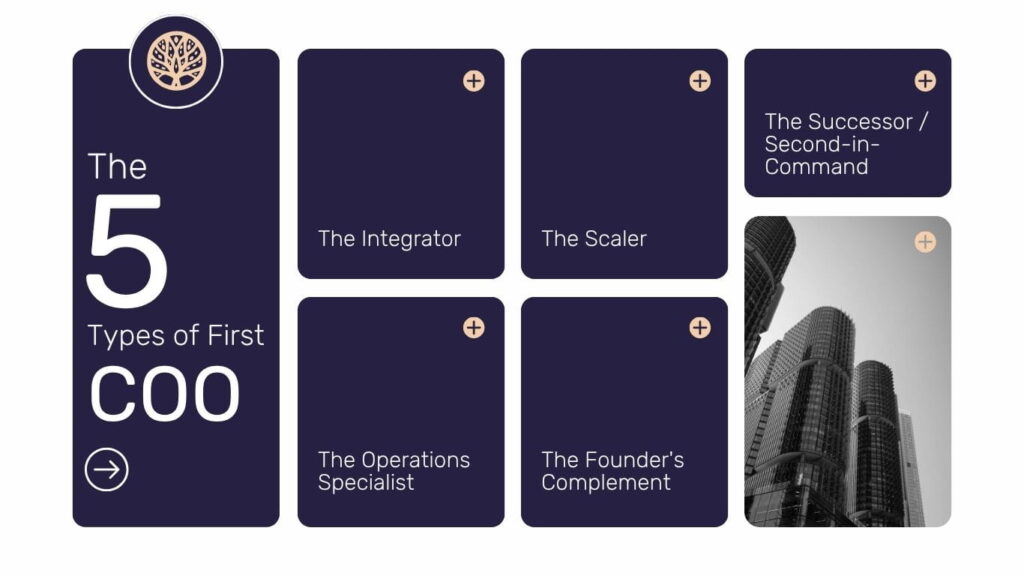
The Five Types of First COO
Match the type to the problem – a COO hired for the wrong one is a costly miss, however capable.
|
Type of COO |
The problem it solves |
When it fits |
|
The Integrator |
Functions run in silos with no one joining them up |
Several capable functional heads, no coordination layer |
|
The Scaler |
Growth is outrunning the operating model |
Rapid expansion – new sites, markets or volumes |
|
The Operations Specialist |
A specific operational engine is the constraint |
Manufacturing and supply-chain-heavy businesses |
|
The Founder’s Complement |
The founder is strong on vision, weak on execution |
Founder-led and promoter-led companies |
|
The Successor / Second-in-Command |
Continuity and eventual leadership succession |
Businesses professionalising or preparing to transition |
COO vs the Alternatives
A COO is not the only answer to an execution problem – and often not the right one.
Before committing to a COO, it is worth being honest about whether a different, often lighter, appointment solves the actual problem.
|
Role |
What it solves |
When it’s the right call |
|
COO |
Ownership of execution across the whole operation |
Execution is the constraint across multiple functions |
|
VP / Head of Operations |
Runs one operational function well |
The gap is in a single function, not across the business |
|
Chief of Staff |
Leverage for the CEO – coordination and follow-through |
The CEO needs bandwidth, not a second operating leader |
|
A strong CFO or functional head |
Financial or functional discipline |
The constraint is financial control or one specialism |
The First COO in a Founder-Led or Promoter-Led Business
Here the first COO is rarely a capability hire.
It is an authority decision dressed up as a capability hire.
In many founder-led and promoter-led businesses in India, the first COO is really a professionalisation move: the organisation is trying to shift from running on one person’s instincts to running on a system, and the COO is meant to be the bridge.
But the challenge is not identical in both.
In a founder-led business, it is usually about moving from founder-led execution to delegated execution.
If you are not yet sure the answer is a COO at all, rather than a new chief executive to lead the company, that is a different and prior decision, and we work through it in CEO or COO: Which Should a Founder-Led Business Hire First?
In a promoter-led or family-owned business it can be broader – establishing professional operating authority without disrupting the promoter’s role in ownership, governance and strategic direction.
In either case, the constraint is almost never whether a capable operator can be found. It is whether the founder or promoter is genuinely willing to let that operator operate. This is the same authority-transfer problem that sits at the centre of the promoter-to-professional transition, and it defeats more first-COO appointments than any shortfall in the candidate.
In Practice: The COO Who Had the Title but Not the Wheel
A founder-led industrial manufacturer, scaling fast across two plants, hired an experienced COO to take operations off the promoter’s plate. On paper it was the right move at the right time. In practice, the plant heads kept taking the decisions that mattered straight to the promoter – as they always had – and the promoter kept taking them. Within months the COO was managing upward for permission rather than running the operation.
The problem was not the COO’s capability; the operating plan they had built was sound. The problem was that the authority was never actually transferred. It began to work only when the promoter named, explicitly, which operational decisions were now the COO’s to make and defend – and then let one he disagreed with stand.
“In a founder-led business, the first COO is rarely a capability hire.
It is an authority decision dressed up as a capability hire. The question is not whether the founder can find someone able to run operations – they usually can.
It is whether the founder is genuinely ready to let someone else run them.
Until that is settled, the strongest COO in the market will fail.”
What to Look for in a First COO
Complementary, not a clone – and able to operate with authority that has genuinely been handed over.
Once the problem is clear and the decision to hire is real, the profile follows from four things:
Complementary to the CEO.
A COO who mirrors the founder's strengths adds cost, not capacity. The value is in covering what the CEO does not.
Execution strength, evidenced.
A track record of actually building and running operations at the next scale up - not just advising on them.
Credibility with the existing team.
The COO has to be followed by the functional heads on conviction, not just on the org chart.
Able to operate with delegated authority.
The best operator in the world cannot succeed in a role where the authority stays with the founder. Fit here is about the founder as much as the candidate.
How the First COO Hire Goes Wrong
The failures are predictable, and almost all of them are set before the search begins.
First-COO appointments fail in a small number of recognisable ways:
The wrong type for the problem - a scaler hired for an integration gap, or vice versa.
A COO hired to avoid a delegation decision the founder was never willing to make.
An undefined mandate - no clear line between what the CEO owns and what the COO owns, so the two collide or duplicate.
Even a well-matched COO can fail if the transition is handled badly. How the first ninety days are structured – the mandate made explicit, the relationships handed over, the authority actually transferred – largely determines whether the appointment holds. We cover that in our guide to a CXO’s first 100 days.
Frequently Asked Questions on Hiring a COO in India
When should a startup hire its first COO?
When execution becomes the constraint on growth – typically when the founder can no longer personally coordinate operations, or a scaling event (new market, funding, rapid headcount growth) is about to multiply complexity.
It is a problem-driven decision, not a revenue milestone.
Many startups are better served first by a strong Head of Operations or a Chief of Staff, and only later by a COO.
What is the difference between a COO and a VP of Operations?
A VP or Head of Operations runs one operational function well.
A COO owns execution across the whole business – coordinating multiple functions and holding the operating model together.
If the gap is in a single function, a VP is usually the right and lighter answer; if it spans the business, it is a COO problem.
Do family businesses and promoter-led firms need a COO?
Often, yes – but the first COO in a promoter-led business is really a professionalisation and authority decision, not just a capability hire. The role only works if the promoter is genuinely willing to transfer operational authority. Where that willingness is absent, even a strong COO will fail.
Should the first COO be an internal promotion or an external hire?
It depends on where the capability and credibility already sit. An internal promotion brings context and trust but may lack experience at the next scale; an external hire brings that experience but must build credibility from scratch. Benchmarking the internal option against the external market is the disciplined way to decide.
How do you divide responsibilities between a CEO and a COO?
The clearest split is CEO outward and forward – vision, capital, customers, key relationships – and COO inward and operational – running the business day to day.
The specific line must be drawn explicitly before the hire; an undefined boundary is the single most common cause of CEO – COO friction.
What are the signs a company hired a COO too early?
The COO has little genuine authority, duplicates the CEO rather than complementing them, or was hired to solve a single-function gap that a specialist would have handled. If the founder is still making the operational decisions the COO was hired to own, the appointment was premature – or the delegation decision was never really made.
These FAQs covers the most common questions we hear when it comes to hiring a COO for a promoter owned /startup in India.
For a more comprehensive breakdown, including questions on fees, timelines, guarantees, and how the process works step by step, visit our detailed Executive Search FAQ.
97% placement success rate across hundreds of leadership mandates.
50+ years of combined search experience across our founding team.
80% repeat engagement rate > our clients come back because our process works.
We combine the best practices of a global search firm with the entrepreneurial responsiveness and senior-partner involvement of a boutique consultancy.
The Right COO Starts With the Right Question
The first COO decision is rarely about company size and never about a title. It is about a specific problem: what has become the constraint on the business, and is a COO – rather than a lighter appointment, or a change in how the founder works – genuinely the right way to solve it.
Get that question right, and the profile, the type and the mandate follow from it. Get it wrong, and you add a very senior, very expensive answer to a question no one actually asked.
At Pipal Tree Services, we help founders and boards make this call before the search begins – defining the problem the COO is there to solve, the authority the role will genuinely carry, and the type of operator the situation calls for. Our COO search practice is built around that discipline: the right operator for the actual constraint, not an impressive CV for an undefined role.
If you are weighing your first COO – or you have made the hire and want the transition to hold – it is a conversation worth having early.
Write to me at [email protected]

Rahul Bahuguna
“With over two decades of experience across executive search, digital strategy, and business consulting, Rahul brings a unique entrepreneurial perspective as Director & Co-Founder of Pipal Tree Services. At Pipal Tree, Rahul leverages his background in strategy, market intelligence, and digital transformation to guide mission-aligned executive search and board mandates. He specializes in building long-term client partnerships, leading complex leadership searches, and shaping Pipal Tree’s distinct positioning at the intersection of talent and purpose. His ability to combine strategic insight with practical execution makes him a trusted advisor to organizations seeking leaders who can drive meaningful, sustainable change.”