

CEO vs Managing Director vs Country Head in India: Which one is right?
The right India title depends on the authority the role actually carries – not on global consistency.
A Country Head or GM fits a sales and service presence reporting into a regional structure.
A Managing Director fits a registered Indian entity where the role carries statutory and P&L accountability.
CEO India is appropriate only where the India business sets its own strategy and the role holds full commercial ownership.
Table of Contents
Picture this. A European valve manufacturer is preparing to hire its first dedicated India leader.
The board wants a Managing Director.
The CHRO’s brief says Country Head.
The regional VP insists on GM India for consistency across APAC.
And someone on the leadership team asks: why not just call them CEO India?
4 titles.
Same role.
Completely different implications.
For most mid-sized MNC manufacturers with operations in India – companies making valves, pumps, drilling equipment, compressors, instrumentation, or other industrial products – this is not just a naming exercise.
The title you assign your India leader shapes their legal accountability under Indian corporate law, their commercial credibility with EPC buyers and PSU procurement teams, the calibre of talent you can attract for the role and the team beneath it, and the decision-making authority they actually carry within your global organisation.
Yet this decision is almost always made by default — driven by the global HR titling framework or whichever term the hiring manager happens to use first.
The result?
A leadership appointment that may be technically correct on your internal org chart but strategically wrong for the Indian market. And in India’s industrial ecosystem, where hierarchy, title parity, and statutory authority genuinely influence business outcomes, getting the title wrong can quietly undermine your entire India operation.
The core argument of this guide is straightforward: the right title for your India leader is a function of your India operating model — not your global HR policy.
A pure export manufacturing hub needs a different leader, a different mandate, and a different title than an operation selling equipment into the Indian EPC market.
Our Delhi NCR executive search practice sees this most sharply along the Noida EPC and industrial-engineering corridor, where PSU procurement credibility demands the statutory weight of an MD title.
Our Chennai executive search practice sees the opposite pull: the manufacturing OEM cluster and their supplier ecosystem – often calls for a CEO or Country Head structure built around export-facing, multi-plant authority rather than domestic EPC sales.
This guide provides the strategic framework to make that decision with clarity.
The Four Titles Decoded: What Each Actually Means in India
Before we get to the strategic framework, it helps to understand what each title actually carries in terms of legal standing, cultural perception, and commercial weight in the Indian business ecosystem. This context is essential — because the same title can mean very different things in Mumbai than it does in Munich or Minneapolis.
Managing Director (MD)
The Managing Director is the only title among the four with a specific legal definition under Indian corporate law.
Section 2(54) of the Companies Act, 2013 defines an MD as a director on the company’s board who is “entrusted with substantial powers of management.”
This carries real weight: board-level fiduciary duties, statutory compliance obligations, personal legal liability for corporate governance, and the authority to represent the company in all statutory and regulatory matters.
In the Indian business ecosystem, “Managing Director” is the most recognised and respected leadership title. Indian EPC procurement teams, government bodies, PSU officials, and banking partners treat the MD as the ultimate decision-maker for the India entity.
When selling valves to L&T for a refinery expansion or bidding on an ONGC equipment tender, an MD commands a fundamentally different meeting than someone with a lesser title. Title parity matters deeply in Indian industrial procurement.
An MD appointment also triggers specific regulatory requirements — board resolution, shareholder approval, MCA filings, and a maximum tenure of five years per appointment (renewable). The MD is classified as Key Managerial Personnel (KMP), and for companies above prescribed paid-up capital thresholds, appointing an MD or whole-time director is mandatory under the Act.
CEO India
The CEO title carries no distinct legal definition under the Companies Act, 2013. It is, however, recognised as a Key Managerial Personnel designation under Section 2(51).
Critically, the CEO title alone does not automatically confer board membership, statutory signing authority, or the fiduciary obligations that come with being a director. A person can be both CEO and director, but these are separate appointments.
Culturally, “CEO India” carries strong global prestige and is increasingly used by MNCs to signal that their India operation is a strategic growth engine rather than a regional outpost.
In India’s industrial circles, the title is well understood and respected — though with traditional manufacturing clients and PSU procurement teams, it carries slightly less statutory gravitas than MD.
This is why many companies opt for the combined designation “Managing Director & CEO” — it captures both the Indian legal standing and the global title recognition.
Country Head
Country Head is a purely organisational title with no recognition whatsoever under Indian corporate law. It confers no statutory authority, no board membership, and no signing powers unless separately granted through a board resolution or power of attorney.
In MNC circles, the title is well understood and carries reasonable respect. However, in India’s manufacturing and EPC ecosystem, the perception can be ambiguous. An Indian EPC procurement director meeting a “Country Head” may perceive less decision-making authority than meeting an “MD” – particularly for large-value capital equipment decisions where the buyer needs confidence that the person across the table can commit to pricing, delivery timelines, and contractual terms without referring back to a regional headquarters.
Country Head works effectively as a transitional title when India is part of a regional cluster (such as APAC or Middle East & India), when the company is scaling its India presence and hasn’t yet established a full subsidiary structure, or when the leader’s role is genuinely regional rather than India-specific.
General Manager India (GM India)
GM India carries no legal standing under the Companies Act. In the Indian industrial context, “General Manager” is perceived as a senior but distinctly not-top-level position. This creates a significant authority gap when the individual holding this title is expected to negotiate with EPC contractor VPs, manage a manufacturing plant, represent the company to government regulators, and build a leadership team beneath them.
An honest assessment: for companies with manufacturing facilities and any commercial presence in India, the GM title is rarely the right choice.
It works in a narrow scenario – when India is purely a manufacturing or export hub with no local customer interface and the India leader’s role is entirely operational. Beyond that, the title actively undermines commercial credibility and talent attraction.
How Your India Operating Model Determines the Right Title
Here is the central argument of this guide: the right title is determined by what your India operation is trying to be – not by your global HR framework.
A title that works perfectly for a pure export manufacturing hub becomes inadequate the moment you start selling into the Indian market. And a title that’s essential for a fully integrated India operation would be premature for a company just setting up its first India facility.
The calculus changes in an Indian promoter-led manufacturer, where the first professional CEO appointment is less a title decision than an authority transfer – we work through that separately in How to Hire a Manufacturing CEO.
Choosing the right leadership model is the first decision in any executive search for manufacturing leaders in India – the title an MNC assigns determines the authority, mandate, and profile the search must target.
Based on our experience working with international MNC manufacturers across the EPC and industrial equipment space, India operations typically fall into one of five archetypes.
Each points to a different title, mandate, and leadership profile.
Pure Export Manufacturing Hub
The India facility manufactures valves, pumps, compressors, or equipment components entirely for the global supply chain. There is no local commercial function — no Indian customers, no local sales team, no engagement with Indian EPC contractors. The India leader’s job is singular and clear: operational excellence. Quality, cost, delivery, safety, regulatory compliance, and labour relations.
Recommended Title
GM India or Plant Head (with a nominee director on the board for statutory compliance)Leadership Profile
Manufacturing operations expert. Lean/Six Sigma orientation. Strong on supply chain management, quality systems, safety protocols, and Indian labour relations.Reporting Line
Global VP Manufacturing or COOIndia Revenue Context
The facility is a cost centre. No India P&L. Revenue is attributed to global or regional commercial teams.In Practice
A Swiss instrumentation manufacturer runs a Pune facility producing pressure transmitters exclusively for European and Middle Eastern markets. The India leader manages 400 employees, production schedules, quality certifications, and supplier relationships. A GM title is defensible here because there is no Indian customer interface requiring commercial gravitas. The statutory compliance responsibilities (factory licensing, environmental clearances, labour law) are handled through a nominee director on the board.The caveat
While till some years back, this role was pretty common, we have observed that this is now not much in demand. Most MNC manufacturers who set up in India for export eventually discover that Indian customers want to buy from them too — especially if they’re manufacturing products relevant to India’s energy, infrastructure, or industrial sectors. When that happens, the operating model shifts, and the title must shift with it.Export Manufacturing + Emerging India Commercial
The company initially set up in India for cost-effective manufacturing and global export. But Indian EPC contractors have started approaching them for local supply. Perhaps a refinery project needs valves faster than importing allows. Perhaps an Indian EPC contractor bidding on an overseas project wants an India-manufactured alternative at competitive pricing. India commercial revenue is early-stage — maybe 10–20% of facility output — but the trajectory is clear.
The India leader now faces a dual challenge: keep the manufacturing engine running at global quality standards while simultaneously building a fledgling sales and business development function in a market they weren’t originally set up to serve. .
Recommended Title
Country Head (transitional) → Managing Director (as commercial revenue grows and customer-facing authority becomes critical)Leadership Profile
The hardest profile to find. Must understand manufacturing operations AND be capable of building a commercial engine from scratch.The manufacturing-to-commercial bridge leader.
Reporting Line
Dual reporting: global manufacturing VP + regional commercial VP. Or directly to global CEO if India is a strategic priority.Critical Transition Signal
When inbound commercial enquiries start requiring formal quotations, tender responses, or contract negotiations with Indian EPC buyers — the title must upgrade. A GM or Country Head cannot credibly lead these conversations at the level they demand.In Practice
A German valve manufacturer with a Gujarat facility built primarily for export begins receiving direct enquiries from Indian EPC contractors for supply on domestic refinery and petrochemical projects. The GM India lacks the commercial mandate and market-facing credibility to convert these opportunities into revenue. Senior Indian buyers expect to negotiate with someone who has signing authority and the stature to make commitments.The caveat
This is also the archetype where talent decisions become particularly consequential. Strong candidates for dual-mandate roles will evaluate whether the title matches the actual scope of responsibility. Offering a “GM India” title for what is effectively a Country Head or MD mandate may cost you your first-choice candidates.India Market-Focused with Manufacturing
India is a significant commercial market for the company. The India operation sells equipment — valves, pumps, drilling tools, compressors, instrumentation — to Indian EPC contractors, oil and gas companies, refineries, power plants, water utilities, or PSUs. Manufacturing exists in India to serve this market (and possibly export as well), but the India leader’s primary job is market expansion, key account management, and revenue growth. Manufacturing is an important supporting capability, not the central mandate.
Recommended Title
Managing Director or CEO India (MD strongly preferred for statutory and commercial reasons)Why Non-Negotiable
When your India leader sits across from VP Procurement at L&T for a ₹50 crore valve order for a refinery expansion, or negotiates a framework agreement with IOCL, they need a title that signals decision-making authority. Indian EPC procurement is hierarchical — title parity determines access to senior decision-makers.Leadership Profile
Commercially driven with deep Indian EPC and industrial ecosystem relationships. Understands how Indian procurement cycles work — tender timelines, L1/L2 dynamics, PSU processes, pre-qualification requirements. Can manage a manufacturing facility but primary value is market-building and revenue growth.Reporting Line
Directly to global CEO or President. Any intermediary layer (regional VP, APAC head) dilutes the authority signal — both internally and in the market.In Practice
A UK-based pump manufacturer selling into Indian water infrastructure and refinery projects. Their India MD manages a Vadodara manufacturing plant AND a commercial team selling to IOCL, BPCL, municipal water authorities, and EPC contractors across India. The MD title provides statutory signing authority for government tenders, credibility at industry conferences and trade exhibitions, and the gravitas to negotiate at VP level with major EPC procurement teams. A Country Head title would not achieve the same access or commercial outcomes.Engineering and Design Centre + Manufacturing
The India operation houses R&D, product design, application engineering, or design services alongside manufacturing. India is not just building what headquarters designs — it is actively contributing to global product development. Think: a European valve manufacturer whose India engineering team designs custom high-temperature or high-pressure valve solutions for specific refinery or offshore applications.
Recommended Title
Managing Director (statutory requirement likely), potentially with a secondary descriptor: “MD & Head of Engineering, India” to signal the dual mandateLeadership Profile
Technical leadership credibility combined with business management capability. Must be respected by both the global engineering team and the India commercial team. Often drawn from senior engineering leaders who have successfully made the transition to general management.Reporting Line
Dotted line to Global Engineering Head for engineering priorities; solid line to global CEO or COO for business performance.<Talent Implication
India’s best engineers want to work for an MD, not a Country Head. The title directly impacts your ability to attract senior engineering and design talent for the India centre. This compounds over time — a strong engineering leader attracts other strong engineers.In Practice
A European valve manufacturer whose Pune-based India team designs custom valve solutions for high-temperature refinery and petrochemical applications. The MD leads a 60-person engineering team alongside a manufacturing unit and a growing commercial function. The engineering depth elevates India’s strategic importance within the global organisation — India isn’t just a production base, it’s an innovation contributor. The MD title reflects this strategic weight and gives the leader the authority to make R&D investment decisions and attract top engineering talent.Full India Operations > Manufacturing + Engineering + Commercial + Aftermarket
The most mature and complex archetype. India is a fully integrated operation spanning manufacturing, engineering and design, commercial sales to the Indian market, aftermarket services and spares, and possibly an export function. The India entity may represent 20–40% of global revenue. This is, in every meaningful sense, a company within a company.
Recommended Title
Managing Director & CEO, or Managing Director (with a strong India leadership team reporting to them)Why
This leader needs statutory board authority (MD), commercial credibility equivalent to a CEO, and the operating capability to manage a complex, multi-function organisation. Anything less than MD undermines both internal authority and external standing.Leadership Profile
The rarest and most valuable profile in India’s industrial leadership market. A true P&L leader with multi-functional experience — manufacturing, commercial, engineering — in the Indian industrial context. Must manage the global headquarters relationship as an equal partner, not a regional subordinate.Reporting Line
Global CEO directly. Period.Any intermediary structure signals that India is a regional operation, not a strategic one.
In Practice
A Japanese industrial equipment conglomerate with India operations spanning a Chennai manufacturing plant, a Hyderabad engineering centre, a Mumbai commercial office selling to EPC contractors and PSUs, and a pan-India aftermarket services network. India revenue exceeds ₹1,500 crore. The India MD & CEO sits on the parent company’s Asia-Pacific leadership council, has authority to make investment decisions, signs government contracts, and represents the company at the highest levels of Indian industry.This leader is a peer to the global C-suite, not a report.
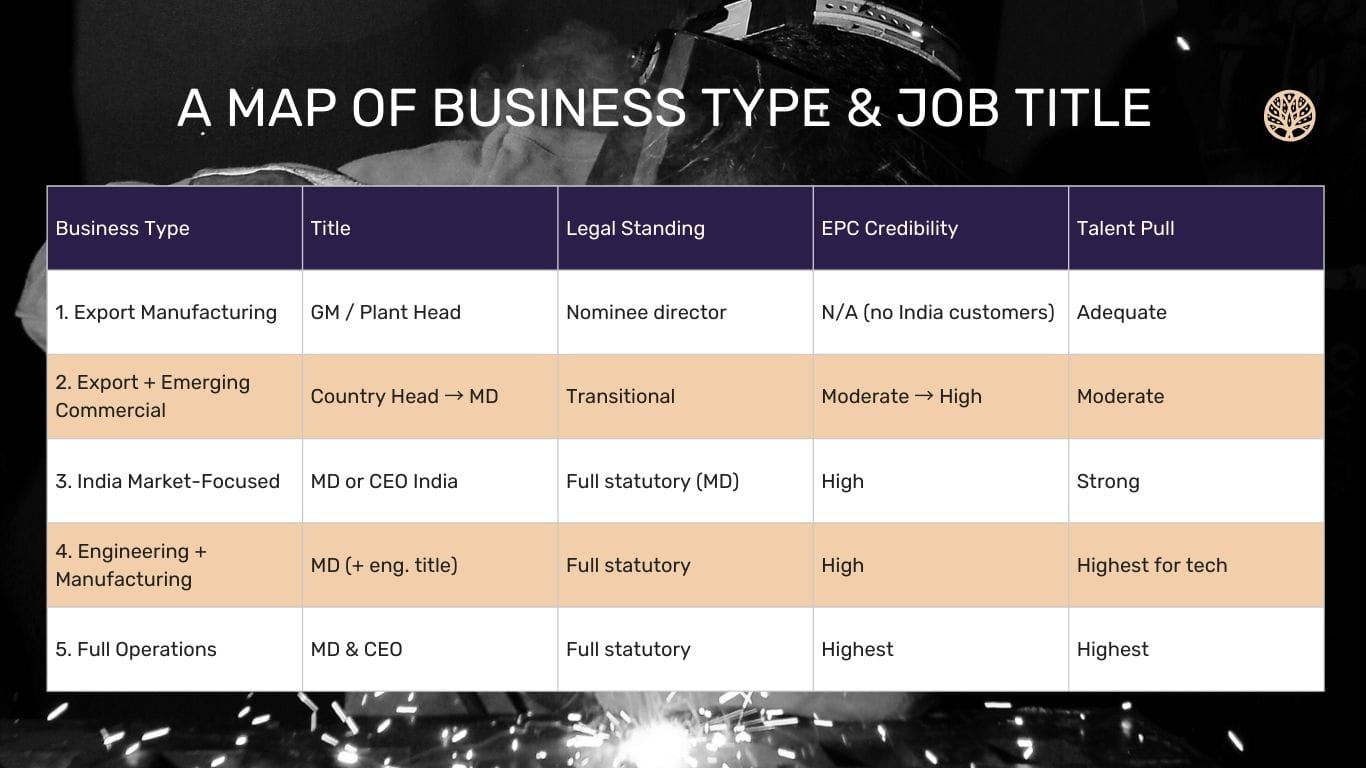
The Decision Framework: From Operating Model to Title
The five archetypes provide the strategic context. But when you’re in a boardroom making this decision, you need a sharper tool. Here are five sequential questions that will lead you to the right title for your India operation.
-
Does India have a Private Limited subsidiary registered under the Companies Act?
If yes, you will need either a Managing Director or CEO designated as a director on the board. The statutory requirements for Indian Pvt Ltd companies make this effectively mandatory for any meaningful operation.
-
Does the India leader need to sign regulatory filings, government contracts, banking documents, or high-value commercial agreements?
If yes, an MD designation provides the clearest statutory authority. CEO with director status can work, but MD remains the gold standard for signing authority in Indian regulatory and commercial contexts.
-
Does the India leader interface directly with Indian customers at VP level or above?
If your India operation sells to EPC contractors, PSUs, or industrial buyers, the leader needs a title that commands credibility in those meetings. Managing Director or CEO India - never GM. Indian industrial procurement is hierarchical, and the title on the business card determines access to decision-makers.
-
Is India a standalone P&L or part of a regional cluster?
Standalone P&L operations need an Managing Director or CEO India with direct reporting to the global CEO. Regional cluster structures (India + Middle East, India + APAC) can use Country Head as a transitional title — but should plan an upgrade path as India scales.
-
Does the India operation include engineering or design functions contributing to global product development?
If yes, the leader needs an MD title that reflects India’s strategic contribution. The title directly affects your ability to attract senior engineering talent and signals to the global organisation that India is an innovation partner, not just a production facility.
Once you’ve answered these five questions and arrived at the right title, the next step is translating that into a search mandate. Our guide on How to Write a Strong Executive Job Description provides a practical framework for defining the role with the precision that a successful search requires.
Why Title Selection Matters More in India’s Industrial Ecosystem
The framework above applies to MNC manufacturers globally. But several India-specific dynamics make this decision particularly consequential here.
Commercial Credibility and the EPC Procurement Hierarchy
Indian EPC contractors – L&T, Thermax, BHEL, Tata Projects, Godrej Process Equipment, operate with deeply hierarchical procurement structures. When awarding high-value equipment orders, valves for a refinery, compressors for a gas processing plant, instrumentation for a power project — senior procurement decision-makers expect to engage with counterparts of equivalent stature.
An Managing Director or CEO India gets meetings with VP Procurement.
A GM India is more likely to be routed to deputy managers.
This isn’t about ego; it’s about how Indian industrial procurement actually works. For companies serving this market, our Industrial & Manufacturing Executive Search practice is built around understanding these dynamics.
Government and PSU tenders add another layer. For large capital equipment purchases, PSUs often require documentation signed by the authorised representative of the Indian entity. An MD’s statutory authority makes this straightforward.
A Country Head or GM may need additional powers of attorney, adding friction and sometimes raising questions about the company’s commitment to the Indian market.
Title confusion is one of several reasons these searches stall before they start; we set out the wider pattern in 7 Reasons Global Manufacturers Struggle to Hire India Leaders.
Talent Attraction and Retention
The title you offer your India leader determines not just whether they accept – it determines who applies in the first place.
A strong Indian executive running a ₹500–1000 crore industrial operation will expect an MD or CEO India title.
Offering “GM India” for a role with full P&L responsibility and manufacturing oversight may cost you your first-choice candidate.
The title also cascades downward: strong functional leaders – plant heads, engineering directors, commercial heads – want to report to an MD or CEO, not a GM.
Title misalignment is one of the most common and most preventable reasons that strong candidates walk away from otherwise compelling opportunities.
Legal and Compliance Implications
The MD designation triggers specific obligations under the Companies Act, 2013: board-level fiduciary duties, personal liability for statutory non-compliance, responsibility for annual filings and financial statements, and accountability under various labour, environmental, and factory licensing regulations. India also requires at least one resident director who has been present in India for at least 182 days in the preceding calendar year — the India leader typically fills this requirement.
For manufacturing facilities specifically, factory licensing, environmental compliance, pollution control board clearances, and labour law obligations often require a named responsible person with appropriate authority. The India leader’s title determines whether they have the statutory standing to fulfil this role directly or whether additional governance layers are needed.
Headquarters Relationship and Decision-Making Speed
The title implicitly defines the autonomy level – both in practice and in perception. An MD with a board seat has more negotiating leverage with global headquarters than a Country Head reporting into a regional structure.
For mid-sized MNC manufacturers where India may represent 15–30% of global revenue but has distinct operational complexity – manufacturing, local regulations, EPC project cycles, currency dynamics. The leader needs enough authority to make decisions at the speed the Indian market demands.
Aligning HR, talent acquisition, and business leadership around a common understanding of the leadership role is essential before the search begins.
When & How to Upgrade the Title from GM/Country Head
5 Signals It’s Time to Upgrade
Many MNC manufacturers enter India with a GM or Country Head and later realise they need to elevate the role. This is natural — it reflects the evolution of the India business. But the transition needs to be managed deliberately, not reactively.
- You’re losing deals or meeting access because Indian EPC buyers perceive the India leader as lacking decision-making authority.
- India commercial revenue is crossing 15–20% of facility output and growing.
- Senior talent is declining offers or leaving because the title doesn’t match the actual scope of responsibility.
- Compliance complexity is increasing — environmental clearances, government contracts, PSU registrations, banking facilities — and the current title creates friction.
- The India operation is gaining engineering or design mandates beyond pure manufacturing.
Managing the Transition
The transition from Country Head or GM to Managing Director involves formal governance changes: a board resolution, shareholder approval, MCA filings, and updating the company’s statutory records. If the incumbent is being promoted, their employment terms, directorship appointment, and remuneration structure need to be formalised under the Companies Act.
If the company is hiring externally for the elevated role, the mandate must be clearly redefined before beginning the search.
This is a critical juncture where many companies face a strategic choice: promote the incumbent (who understands the business but may lack the profile for the expanded mandate) or bring in a new leader with the experience to take the India operation to its next phase.
This kind of headhunting almost always requires a structured talent search process, not a reactive recruitment effort.
“The right title for your India leader isn’t decided by your global HR policy – it’s decided by what your India operation is trying to become”
How Pipal Tree Approaches India Leadership Mandates for MNC Manufacturers
At Pipal Tree Services, we work extensively with international MNC manufacturing companies – particularly in the EPC, Oil & Gas and industrial equipment space, with manufacturing, engineering, and design units in India.
Our practice covers the full spectrum of industrial and manufacturing executive search from plant heads to MDs to full C-suite leadership teams.
The most common mistake we see is this:
Global headquarters defines the India leadership role using their internal titling framework without understanding how that title translates in the Indian industrial ecosystem.
A title that makes perfect sense on the global org chart can actively undermine the India leader’s effectiveness in the market.
Our approach starts with mandate clarity. Before we identify a single candidate, we help clients answer the strategic questions this guide raises:
- What is your India operating model?
- What authority does the leader actually need?
- How will the Indian market — EPC buyers, PSU procurement teams, government regulators, banking partners — perceive this role?
- What calibre of talent will this title and mandate attract?
Only after the mandate is crystallised do we begin the search. We assess candidates not just on functional competence but on their ability to operate in the specific autonomy model the title and structure create. We understand the Indian buyer landscape, PSU dynamics, and industrial procurement hierarchy and this understanding directly informs how we evaluate candidate fit.
Our mission-aligned approach ensures we find leaders who don’t just fit the role on paper but can genuinely transform the India operation. This is what distinguishes us among the top executive search firms in India. We run dedicated search practices across CEO , COO, and CFO mandates, as well as Board Services and other senior leadership positions – each informed by deep understanding of how title, mandate, and operating model interact in the Indian market.
At Pipal Tree Services, being one the top executive search firms in india, we run dedicated search practices across the full C-suite, including CEO, CFO, CTO, COO, CHRO, CMO, CIO, and CRO mandates, as well as other senior leadership positions. Each practice brings role-specific assessment frameworks, compensation benchmarking, and candidate networks built over years of focused engagement.
Defining the right competencies upfront is what separates a successful search from an expensive mistake. Our role-specific insights help organisations sharpen their leadership mandate before the search begins.
Frequently Asked Questions
Is a Managing Director legally higher than a CEO in India?
Under the Companies Act, 2013, “Managing Director” has a specific legal definition with statutory powers, board membership, and fiduciary obligations. “CEO” is recognised as Key Managerial Personnel but without the same legal weight. In practice, the authority each role carries depends on the company’s governance structure.
Many Indian subsidiaries of MNCs resolve this by using the combined designation “Managing Director & CEO” which provides both statutory standing and global title recognition.
Can the same person be both MD and CEO of an Indian subsidiary?
Yes, and this is increasingly common. Combining both designations provides the legal authority of the MD appointment with the global recognition of the CEO title. This is particularly useful for MNC subsidiaries where the India leader needs to operate in both the Indian regulatory and commercial ecosystem and the global corporate structure.
What happens if we appoint a GM but the role actually requires MD-level authority?
The individual will likely face challenges signing statutory documents and regulatory filings, executing high-value contracts with EPC buyers and PSUs, and commanding credibility with senior procurement decision-makers.
This creates operational bottlenecks, missed commercial opportunities, and over time, talent retention issues as the leader feels the gap between their actual responsibility and their formal authority. The longer this misalignment persists, the more costly it becomes.
Do Indian EPC buyers actually care about the title of the person they’re dealing with?
Yes. Indian industrial procurement is hierarchical, and this is not changing. Senior decision-makers at major EPC contractors and PSUs expect to engage with counterparts of equivalent stature. Title perception directly impacts meeting access, negotiation dynamics, and the depth of relationship you can build with key accounts. For capital equipment purchases worth crores, the buyer wants to know that the person across the table has the authority to commit.
How do we manage the transition from Country Head or GM to Managing Director?
This requires a formal board resolution, shareholder approval, MCA filings, and updating the company’s statutory records.
If the incumbent is being promoted, their employment terms and directorship need to be formalised under the Companies Act.
If hiring externally, define the new mandate, including title, authority, reporting line, and success metrics, clearly before beginning the search.
The transition should also be communicated to key Indian stakeholders (clients, banks, government bodies) to establish the new authority structure.
Should we prioritise global title consistency or India-specific appropriateness?
India-specific appropriateness should take priority for the India leadership role. Global consistency matters for internal HR systems and career frameworks, but your India leader’s effectiveness depends on how the Indian market perceives their authority.
Many companies resolve this pragmatically: the statutory title (MD) is used for Indian legal, regulatory, and commercial purposes, while the role is mapped internally to a global equivalent (such as “Senior Vice President” or “Country President”) for compensation benchmarking and career progression.
These FAQs cover the most common questions we hear from global headquarters teams making this decision.
For a more comprehensive breakdown, including questions on fees, timelines, guarantees, and how the process works step by step, visit our detailed Executive Search FAQ.
Start with Mandate Clarity, Not a Job Description
Choosing the right title and mandate for your India leader is not an HR exercise – it is a strategic decision that shapes commercial credibility, regulatory standing, and your ability to attract transformational talent in one of the world’s most competitive industrial markets.
Whether you are entering India for the first time, scaling from export manufacturing into Indian market sales, or restructuring an existing operation that has outgrown its current leadership model, the leadership definition must come before the leadership search.
At Pipal Tree Services, we work extensively with international MNC manufacturers in the EPC and industrial equipment space to define, search for, and place the right India leadership.
Our mission-aligned approach combines deep market intelligence, structured leadership assessment, and sustained post-placement support to ensure your next hire becomes your next competitive advantage.
If you’d like to discuss how we can strengthen your leadership team, reach out to me at [email protected].
Because the best time to find your next leader is before you need one.

Sonia Sharma
"With over 25 years in talent leadership—including 20+ years in executive search—Sonia brings valuable dual perspective as Pipal Tree's founder. Her career spans both consultancy roles at prestigious firms (Korn/Ferry International, Accord India, Stanton Chase) and corporate leadership. Sonia specializes in executing confidential, high-stakes searches for global and Indian multinationals."

[…] dismantle these roadblocks. One global firm, for instance, used AI to anonymize résumés and scan job descriptions for biased language, resulting in fairer and more diverse shortlists. A leading tech giant deployed […]