

How to set up a GCC in India?
Setting up a GCC in India involves six core steps: defining the centre’s purpose, choosing a legal structure (wholly-owned subsidiary, BOT, managed, EOR, JV or hybrid), selecting a location, building infrastructure, hiring leadership first, and establishing governance.
Depending on the structure you choose, a GCC takes roughly 3 to 12 months from decision to launch and the leadership hire is the single biggest determinant of long-term success.
Table of Contents
Global Capability Centres (GCCs) in India have undergone a profound transformation. What began as back-office support hubs have evolved into global value creators—now driving innovation, technological breakthroughs, and research and development for multinational corporations worldwide.
This evolution represents more than organizational restructuring. The shift from business services to capability centres is fundamentally a shift from transactional to strategic and transformational impact. Today’s GCCs don’t just execute—they innovate, lead, and create competitive advantages.
The economic impact is substantial. According to the Reserve Bank of India, GCCs are forecast to contribute 2% of India’s GDP and generate 2.8 million jobs by 2030. These centers are reshaping India’s services economy while boosting employment and driving exports at unprecedented levels.
At Pipal Tree Services, we believe successful GCCs are built on purpose-driven leadership and mission-aligned teams. This guide outlines the strategic framework for establishing a GCC that delivers transformational value from day one.
What's Powering India's GCC Boom?
Political Stability and Progressive Policies
India offers a politically stable environment with liberalized Foreign Direct Investment (FDI) policies that welcome global enterprises. Easy access to Special Economic Zone (SEZ) infrastructure provides tax advantages and streamlined operations. As the world’s third largest startup ecosystem, India actively cultivates innovation and entrepreneurial thinking – qualities that translate directly to GCC success.
Compelling Economic Advantages
The financial case remains powerful. Companies achieve 25-30% cost savings compared to comparable destinations, according to NASSCOM’s GCC research. You’re also operating in the world’s fastest-growing major economy and third-most digitalized marketplace, with access to the third-largest consumer base globally—providing invaluable market insights and testing opportunities.
Unparalleled Talent Depth
India possesses the world’s second largest STEM-educated workforce with the lowest demand-supply gap in technology talent among top tech countries. The availability of English-speaking, culturally adaptable, ambitious young professionals creates a sustainable talent pipeline that few locations can match.
This talent advantage extends beyond numbers.
India’s professionals bring cultural curiosity, adaptability, and a hunger to solve complex problems – qualities essential for capability centers that aim to innovate, not just execute.
World-Class Technology Infrastructure
India’s digital transformation capabilities are powered by the second largest digital skills workforce globally. High-speed 5G and 6G connectivity, expanding data center capacity, and substantial cloud infrastructure investments create a technology foundation that supports the most advanced operations.
Business-Friendly Legal Framework
Recent regulatory reforms have transformed India’s business environment. A streamlined registration process, reduced tax burden on services exports, internationally aligned data protection laws, and the absence of IP localization requirements make India an attractive jurisdiction for global innovation centers.
The 6 Steps to Setting Up a GCC in India
Step 1: Define Your Purpose with Precision
Every successful GCC begins with clarity of purpose. What specific value will your center create? Will you focus on IT services, research and development, analytics, finance operations, or engineering?
Ask yourself:-
-
- What business outcomes must this GCC deliver in 12, 24, and 36 months?
- Which functions will drive the greatest strategic value?
- What headcount trajectory supports these ambitions?
- How will success be measured beyond cost savings?
-
This foundational clarity drives every subsequent decision– from location selection to leadership hiring strategy. Without it, you risk building infrastructure without purpose or hiring talent without direction.
Purpose-driven GCCs outperform cost-focused centers by every metric. They attract better talent, generate higher innovation output, and achieve faster capability maturity.
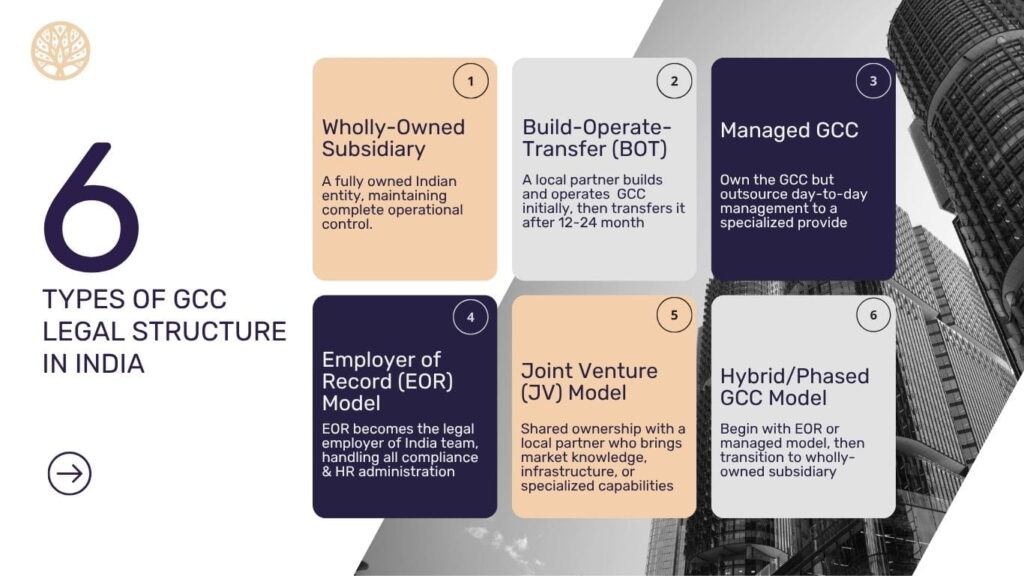
Step 2: How to Choose Your GCC Legal Structure
Type 1 : Wholly-Owned Subsidiary
You establish a fully owned Indian entity, maintaining complete operational control.
Pros:
- Maximum control over operations, culture, and strategy
- Strongest brand presence and talent attraction
- Full IP ownership and protection
- Long-term cost efficiency
Cons:
- Longest setup timeline (4-6 months)
- Highest initial capital requirement
- Full compliance and operational responsibility
- Requires deep local expertise
Best for: Organizations committed to long-term India presence with substantial scale ambitions.
Type 2 : Build-Operate-Transfer (BOT)
A local partner builds and operates your GCC initially, then transfers it to you after 12-24 months.
Pros:
- Fastest time-to-market (operational in 2-3 months)
- Lower initial risk and capital outlay
- Partner handles early compliance complexity
- Knowledge transfer built into model
Cons:
- Higher operating costs during BOT phase
- Potential cultural misalignment during transition
- Dependency on partner quality and expertise
- Transfer complexity if poorly structured
Best for: Companies new to India wanting to accelerate launch while learning the market.
Type 3 : Managed GCC
You own the GCC but outsource day-to-day management to a specialized provider.
Pros:
- Maintain ownership and control
- Reduce operational complexity
- Access partner’s local expertise
- Focus internal resources on strategic work
Cons:
- Ongoing management fees impact economics
- Potential limits on cultural integration
- Less direct control than wholly-owned model
- Partner dependency for operational excellence
Best for: Organizations wanting ownership benefits without full operational burden.
Type 4 : Employer of Record (EOR) Model
An EOR becomes the legal employer of your India team, handling all compliance and HR administration.
Pros:
- No legal entity required
- Fastest, lightest entry model
- Minimal compliance burden
- Easy to exit or restructure
Cons:
- Higher per-employee costs
- Limited scalability beyond 50-100 employees
- Less employer brand presence
- Reduced talent attraction for senior roles
Best for: Testing the market, running small specialized teams, or exploring GCC feasibility.
Type 5 : Joint Venture (JV) Model
Shared ownership with a local partner who brings market knowledge, infrastructure, or specialized capabilities.
Pros:
- Shared risk and investment
- Access to partner’s market expertise
- Faster market entry than wholly-owned
- Potential for unique capability combinations
Cons:
- Shared control and decision-making
- Potential for strategic misalignment
- Complex governance requirements
- Exit complexity if partnership fails
Best for: Entering specialized markets or accessing unique partner capabilities.
Type 6 : Hybrid/Phased GCC Model
Begin with EOR or managed model, then transition to wholly-owned subsidiary as you scale.
Pros:
- De-risked market entry
- Learning period before full commitment
- Maintains path to complete control
- Scalable as confidence builds
Cons:
- Transition costs and complexity
- Potential talent disruption during shift
- May delay full cultural integration
- Requires clear phase gates and criteria
Best for: Organizations wanting to validate the model before full commitment.
Step 3: Where to Locate Your GCC in India
The Tier-1 Reality
Cities like Bangalore, Hyderabad, Pune, Mumbai, and Delhi-NCR offer deep specialized talent pools, established ecosystems, and robust infrastructure. However, 70% of companies report higher attrition in tier-1 cities as organizations compete intensively for the same professionals. Annual attrition in competitive functions can reach 25-30%.
The Tier-2 Opportunity
The Hub-and-Spoke Strategy
-
-
- Establish AI research in Bangalore where specialized talent concentrates.
- Locate process operations in Indore where costs remain manageable and attrition stays controlled.
- Position analytics work in Pune to access its strong data science ecosystem.
-
Step 4: Build Infrastructure That Enables Growth
Physical Infrastructure:
- Choose between a SEZ vs non-SEZ setup
- Office space with 30-50% expansion capacity
- Locations accessible via public transport
- Compliance with safety, accessibility, and environmental standards
- Amenities that support talent attraction and retention
Vendor ecosystems for facilities, IT, and compliance
Technology Infrastructure:
- Secure, scalable network architecture
- Collaboration tools enabling seamless global teamwork
- Business continuity provisions including backup connectivity and power
- Security infrastructure meeting global corporate standards
Timeline Reality
In major cities, identifying and fitting out appropriate office space takes 4-6 months. Factor this into your launch planning.
Step 5: Hire Your Core Team - Leadership First, Scale Later
Your first senior appointment, the “GCC Head or Site Leader”, sets the trajectory for everything that follows. This person defines the culture, makes the early architecture and talent decisions, and determines whether your India centre becomes a strategic capability or a cost centre.
It is the single highest-leverage decision in the entire setup, which is why it deserves a process of its own rather than a line on a checklist.
Because assessing GCC leaders in India differs materially from a domestic hire, we’ve covered it in depth separately. Our complete guide to GCC leadership hiring in India sets out the seven dimensions that predict GCC leadership success, the five-stage assessment process, compensation benchmarks, and the mistakes international companies make most often.
Once the leader is in place, they own the build-out of the core team the functional heads, the first engineering or operations managers, and the senior individual contributors who set the technical and cultural bar for everyone hired after them.
Critical First Hires:
- GCC Head/Managing Director
- Functional leaders for each core capability
- Compliance and legal advisors
- HR team to drive talent strategy and culture-building
What Makes a Great GCC Leader?
- Dual World Credibility
They must command respect from Silicon Valley investors and Bangalore engineers alike. - Real Decision-Making Authority
Token leadership roles kill momentum. - Deep Local Expertise With Global Exposure
Leaders who have worked abroad understand both worlds. - Innovation Mindset
Position the GCC as an innovation hub, not a cost centre. - Builder’s Instinct
Ability to build, scale, and continuously optimise operations.
Step 6: Establish Governance That Enables, Not Constrains
Strong governance from day one prevents future headaches while enabling the autonomy that GCCs need to deliver strategic value.
Reporting Structures
Define clear authority lines between the GCC and global headquarters, including:
-
-
-
- Decision rights at each level
- Escalation paths for key issues
- Direct vs. dotted-line reporting relationships
- Communication cadences and protocols
-
-
Collaboration Frameworks
How will your GCC work with global teams?
Need to establish:-
-
-
- Cross-functional collaboration models
- Knowledge sharing mechanisms
- Innovation feedback loops
- Meeting rhythms that respect time zones
-
-
Performance Metrics That Matter
Move beyond activity metrics to outcome measures:
-
-
-
- Business value delivered, not just tasks completed
- Innovation generated and implemented
- Capability development and skill growth
- Strategic impact on corporate objectives
- Quality metrics appropriate to your functions
-
-
Service Level Agreements
Where appropriate, create SLAs that set clear expectations while allowing flexibility for strategic work that doesn’t fit rigid timelines. Balance accountability with the autonomy innovation requires.
According to NASSCOM’s governance research, GCCs with well-defined governance structures achieve operational maturity 40% faster while maintaining higher employee engagement scores.
"The best search firms don't just fill your current opening. They provide market intelligence, assist with succession planning, and become trusted advisors in building your leadership team."
Sonia Sharma, CEO Founder Tweet
How Long Does It Take to Set Up a GCC in India?
The Fatal Error: Managing Capability Centers Like Vendors
Once the foundation and team are in place, most companies make a critical mistake that undermines everything they’ve built.
They run their GCC as if it were an outsourced vendor – just housed inside their own payroll.
They track activity metrics instead of outcomes.
They require approval for every decision, regardless of significance.
They centralize knowledge and decision-making at headquarters.
Then they wonder why the center never evolves beyond processing work handed down from above.
The GCC Maturity Paradox
Organizations establish GCCs to build strategic capabilities, then manage them in ways that prevent strategic thinking.
They say they want innovation but measure productivity.
They claim to want ownership but maintain control over every decision.
They position the center as a partner but treat it as a service provider.
This contradiction creates what we call the “smart execution trap” – the GCC executes brilliantly but never contributes to strategy, challenges assumptions, or drives innovation.
The Alternative Approach
The most successful GCCs operate differently.
They:-
-
- Focus on outcome metrics aligned with business strategy, not activity tracking
- Grant genuine decision-making authority appropriate to the team’s expertise and function
- Invest in continuous capability development, not just headcount growth
- Create two-way knowledge flows where the GCC influences global strategy and decisions
- Celebrate innovation and experimentation, including controlled failures that generate learning
- Position the center as a strategic partner in communications, org charts, and leadership forums
-
This shift from vendor mindset to capability partner mindset determines whether your GCC becomes a strategic asset or remains an offshore processing center.

What Makes a GCC Setup Succeed
Setting up a GCC in India offers compelling advantages
- cost efficiency,
- talent access,
- technological infrastructure,
- and strategic value creation.
However, success requires more than following a setup checklist.
The GCCs that thrive make thoughtful decisions about legal structure, location strategy, and infrastructure. They establish strong governance without micromanagement. Most importantly, they invest in purpose-driven, mission-aligned leadership from day one.
Leadership is the Multiplier
Every other decision
- Location,
- Structure,
- Infrastructure
creates the foundation.
Leadership determines what you build on that foundation.
The right leader attracts exceptional talent, builds innovation culture, navigates complexity, and delivers transformational results.
The wrong leader, regardless of how impressive the infrastructure, creates an expensive execution center that never reaches its potential.
This is why leadership hiring deserves your greatest attention and investment.
Frequently Asked Questions On Setting Up a GCC in India
How long does it take to set up a GCC in India?
What are the steps to set up a GCC in India?
- Define the centre’s purpose,
- Choose a legal structure,
- Select a location,
- Build infrastructure,
- Hire leadership first, and
- Establish governance.
What is the best legal structure for a GCC in India?
There is no single best structure; it depends on your timeline, control needs and risk appetite. A wholly-owned subsidiary gives maximum control, BOT and managed-GCC models reduce early risk, an Employer of Record enables the fastest start, and JV or hybrid models suit specific situations. Many companies phase from one into another as the centre matures.
Where is the best location to set up a GCC in India?
The Tier-1 hubs – Bengaluru, Hyderabad, Pune, Mumbai and Delhi NCR, offer the deepest talent pools but the highest competition and attrition.
Tier-2 cities such as Indore, Coimbatore and Kochi offer better retention and lower cost. Many mature GCCs use a hub-and-spoke model anchored in a Tier-1 city.
How much does it cost to set up a GCC in India?
Who should be the first hire when setting up a GCC in India?
See our full guide to GCC leadership hiring in India.
These FAQs cover the most common questions we hear from teams looking to set up their GCC in India.
For a more comprehensive questions on executive search and its breakdown, including questions on fees, timelines, guarantees, and how the process works step by step, visit our detailed Executive Search FAQ.
How Pipal Tree Services Supports Your GCC Journey
At Pipal Tree Services, as one of the top executive search firms in India, we’ve supported organizations through leadership hiring and team scaling. Our deep understanding of India’s talent markets, compensation benchmarks, and cultural dynamics helps companies build GCCs that deliver sustained value.
We specialize in identifying mission-aligned leaders who bring both strategic vision and operational excellence. Our executive search methodology combines rigorous assessment with extensive networks across technology, finance, operations, and emerging functions.
Whether you’re exploring GCC establishment or strengthening existing India operations, we invite you to partner with us in building teams that create transformational impact.
Ready to build your purpose-driven GCC leadership team?
Let’s start with a conversation about your leadership needs and the transformation you’re navigating.
No pressure. Just talk.
Write to me at [email protected]

Rahul Bahuguna
“With over two decades of experience across executive search, digital strategy, and business consulting, Rahul brings a unique entrepreneurial perspective as Director of Pipal Tree Services. At Pipal Tree, Rahul leverages his background in strategy, market intelligence, and digital transformation to guide mission-aligned executive search and board mandates. He specializes in building long-term client partnerships, leading complex leadership searches, and shaping Pipal Tree’s distinct positioning at the intersection of talent and purpose. His ability to combine strategic insight with practical execution makes him a trusted advisor to organizations seeking leaders who can drive meaningful, sustainable change.”

[…] dismantle these roadblocks. One global firm, for instance, used AI to anonymize résumés and scan job descriptions for biased language, resulting in fairer and more diverse shortlists. A leading tech giant deployed […]