

Table of Contents
There is extensive literature on what a CTO should do.
There is almost nothing written about how a CTO should structure their team and that gap is where most engineering organisations fail.
The CTO role receives the strategic coverage.
The engineering organisation beneath the CTO receives the operational scrutiny.
Yet how that organisation is structured:
- “Who reports to whom“
- “Where product sits relative to engineering”
- “How QA is organised“
- “When a VP Engineering becomes necessary”
- “What the India engineering centre reports into”
determines whether the company ships at speed or drowns in coordination overhead.
Small engineering teams of 6-9 members show 20% higher pull request velocity and 25% faster lead time than larger teams. But building and sustaining those small, fast teams requires getting the organisational design right as the company scales.
This guide covers the CTO team structure across every major company stage, Seed through Enterprise and GCC, along with the four foundational org models, the VP Engineering versus CTO distinction, the difference between CTO and CPTO structures, and the India-specific dynamics that most global CTO guidance ignores entirely.
For the strategic question of which C-level technology role to appoint in the first place, see our CTO vs CPO vs CPTO: The Complete Guide.
Technology Team Structure by Company Stage
There is no universal CTO team structure.
There is only the structure that is right for your stage. A squad-based model that enables rapid experimentation at Series B creates expensive overhead at seed stage. A platform-and-application split that works beautifully at 150 engineers is premature at 30.
The most common engineering org mistakes come from copying the structure of a company that is one or two stages ahead.
Stage 1 : Technology Team Structure For Seed Stage (under 15 engineers)
At seed, the CTO is the engineering organisation.
They code, review PRs, make architecture decisions and handle most of what will later become multiple leadership roles.
There are no managers, no org chart, and no reporting hierarchy to design . This is because the team size is small enough that a tech org structure adds overhead without adding much value.
| Dimension | Seed Stage Reality |
| Team size | 5–15 engineers. Often 3–5 in the earliest days. |
| CTO direct reports | All engineers report directly to the CTO. No engineering managers yet. |
| Product | Product function is usually the co-founder or the CTO themselves. No formal CPO or PM layer. |
| The CTO’s job | Write code. Make architecture decisions. Hire engineers. Represent technology to investors. All four simultaneously. |
| When this breaks | When team crosses 10–12 engineers and the CTO is spending more time in 1:1s than in architecture. The signal: deploys are getting inconsistent and the CTO can’t tell you why. |
Pipal Tree Insight
Many seed-stage companies make the mistake of hiring too senior too early.
A VP Engineering at seed stage adds process overhead before there is enough team to justify it.
The fractional CTO model is worth considering at this stage: strategic technology leadership without the full-time cost.
Stage 2 : Technology Team Structure For Series A (15–40 engineers)
Series A is where the CTO team structure must first be deliberately designed.
The team is large enough that the CTO can no longer manage everyone directly, but small enough that adding too many management layers creates bureaucracy.
This is the moment to introduce the first Engineering Manager layer.
| Dimension | Series A Reality |
| Team size | 15–40 engineers organised into 2–3 teams. |
| CTO direct reports | 2–3 Engineering Managers + 1 Senior Technical Lead (Principal Engineer or Architect). May also include Head of Product if product hasn’t separated yet. |
| Product | Product begins to formalise. First dedicated PM or Head of Product. Relationship with engineering is the CTO’s most important cultural design decision. |
| The CTO’s job | Technology direction. Architecture decisions. Engineering Manager mentoring. Investor and board representation. Beginning to step back from hands-on coding. |
| When this breaks | When the CTO is still being pulled into day-to-day delivery decisions at 30+ engineers. The signal: standups have 20 people and the CTO is facilitating all of them. |
Stage 3 : Technology Team Structure For Growth Stage - Series B / Series C (40–150 engineers)
This is the most structurally consequential stage.
The organisation has proven product-market fit and is scaling fast.
The CTO who could still manage a 30-person team directly cannot manage a 100-person organisation.
Series B and beyond is when adding a VP Engineering becomes critical, as headcount passes 20+ engineers and the separation between vision and execution becomes essential. The CTO must make a clean transition from execution owner to technology strategist.
| Dimension | Growth Stage Reality |
| Team size | 40–150 engineers across 5–12 teams. |
| CTO direct reports | VP Engineering (owns delivery). Head of Platform / Infrastructure. Head of Data Engineering. Head of Security (emerging). CPO or VP Product (peer relationship). |
| New Functions | Platform and Application teams begin to separate. |
| The CTO’s job | Architecture decisions. The CTO is no longer coding. |
| When this breaks | When the VP Engineering hasn’t been hired and the CTO is still in sprint planning. Or when Platform and Application have no shared ownership model and teams are blocking each other constantly. |
Stage 4 : Technology Team Structure For Enterprise - Pre-IPO / Late Stage (150+ engineers)
At enterprise scale, the CTO is almost entirely external-facing: board, investors, strategic technology decisions, major vendor relationships, and public representation of the technology organisation.
Around 90% of CTOs report directly to the CEO, giving them strong influence on business decisions, while only 30% of VPs Engineering report to the CEO, reflecting their operational focus.
The VP Engineering (or multiple VPs) runs the organisation.
| Dimension | Enterprise Reality |
| Team size | 150–1,000+ engineers. Multiple product lines, geographies, and business units. |
| CTO direct reports | Multiple VP Engineering (by BU or product line). VP Platform / SRE. VP Data and ML / Head of AI. VP Security and Compliance. VP Engineering Excellence / Developer Experience. CISO (often dotted-line). |
| New Functions | Long-horizon technology bets. Board-level risk assessment. Strategic technology partnerships. Innovation pipeline. The CTO’s primary stakeholders are now external – board, investors, regulators, and strategic partners. |
| The CTO’s job | Architecture decisions. The CTO is no longer coding. |
| When this breaks | When the CTO’s span of control is too wide. The optimal span for engineering leaders is 5–8 direct reports. |
GCC - Global Capability Centre Technology Team Structure
India’s GCC sector is in a structural inflection point. According to the Zinnov-NASSCOM GCC Landscape 2026 report, India now hosts 2,117 GCCs employing 2.36 million professionals, generating USD 98.4 billion in annual revenue.
Critically, 64% of GCC site leaders now hold dual mandates: global business unit ownership combined with site leadership.
This is the org design question becoming urgent across the sector.
GCC engineering organisations face a structural question that no other stage faces: is India a delivery centre reporting upward to a global CTO, or is India a strategic innovation hub with its own engineering leadership authority.
The answer determines everything about how the CTO team structure is designed.
| Dimension | Delivery Centre Model | Innovation Hub Model |
| India role | Executes on global product roadmap defined at HQ | Co-owns global product decisions, contributes to roadmap |
| India engineering head title | Head of Engineering India / Director Engineering | VP Engineering India / CTO India (or CPTO) |
| Reporting line | Solid line to Global CTO. Dotted line to India MD. | Solid line to India MD. Dotted line to Global CTO. |
| Talent signal | Attracts strong execution leaders. Loses architects and product thinkers. | Attracts builders and decision-makers. Higher comp and autonomy expectations. |
The GCC Engineering Org Reality in 2026
The Zinnov-NASSCOM report notes that India GCCs now run 45% expertise and frontier work, closer to HQ than any other global engineering market.
5% of India GCCs now operate at the highest maturity level: AI-led operating models, CXO-level mandates from India, and co-innovation at the ecosystem level. The engineering org structure must reflect this reality - delivery-centre reporting lines are increasingly misaligned with what India GCC engineering teams are actually doing.
“We see it in almost every founder conversation. The company has a brilliant CTO who is still in standups, still reviewing every PR, still the bottleneck for every architecture decision. They don’t need a new CTO. They need a VP Engineering who can take the execution weight off so the CTO can do what only the CTO can do.
Those are fundamentally different searches and confusing them is an expensive mistake”
The 4 Foundational CTO Team Structure Models
Model 1: Functional Engineering Organisation
CTO Team Structure
All engineers organised by technical function – Frontend, Backend, QA, DevOps – reporting through engineering managers to the CTO or VP Engineering.When it works
Seed and early Series A. Single product. Small teams where functional expertise clustering makes mentorship easier.When it breaks
Multiple products or features. Handoffs between Frontend and Backend become the biggest bottleneck. Shipping a single feature requires three-team coordination.Model 2: Product Aligned Squad Model
CTO Team Structure
Engineers organised into cross-functional squads, each owning a product area or customer segment. Each squad has engineers, a designer, a PM, and QA embedded.When it works
Series A and B. Multi-product companies. Consumer products where speed of iteration is the primary competitive lever. Spotify’s “Tribe and Squad” model is the most cited version of this.When it breaks
Heavy infrastructure dependencies. Security and compliance-sensitive industries where functional expertise must be centralised. Companies where squads develop independent “fiefdoms” that resist shared platform investment.Model 3: Platform and Application Split
CTO Team Structure
Two parallel organisations under the CTO : – A Platform team building shared infrastructure, developer tools, and – Data infrastructure; and Application teams building customer-facing products that consume platform services.When it works
Series C and beyond. Multi-product B2B SaaS. Companies with significant infrastructure scale that benefits from shared investment.When it breaks
Companies that implement this model before the Platform actually has enough internal customers to justify it. Platform teams without real internal customers build for theoretical needs rather than actual ones.Model 4: Matrix with Functional Excellence Centres
CTO Team Structure
Engineers have a primary reporting line to a product or business unit, but also report into functional Centres of Excellence (Frontend, Data Engineering CoE, AI CoE, Cyber Defence CoE) for craft standards, technical progression, and cross-company consistency.When it works
Enterprise scale. GCCs. Organisations that need to balance business unit autonomy with company-wide engineering standards.When it breaks
Smaller companies where the matrix overhead (two sets of performance reviews, two reporting relationships, competing priorities) consumes more than it produces. According to ICONIQ Capital’s 2024 Engineering Series report, the most effective engineering organisations are those that adapt their structure to fit how they build, communicate, and grow – the model must serve the business, not the other way around.CTO vs VP Engineering: Which Role Do You Actually Need?
Most founders treat CTO and VP Engineering as interchangeable titles.
They are NOT.
They are different jobs with different mandates, different skill sets, and different impacts on the engineering organisation beneath them.
The CTO decides what to build and why. The VP of Engineering decides how to build it and makes sure it ships. Hire a VP of Engineering when you need a CTO, and you’ll have a well-run team building the wrong product.
Hire a CTO when you need a VP of Engineering, and you’ll have brilliant architecture with no one to execute it.Kompella Technologies
| Dimension | CTO | VP Engineering |
| Primary mandate | What to build. Technology vision. Architecture direction. |
How to build it. Delivery. Execution. Team management. |
| Orientation | External-facing: investors, board, strategic partners, product vision. | Internal-facing: engineering managers, delivery, process, team health. |
| Success metric | Architectural scalability, Innovation outcomes, Technology partnerships, Board-level strategic influence. |
Sprint predictability, On-time delivery rate, MTTR, Engineering throughput, Team retention. |
| In standups | Rarely. The CTO at growth stage should not be in sprint standups. |
Frequently. The VP Engineering’s operational effectiveness depends on visibility into delivery rhythm. |
| Reports to | CEO directly. 90% of CTOs report to the CEO. |
CTO at large companies. CEO or COO at growth-stage companies. |
When to Hire CTO or VP Engineering
Seed: CTO Only (or fractional CTO).
The architecture decisions are the priority. You don’t need process discipline at 8 engineers.
Series A: CTO + First Engineering Manager (not a VP Engineering yet).
The team has outgrown direct CTO management but is too small for a full VP layer.
Series B: Hire the VP Engineering First.
Coordination is breaking down. Deploys are inconsistent. The CTO is spending too much time in standups. The Jellyfish research is unambiguous: once the engineering team crosses 15–20 people, the CTO-as-team-manager model becomes untenable.
Series C and beyond: CTO & VP Engineering both as distinct, full-time roles
Roles with clear accountability separation. If you try to have one person do both the role, both side suffers
Pipal Tree Insight
The most common mistake we have seen is promoting the best senior engineer to VP Engineering. Engineering management is a distinct skill set.
The best architect on your team is often a poor people manager. The mistake is conflating technical seniority with leadership capability.
Hire the VP Engineering for management capability, not technical seniority alone.
The CTO’s job is to hire a VP Engineering who is better at running teams than the CTO is - so the CTO can focus on what only the CTO can do.
Who Should Directly Report to a CTO?
Research consistently shows that managers perform best with 5–7 direct reports, with engineering-specific guidance pointing to 8 as the outer limit.
The average engineering manager in 2026 handles 12.1 direct reports. This is significantly above the recommended range, which signals that most engineering organisations are operating with span-of-control problems.
A CTO with 12+ direct reports is a coordinator, not a leader.
-
Series A - B (15–60 engineers)
- 2–3 Engineering Managers (each managing a team of 5–8 engineers)
- 1 Principal Engineer or Staff Engineer (technical depth without management burden)
- Head of Product (if product hasn’t separated into a CPO role)
- Head of QA or Engineering Quality (if quality is a distinct function)
-
Series C–D (60–200 engineers)
- VP Engineering (owns delivery and team management - the CTO’s most important hire at this stage)
- Head of Platform / Infrastructure
- Head of Data Engineering (data has matured into its own discipline with its own hiring needs)
- Head of Security (compliance and security graduate to leadership level at this stage)
- CPO or VP Product (peer relationship - not a report, a partner)
-
Pre-IPO / Enterprise (200+ engineers)
- Multiple VP Engineering (by business unit, product line, or geography)
- VP Platform / SRE
- VP Data and ML / Head of AI
- VP Security and Compliance
- VP Engineering Excellence / Developer Experience
- CISO (often dotted-line or reporting to CEO directly for independence)
Rule of thumb: If the CTO is in more than 3 recurring standups per week, their direct report structure has broken down.
CTO vs CPTO Org Structures: What Changes When You Combine the Roles
This section covers a specific organisational question: once you’ve decided whether to appoint a CTO, CPO, or CPTO – how does the choice change the structure of the team beneath them?
The CTO Org Structure
In a company with a separate CTO and CPO, Product is a peer function reporting to the CEO, not to the CTO.
Engineering and Product maintain independent leadership, coordinating through shared roadmap processes and product-engineering rituals.
The CTO owns technical architecture, infrastructure, security, and engineering delivery.
The CPO owns product strategy, product management, and product design.
The advantage: deep specialisation in both functions.
The challenge: coordination friction.
The relationship between the CTO and CPO is the most critical cultural design element in this structure. When it works, the two functions are genuinely complementary. When it doesn’t, engineering and product become competing organisations with incompatible backlogs.
The CPTO Org Structure
Under a CPTO, both engineering and product management report into a single leader.
Product Managers, Engineers, and Designers sit within the same organisational unit. Planning rhythms are unified. The product-engineering tension that consumes significant leadership bandwidth in separated structures is largely eliminated.
The advantage: unified vision and faster decision-making.
The challenge: engineering makes up 80–90% of R&D headcount in most organisations which means the CPTO role is inevitably weighted toward engineering in practice.
Product management, with 10–20% of headcount, can become underrepresented when the CPTO’s background is engineering-heavy. The CPTO must deliberately protect product strategy time and resist the gravitational pull of engineering problems.
| Dimension | Separate CTO + CPO | CPTO (Combined) |
| Who reports to whom | CTO and CPO are peers. Both report to CEO. | Engineering and Product both report to CPTO. |
| Planning | Separate roadmaps that must be coordinated. Frequent alignment meetings. | Single unified roadmap process. Less coordination overhead. |
| Hiring | Larger combined candidate pool. Two roles to fill but more candidates per role. | Smaller candidate pool – fewer leaders can credibly span both engineering and product. |
| Risk | CTO-CPO relationship failure. Competing backlogs. Engineering vs product tensions. | Under-investment in product discipline. CPTO’s engineering background dominates. |
| Best for | Companies with high product complexity needing deep specialist leaders in each domain. | Growth-stage companies where unified vision and speed matter more than depth in each function. |
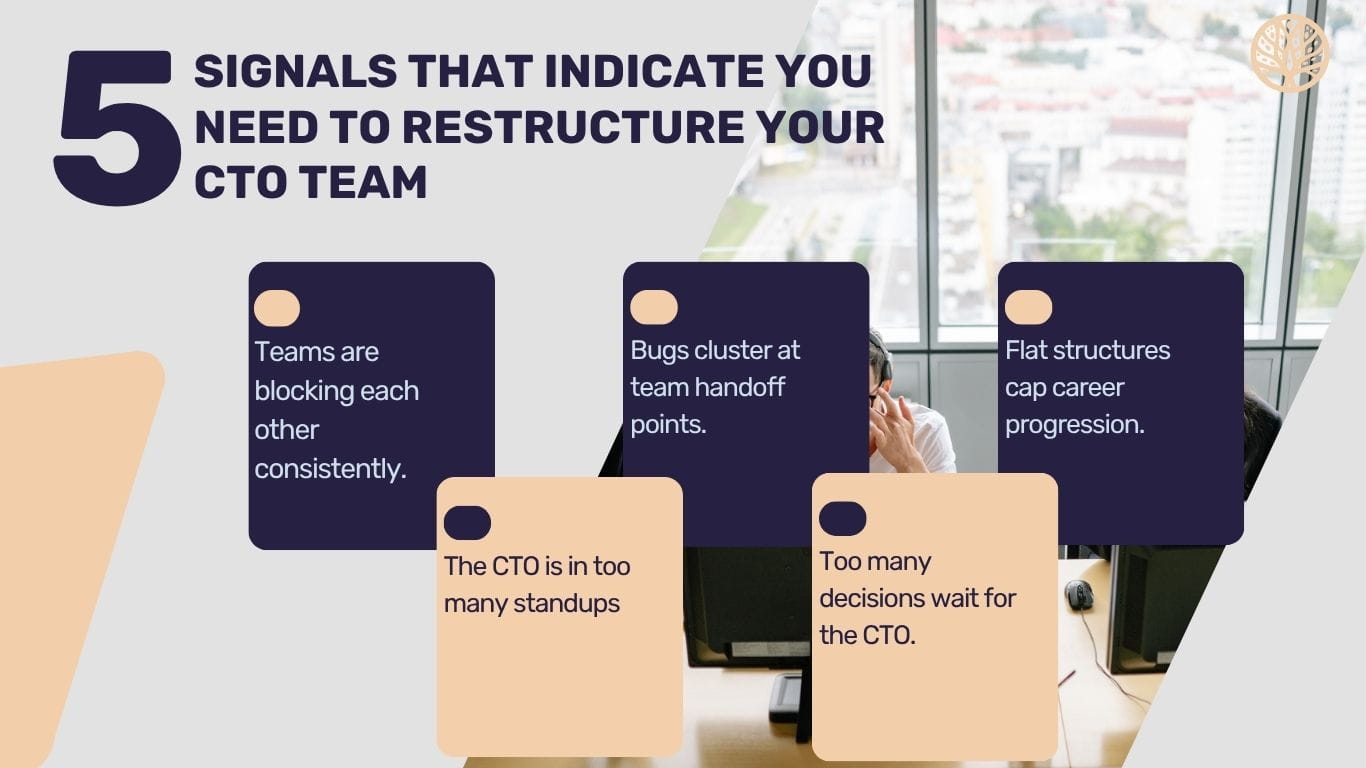
5 Signals That Indicate You Need to Restructure Your CTO Team
The right CTO team structure at Series A will be wrong at Series C.
Recognising when to restructure, before the problems compound rather than after, is one of the most valuable things a CTO can do.
-
Signal 1: Decision velocity has dropped
Too many decisions wait for the CTO.
Engineers are blocked waiting for architecture review. Product launches require the CTO’s personal sign-off on technical choices that should be delegated. This signals that the span of control is too wide or the VP Engineering isn’t empowered enough. -
Signal 2: Cross-team dependencies are stalling delivery
Teams are blocking each other consistently.
A backend change is stuck waiting for an API contract review. A Platform change is breaking Application teams without warning. These are architectural problems surfacing through organisational symptoms - the team structure needs to reflect the actual dependency graph of the systems being built. -
Signal 3: Quality is suffering at the seams
Bugs cluster at team handoff points.
The “it’s someone else’s problem” pattern emerges at every inter-team boundary. Quality issues between Frontend and Backend, between Platform and Application, or between Engineering and QA are structural signals - the ownership model is unclear at the interfaces. -
Signal 4: Senior engineers are leaving
Flat structures cap career progression.
Principal Engineers and Staff Engineers see no growth path. Senior engineers are the most mobile segment of the engineering talent market - they leave when the organisation can’t give them scope, autonomy, or a meaningful technical challenge. -
Signal 5: The CTO is in too many standups
This is the simplest and most reliable signal.
If the CTO is facilitating daily standups for more than one team, the management layer beneath them has not been properly built. The CTO’s calendar should have no more than 2–3 recurring team meetings per week. Everything else is a structural failure.
India-Specific CTO Team Structure Considerations
Most CTO team structure guidance is written for Silicon Valley or European contexts. India’s engineering talent market, regulatory environment, and organisational dynamics create specific considerations that change how the CTO team should be structured.
With over 170 new GCC setups in 2025 alone, and India now being the second-largest market for enterprise AI talent globally, the India-specific engineering org question is one every global CTO will face.
The GCC Reporting Line Question
The most common structural mistake in GCC engineering organisations is designing the India reporting line for what the operation was, not what it is becoming. India GCCs now run 45% expertise and frontier work, with 64% of GCC site leaders holding dual mandates combining global business unit ownership with site leadership. An engineering org structure designed for a delivery centre – with India reporting into a global VP Engineering with dotted-line authority to the India MD – actively prevents the India organisation from operating at the level the talent and mandate now demand.
The question to resolve before designing the structure:
a) Is India a delivery centre (India executes HQ’s decisions) or
b) An innovation hub (India co-creates and co-owns product decisions)?
The structural answer is different in each case and cannot be blurred without creating permanent authority confusion.
The Director of Engineering Trap
India’s engineering talent market has a specific problem: the “Director of Engineering” title is widely misused.
Large Indian IT services firms and early-generation software companies apply the Director title to roles that are essentially Senior Engineering Managers – strong at delivery coordination but without genuine architectural authority or engineering strategy capability.
When a global CTO hires for a “Director of Engineering, India” and receives profiles with the right title but the wrong mandate, the result is an engineering centre that executes excellently but never develops the strategic engineering muscle the company needs.
The structure must match the mandate.
If India needs genuine engineering leadership – architectural ownership, technical roadmap authority, the ability to attract and retain Senior Engineers and Staff Engineers – the title should be VP Engineering India or Head of Engineering with clear scope, not Director Engineering.
As we discussed in Why Top Executives Decline Job Offers, senior engineering talent evaluates mandate clarity as much as compensation.
Talent Market Realities In India
India has extraordinary depth in specific engineering specialisations – backend systems, data engineering, cloud infrastructure, and increasingly AI/ML.
It has historically been thinner in product design, developer experience, and front-end craft.
A CTO structuring an India team who maps HQ’s org chart directly onto India will create roles that are genuinely difficult to fill locally.
According to NASSCOM, India’s GCCs have over 120,000 AI/ML professionals and 185 dedicated AI/ML Centres of Excellence (NASSCOM, 2025) – but the talent distribution is uneven across specialisations.
Design the India engineering structure around what the talent market can actually supply at the compensation and seniority level the company can offer, not around what an ideal theoretical org chart would look like.
“Most CTO failures aren’t actually CTO failures. They’re org design failures that get blamed on the CTO.
Get the structure right before you blame the person – or, even better, design the structure with the person before they accept the offer.”
5 Common CTO Team Structure Mistakes
Mistake 1: Treating Product as a Sub-Function of Engineering
When Product Management reports to the CTO rather than to the CEO alongside the CTO, it signals – both culturally and structurally – that product decisions are downstream of engineering decisions. The best product talent will not work in an organisation where product reports to engineering. Separate the two functions at the leadership level and let them collaborate as peers.Mistake 2: Premature Platform Investment
Building a Platform team before there is enough application complexity to justify it creates an engineering sub-organisation with no real internal customers. Platform teams without genuine consumers build theoretical infrastructure that gets thrown away when the applications don’t actually need it. The signal that you’re ready for Platform: three or more Application teams are independently solving the same infrastructure problem.Mistake 3: The Single VP Engineering Bottleneck
As the engineering organisation scales from 30 to 100 engineers, the VP Engineering role becomes the structural bottleneck. Everything flows through one person: hiring decisions, architecture reviews, delivery accountability, team escalations. Large teams show 15% lower productivity per engineer due to higher coordination overhead. The organisation needs to add VP Engineering depth by business unit or product line before this single point of failure compounds.Mistake 4: Hiring Senior Engineers as Managers
The most technically proficient engineer on the team is often the worst choice for Engineering Manager. Engineering management is a distinct profession: it requires patience with ambiguity, comfort in 1:1 conversations, the ability to derive satisfaction from others’ growth rather than personal technical achievement, and skill in navigating organisational complexity. Promoting the best engineer to manager loses both a strong individual contributor and often gains a miserable manager.Mistake 5: Outsourcing Org Design to the Incoming CTO
Boards and founders often tell a new CTO: “figure out the team structure in your first 30 days.” This creates a CTO who spends their political capital on reorganisation before they have established trust. The org design should be a collaborative decision between the CTO and the leadership team, with enough pre-work done before the new leader joins that the first 90 days are about implementation, not debate.When CTO Need External Search Support for Engineering Leadership Roles
Getting the CTO team structure right is only possible if you have the right leaders in the right roles. The three engineering leadership positions where external search most consistently delivers better outcomes than internal recruitment:
Hiring the First VP Engineering
The VP Engineering hire is the most leveraged engineering leadership decision a CTO makes. Done well, it frees the CTO to do strategic work and accelerates the organisation.
Done poorly, it creates a bottleneck that compounds every month. The candidate must combine genuine people management capability, delivery orientation, technical credibility, and the willingness to be fully operational – a rare combination that the best candidates are not actively searching job boards for.
A retained search is almost always the right model for this hire. Our CTO Search practice covers engineering leadership searches at every level.
Restructuring After a Missed Milestone
When an engineering organisation has missed a critical delivery commitment and the post-mortem reveals structural causes – cross-team dependency failures, unclear ownership, management layer gaps – the restructuring often requires bringing in new leadership alongside the new design.
Promoting internally perpetuates the cultural patterns that created the problem.
External search for a VP Engineering or Head of Platform at this moment brings both a new perspective and the structural authority to implement changes.
Building an India Engineering Centre
As the GCC and India engineering centre data above shows, India is no longer just a delivery market.
Companies building engineering capability in India need local market intelligence on talent availability, compensation benchmarks, title norms, and the specific qualities that separate a genuinely senior India engineering leader from a well-credentialed middle manager.
This is where search partners with deep India engineering market knowledge consistently outperform global generalist firms or internal HR-driven searches. See our Technology industry search practice for context on how we approach these mandates.
Frequently Asked Questions
How many engineers can one CTO manage directly?
At seed stage, a CTO managing 5–10 engineers directly is normal and healthy. Beyond 15 engineers, the CTO should be introducing an Engineering Manager layer rather than expanding their own direct report count. Research suggests 5–7 direct reports is optimal for managers to do their best work.
A CTO with more than 8–10 direct reports is operating in coordinator mode, not leader mode.
Should the CTO or VP Engineering own engineering hiring?
Both, at different levels.
The CTO owns senior engineering leadership hiring – VP Engineering, Head of Platform, Principal Engineers.
The VP Engineering owns hiring beneath that: Engineering Managers, Senior Engineers, and team composition. Blurring this creates competition between the two roles for the same talent decisions and undermines the VP Engineering’s authority to build the team.
When should an India engineering centre have its own CTO versus reporting to a global CTO?
When India represents more than 30% of total engineering headcount, or when India has genuine product or architecture ownership (not just delivery execution), a dedicated India engineering leader with CTO or VP Engineering India authority is justified.
The reporting line should reflect the operational reality: if India is co-creating product, the India leader should have direct access to the global CTO as a peer, not as a subordinate.
What is the difference between a CTO team structure and an engineering org chart?
An org chart shows the reporting lines.
A team structure shows the operating model – how teams interact, where authority sits, what the decision rights are at each level, and how the organisation responds to different types of problems. Two companies can have identical org charts and completely different team structures.
The org chart is a document; the team structure is a system.
How often should a CTO restructure their engineering team?
The structural principle: design for where you’ll be in 12–18 months, not where you are today.
For fast-growing companies, meaningful restructuring typically happens every 18–24 months as the organisation doubles in size.
The signal that restructuring is overdue is almost always visible 6 months before the decision is made – the five signals in Section 7 of this guide are reliable early indicators.
Should I hire a VP Engineering before a CTO?
For most startups with a technical co-founder acting as CTO, the VP Engineering is the right next hire once the team crosses 20 engineers – because coordination and delivery are the bottleneck, not technical vision.
The exception: if the founding CTO has left, or if the company is making a major technical pivot, the strategic technology direction must be reset before optimising delivery. In that case, hire the CTO equivalent first.
These FAQs cover the most common questions we for CTO team structure.
For a more comprehensive breakdown, including questions on fees, timelines, guarantees, and how the process works step by step, visit our detailed Executive Search FAQ.
Why Pipal Tree is one of the top executive search firm in India
97% placement success rate across hundreds of leadership mandates.
50+ years of combined search experience across our founding team.
80% repeat engagement rate > our clients come back because our process works.
We combine the best practices of a global search firm with the entrepreneurial responsiveness and senior-partner involvement of a boutique consultancy.
Building the Engineering Organisation That Can Scale
The right CTO team structure is not a one-time decision. It is a continuous design challenge that must evolve with the company’s stage, product complexity, and the talent you can attract and retain. The companies that get it right don’t wait until the structure has demonstrably failed – they restructure slightly ahead of the need, with the next stage in mind.
Because the engineering organisation doesn’t fail when it runs out of engineers. It fails when it runs out of structure.
At Pipal Tree Services, we work with technology companies, GCCs, and global manufacturers with India engineering centres to define the right engineering leadership mandate and find the right person to fill it.
So let’s start with a conversation.
No pressure.
Just talk.
Write to me at [email protected]

Rahul Bahuguna
"With over two decades of experience across executive search, digital strategy, and business consulting, Rahul brings a unique entrepreneurial perspective as Director & Co-Founder of Pipal Tree Services. At Pipal Tree, Rahul leverages his background in strategy, market intelligence, and digital transformation to guide mission-aligned executive search and board mandates. He specializes in building long-term client partnerships, leading complex leadership searches, and shaping Pipal Tree’s distinct positioning at the intersection of talent and purpose. His ability to combine strategic insight with practical execution makes him a trusted advisor to organizations seeking leaders who can drive meaningful, sustainable change."