

Table of Contents
How Do Global Companies Hire Senior Leaders for India Operations?
Global companies that successfully hire senior leaders in India follow 5 practices:- They define the mandate and authority structure before the search begins;
- They reach passive candidates through specialist India search partners rather than job postings;
- They benchmark compensation against current India market rates, not converted HQ salaries;
- They plan for 60–90 day notice periods in the hiring timeline; and
- They invest in structured onboarding that bridges the HQ–India operating dynamic.
A US-based VP of HR at a fast-growing technology company described her experience trying to hire a CFO for their India entity.
Nine months of effort.
A LinkedIn posting.
Two Mumbai recruitment agencies.
One hundred and forty applications, twelve interviews.
The role was still unfilled, and her CEO was flying to India every six weeks to cover the gap personally.
What they had not done in nine months: approach a single passive candidate. Every person they evaluated had come to them. The CFO they actually needed, 22 years of India financial leadership, deep banking relationships, genuine board-level credibility, was settled in a senior role at a PE-backed manufacturer and had not opened a job platform in two years.
This pattern repeats across most global companies hiring senior leaders in India for the first time.
To hire senior leaders in India successfully, global companies need a fundamentally different playbook from the one that works in the US or Europe. This is not because India is more difficult, but because the dynamics of India’s senior leadership market are different in specific, predictable, and entirely manageable ways. This guide covers what those differences are and what to do about each one.
Who this guide is for: CHROs, regional MDs, and founders at US and European companies making a senior India leadership appointment – whether for a Global Capability Centre, an MNC subsidiary, a PE-backed portfolio company, or a scaling startup with India operations.
Throughout this guide, “global company” covers all these contexts – from an established multinational with a thirty-year India footprint to a US software company making its first India hire.
The timing matters more than ever. India received USD 58.85 billion in FDI inflows in FY 2025–26, up 18% year-on-year , and more than 170 new Global Capability Centres were established in India in 2025 alone.
Every one of those investments eventually arrives at the same question: who leads this?
Senior leadership hiring in India
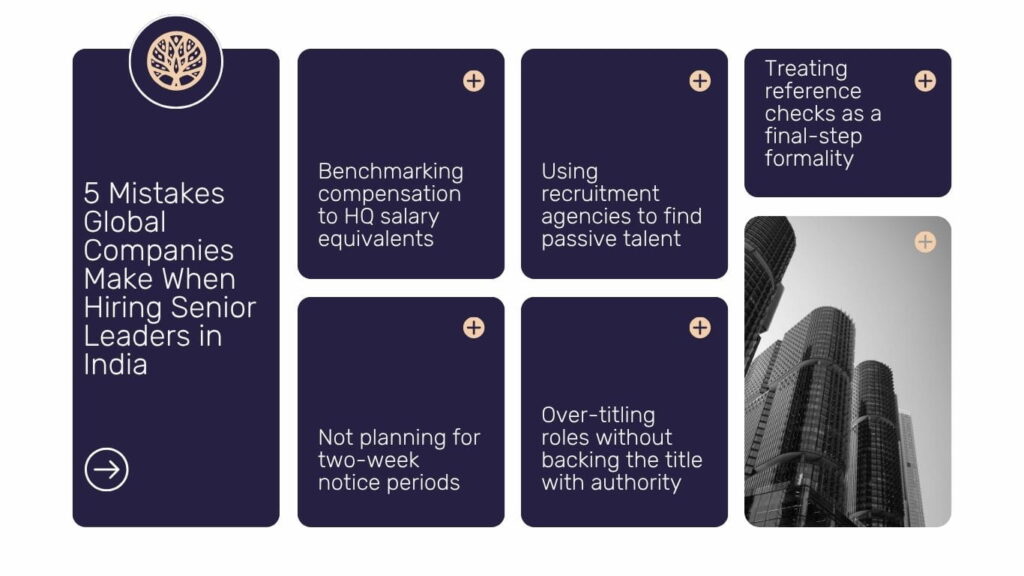
5 Mistakes Global Companies Make When Hiring Senior Leaders in India
Across the India leadership searches we run for international clients, five patterns appear with remarkable regularity.
They are not careless mistakes.
They are home-market assumptions applied to a market that operates on different rules. Each one has a corresponding India reality underneath it, and once that reality is understood, the mistake stops being a mistake and becomes a planning input.
Benchmarking Compensation To HQ Salary Equivalents
Converting a US or European salary to rupees – whether by exchange rate or purchasing power parity – consistently underestimates what senior India talent actually costs.
India’s executive compensation has risen sharply over the past five years, driven by competition between GCCs, PE-backed companies, large domestic corporates, and startups all hiring from the same finite senior talent pool.
When a candidate moves, they typically forfeit unvested equity and earned-but-unpaid bonus components, which is why joining bonuses at the senior level are not signing incentives but compensation for what the candidate is leaving behind.
Global companies that resist this norm are consistently outcompeted by companies that understand it. The correct benchmark is current India market data for the specific function and seniority – the compensation section of this guide provides 2026 ranges.
Planning For Two Week Notice Periods
In India, senior professionals serve notice periods of 60–90 days as standard, with 90 days the norm for leadership roles. This a contractual obligation, not a courtesy.
Some candidates can negotiate early release; many cannot, especially if they hold critical roles or sit at IT, financial services, or listed companies.
Notice buyouts are possible but add cost and occasionally create friction with the outgoing employer that follows the candidate into their next role.
A global company that builds a two-to-four week handover assumption into its planning either compresses the assessment process to start the notice clock sooner, or creates offer pressure that pushes toward whichever candidate can start fastest.
Both paths consistently produce the wrong hire.
The realistic planning figure: 90 days from offer acceptance to start date, on top of a 12–16 week search – six to eight months from search kick-off to person in seat.
Using Recruitment Agencies To Find Passive Talent
India’s most capable senior CFOs, CTOs, GCC heads, and business unit leaders are deeply settled. They are managing P&Ls, leading large teams, and being actively retained by employers who know exactly what they would cost to replace.
They are not on Naukri.
They are not monitoring LinkedIn jobs.
As of EY’s most recent GCC Pulse Report, the substantial majority of GCC leadership roles remain based outside India – a finding consistent with the multi-year leadership-localisation gap the industry has been tracking.
This means the pool of leaders who have genuinely run India-based operations with real authority is far smaller than the volume of senior titles in the market suggests.
Recruitment agencies – paid on placement, working multiple mandates simultaneously – source from the active talent pool, because that is what their model can reach.
The person you need requires targeted, credible, relationship-based outreach from someone who has earned the standing to make the call.
This is a structural difference between recruitment and executive search firm, not a quality difference between agencies.
Over-Titling Roles Without Backing The Title With Authority
“Director of Engineering” at a large Indian IT services company frequently describes a senior delivery manager, not an engineering strategist.
“Vice President” signals different seniority depending on whether the company is a bank, a startup, or a conglomerate.
The “Managing Director” designation carries statutory obligations under the Companies Act 2013 that the casual use of “MD” as a seniority label does not.
Giving a delivery-centre leader a Managing Director or Country Head designation to attract stronger candidates – without backing the title with genuine P&L accountability and decision rights – produces a predictable sequence: the right candidate joins, discovers the gap within ninety days, and becomes a candidate again within eighteen months.
The reverse error is equally damaging: under-titling a strategic role to manage internal compensation bands, and losing candidates who read the title as a signal of the role’s real seniority
Our guide to CEO vs Managing Director vs Country Head structures in India covers how to get this right – including the statutory implications of the MD designation.
Treating Reference Checks As A Final-Step Formality
Professional referencing in India is culturally wired toward generosity.
Direct criticism of a former colleague is rare, even when warranted. The information is available – but it lives in what is not said, in the speed and warmth of responses to specific questions, and in carefully phrased qualifications that an experienced listener recognises.
When reference checks happen after the offer has been verbally indicated, they almost never change the decision – they merely confirm it.
Standard Western reference scripts – “would you rehire this person?” – produce uniformly positive answers in India and tell you almost nothing.
Running substantive references at the finalist stage, before the offer is structured, gives the information genuine decision-making value. The assessment section covers the India-calibrated methodology that surfaces real signal.
Before the Search Begins: Define the Mandate, Not Just the Role
The single highest-leverage investment a global company can make in an India leadership hire happens before any candidate is contacted.It is the internal work of defining what this role actually is – with a precision that most job descriptions never reach.
Three questions to resolve internally first:
Question 1: What Authority Does This Role Actually Carry?
Not the aspirational authority in the announcement, the operational authority in practice.
Can this person sign contracts?
Hire their own leadership team?
Make capital allocation decisions without HQ approval?
Senior India candidates probe these questions carefully, because they have seen peers join global companies on inflated mandates and leave within two years.
Question 2 : Is The Reporting Line Genuinely Clear?
A solid line to the global function head and a dotted line to a regional president reads as structure on paper and operates as two competing bosses in practice.
Reporting line ambiguity is among the most common reasons strong India candidates decline global company offers – they evaluate it as a predictor of whether they will actually be able to operate.
Question 3 : What Does Success Look Like At 12 And 24 Months?
Generic definitions attract generic candidates.
A brief that says “build the India finance function from a team of four to a team of twelve while achieving investor-grade reporting within 18 months” attracts candidates who have done precisely that – and repels those who haven’t.
The specificity is the filter. Our guide to writing executive job descriptions for global roles covers the language that signals mandate quality to senior candidates.
India’s Senior Leadership Talent Market in 2026
When a global company goes looking to hire senior leaders in India, they are entering one of the most competitive talent markets in the world.
Three forces have converged to make it that way:
- India’s GCC sector alone now comprises 2,117 centres employing 2.36 million professionals and generating USD 98.4 billion in annual revenue (Zinnov-NASSCOM GCC Landscape 2026)
- PE-VC investment into India reached USD 33 billion in 2025 (Venture Intelligence), creating a wave of PE-backed companies upgrading leadership simultaneously
- Large domestic conglomerates professionalising management and a startup ecosystem hiring first CXOs have added further pressure on the same finite senior talent pool
The result: more organisations are competing for India’s senior leadership talent than at any point in the market’s history.
Four features of this market matter most for a global company planning a search.
-
The Leadership Pipeline Is Thinner Than The Title Volume Suggests
India produces an enormous volume of senior designations. The number of people who have genuinely operated at the level your role requires - owned a P&L, built a function from partial maturity, represented an organisation to international stakeholders - is a fraction of the title-holders. Filtering signal from designation is the core skill of India-market assessment.
-
Talent Is Geographically Clustered By Function.
Bengaluru holds the deepest senior technology and product leadership pool.
Mumbai dominates financial services.
Hyderabad and Pune are strong for engineering, operations, and manufacturing-adjacent leadership.
Delhi NCR has breadth across corporate functions.
If your operation is in one city and the natural talent pool for your function is in another, the relocation conversation needs to be planned into the search from the start - senior Indian professionals with school-age children move cities reluctantly.
-
Counter-Offers Are Aggressive And Well-Funded.
When a senior leader resigns in India’s current market, the employer’s counter-offer arrives within days and is frequently substantial - a 20–40% raise, an accelerated promotion, a retention grant.
A candidate who accepted your offer on Tuesday can be un-resigned by Friday.
The mitigation is engagement quality: candidates moved by mission, mandate, and a relationship built over a proper search process resist counter-offers; candidates moved by compensation alone do not.
-
Your Employer Brand In India May Be Weaker Than You Assume.
A company that is a household name in the US or Germany may be unknown to senior professionals in India outside its immediate industry.
The first conversation with a passive candidate often has to establish who the company is before it can establish why the role is interesting.
This is a solvable problem - but it is one more reason why a credible intermediary who can vouch for the opportunity matters more in India than in markets where your brand precedes you.
“A counter-offer in India’s current market arrives within 48 hours of a resignation and is almost always significant. The candidates who resist it are not the ones who were offered more money by the incoming company.
– They are the ones who were moved by the mandate
– who understood what they were joining and
– why it was worth leaving something good behind.
That conviction is built during the search, not during the negotiation.”
What Senior India Leaders Actually Cost in 2026
The ranges below reflect current market reality across our active search work, corroborated by executive compensation surveys from Aon and Mercer India.
They are indicative – sector, city, company stage, and candidate scarcity all move the number – but they are the right starting point for budget conversations with HQ.
| Function | Established Professional | Senior / P&L Owner |
| CFO India | ₹80L – ₹1.5Cr | ₹1.5Cr – ₹3Cr+ |
| CTO / Head of Engineering | ₹80L – ₹1.5Cr | ₹1.5Cr – ₹4Cr+ |
| CHRO India | ₹60L – ₹1.2Cr | ₹1.2Cr – ₹2.5Cr |
| COO / Operations Head | ₹80L – ₹1.5Cr | ₹1.5Cr – ₹3Cr+ |
| GCC Head / MD India | ₹1Cr – ₹2.5Cr | ₹2.5Cr – ₹7Cr+ |
Three structural notes that change how global companies should read this table:
- These are total CTC figures, not base salaries. Variable pay at senior levels in India typically runs 20–40% of fixed. When comparing against a candidate’s current package, ask for the full CTC structure – fixed, variable, ESOPs, and any retention components – not the headline number.
- The joining bonus is a structural norm, not a negotiating tactic. A settled candidate forfeits unvested equity and earned bonus when they move mid-cycle. Expect the joining bonus conversation for any candidate worth hiring, and budget 15–30% of annual CTC for it in competitive situations.
- ESOPs are expected at startup CXO level. Senior India candidates have become sophisticated about equity. For startup leadership mandates, an offer without a meaningful equity component signals that the company sees the role as staff, not leadership – and the strongest candidates read it exactly that way.
For what the search itself costs – fee structures, payment milestones, and how to evaluate value – see our complete guide to executive search costs in India.
How to Assess India-Based Senior Candidates From Outside India
Assessment is where global companies have the least margin for error and the most exposure to systematic misreading. Three adaptations to standard practice matter most.
Probe For Scope, Not Titles
Given India’s title inflation pattern, the designation on a CV is a weak signal. The assessment must establish actual mandate scope in every significant role: How many people did the candidate genuinely manage – and how many of those were leaders themselves? What was the real P&L or budget accountability? Which decisions did they own outright versus recommend upward? A “Vice President” who needed three approvals to hire a manager and a “General Manager” who ran a ₹400 crore business unit autonomously are not the candidates their titles suggest.
Test For HQ Communication Capability
Your India leader will represent the India operation to your board, your investors, and your leadership team. Functional excellence without the ability to translate India’s operating context into language that lands with a Western leadership team produces a capable leader whom HQ never fully trusts. Assess this directly: ask the candidate to explain a complex India-specific challenge – a regulatory shift, a talent market dynamic, a customer behaviour pattern – as they would present it to a board that has never operated in India. The candidates who can do this fluently are demonstrating the single capability that most determines whether the HQ–India relationship works.
Run India Calibrated Reference Checks
At finalist stage – before the offer is structured – run references with questions designed for India’s generous referencing culture. Ask for the candidate’s greatest developmental area and a specific example of how it showed up. Ask what conditions the candidate needs to do their best work. Ask, on a one-to-ten scale, how strongly the referee would advocate for hiring this person – and then ask why not higher. The gap between a nine and a seven, and the explanation that follows, carries more genuine information than the entire scripted reference call that preceded it.
What Global Companies Consistently Misread
Beyond methodology, three specific misreadings appear so consistently in global company assessments of India candidates that they deserve explicit naming.
Polished English ≠ Leadership Capability.
India’s senior professionals communicate exceptionally well in English.
International interviewers – assessing across what is not always the candidate’s first language – consistently over-weight fluency as a proxy for overall capability. The most articulate candidate in the process is not always the most effective leader in the building.
The correction: anchor the assessment in decision-making track record, team-building evidence, and outcomes – and treat communication polish as one input, not the headline.
Global Exposure Is Not Transformation Capability.
Attending international leadership programmes, presenting quarterly reviews to a global team, or spending eighteen months on a rotation is exposure.
Genuine dual-market capability requires having been accountable for outcomes in both India and an international context – evaluated against both standards.
The correction: probe for roles where the candidate owned results in front of international stakeholders, not roles where they were present in international settings.
MNC Experience Is Not Entrepreneurial Capability.
Many of India’s most credentialed leaders built careers inside well-resourced organisations with mature systems and deep support functions.
An India operation at early or scaling stage requires building from partial maturity, deciding without playbooks, and operating with thinner resources than the candidate has ever experienced. MNC pedigree is a genuine qualification – it is not evidence of the ability to build.
The correction: ask what the candidate has built that did not exist before they arrived, and weight that answer heavily.
From Offer to Impact: The Notice Period and Onboarding Reality
Managing The 90 Day Notice Period Window
The notice period is not dead time – it is the highest-risk phase of the entire process.
The candidate is serving notice inside an organisation that is actively trying to retain them, fielding counter-offers, and – if the resignation has become known in the market – receiving approaches from your competitors.
Three practices protect the hire during this period:
-
Maintain Structured Contact
Setup a process of a fortnightly call between the candidate and their future manager, not just HR check-ins
-
Begin A Pre-Boarding Process.
Share non-confidential strategy documents, organisational context, and stakeholder maps so the candidate arrives informed
-
Negotiate A Notice Buyout To Compress The Window.
Where commercially sensible, budget one to three months of the candidate’s current salary for it.
The Three Onboarding Investments That Determine Year Onex
-
A Physical HQ Visit In The First 60 Days.
The new India leader needs to meet the global leadership team in person, early.
Not a video call series - a visit that establishes them as a peer-level leader rather than a distant regional employee. The credibility built in that week pays back across every subsequent HQ–India interaction.
-
A Written Decision-Rights Framework.
What the India leader owns, what they consult on, and what HQ reserves - agreed and shared with both HQ and India stakeholders before day one.
Ambiguity here is the single most common cause of first-year senior exits from global company India operations.
-
A Structured 90-Day Integration Review.
Not a performance review - an integration review:
what is working, what support gaps exist, and what needs to change about how HQ and India communicate.
The companies that run this conversation retain their India leaders. The companies that assume silence means success discover otherwise at month fourteen.
When to Use a Specialist India Executive Search Partner
Not every India hire requires retained search.
Mid-management roles with active talent pools can be filled through good internal recruitment or quality agencies.
But five scenarios make a specialist India search partner the difference between a successful appointment and a nine-month stall:
This is Your First Senior India Hire.
No local network, no market intelligence, no calibration on compensation or titles. The information asymmetry is the risk – and it is exactly what a specialist executive search partner closes.
The Role Requires A Passive Candidate.
If the person you need is settled, retained, and not looking – which is true for almost every genuinely senior India mandate – only credible, targeted outreach reaches them.
The role is mission-critical and you need to get it right the first time.
The cost of a wrong leadership hire is not just the replacement search. It is the 18–24 months of momentum loss, damaged employer brand, and headquarters confidence deficit that the wrong hire creates.
The Search Is Confidential.
Replacing an incumbent who is still in the role, or entering India quietly ahead of a public announcement, requires controlled outreach that job postings and agencies structurally cannot provide.
A Previous Attempt Failed.
If a DIY or agency-led process produced an underwhelming shortlist or a hire that didn’t last, the second attempt needs different access and a different assessment methodology – not the same process run harder. Our guide on retained versus contingent executive search covers why the model choice drives the outcome.
The Timeline Is Unforgiving.
When the 90-day notice clock means every week of search delay compounds, a partner running a structured 12–16 week process with parallel candidate development protects the timeline in a way sequential internal efforts cannot.
How Pipal Tree Works With Global Companies
Pipal Tree Services is one of top headhunters in India, working with global companies on senior India leadership mandates. This includes MNC subsidiary senior leadership hiring for manufacturers and industrial companies with India operations, and India CXO hiring mandates for PE-backed and high-growth companies.
What we bring to international clients specifically:
- Current India compensation intelligence by function and city;
- The title-calibration judgement to read which profiles carry genuine scope behind the designation;
- Access to passive senior candidates built through years of India market relationships; and
- An assessment methodology calibrated for the misreadings this guide describes.
If you are looking to hire senior leaders for India and are at planning stage or mid-search – reach out at [email protected]
Frequently Asked Questions On GCC Leadership Hiring In India
How long does it take to hire a senior leader in India from outside the country?
Plan for six to eight months from search kick-off to the leader being in seat. A rigorous retained search takes 12–16 weeks to reach an accepted offer; India’s standard senior-level notice period adds another 60–90 days. Companies that need a leader in place by a specific date – a company launch, a fiscal year start, an investor commitment – should begin the search five to eight months ahead of it.
Should we hire an Indian national or an international executive for our India operation?
Demonstrated experience in both India and an international context matters far more than nationality. The most successful profiles are typically Indian professionals with substantive international experience, or diaspora leaders returning to India with current market understanding.
What consistently fails: an international executive with no prior India experience leading the operation remotely, or an India-based leader with no international exposure who cannot bridge to HQ.
Assess for dual-market capability, not passport.
What is a realistic budget for a senior India leadership hire?
For senior leadership hiring in India, the total cash CTC, ₹80 lakh to ₹3 crore covers most functional CXO roles, with GCC head and MD-level mandates ranging to ₹7 crore at scale (see the compensation table in this guide). Add a joining bonus provision of 15–30% of CTC for competitive situations, and retained search fees of 25–33% of first-year CTC. Benchmark against current India market data, not converted HQ salary equivalents.
Do we need an India HR team in place before hiring a senior India leader?
No – and in many cases the senior leader should be hired first, precisely so they can build the team beneath them.
What you do need before the search:
- A legal entity (or a clear plan for one),
- A defined mandate and reporting structure, and
- An HQ sponsor with the authority to make the hire move quickly.
Payroll, benefits administration, and compliance can be run through an India professional employer organisation in the interim.
How do we evaluate candidates we have never met in person?
Video-led processes work for early rounds, but for a senior leadership hiring, at least one substantive in-person interaction before the offer is strongly advisable – either a finalist visit to HQ or a senior HQ stakeholder travelling to India.
Beyond the assessment value, the in-person investment signals to the candidate that the company treats the role with the seriousness that will make them confident to resign a settled position.
Can the India leader start remotely while we set up the office?
For a defined transition period, yes – senior leaders routinely operate from home offices or co-working spaces while permanent facilities are established. What does not work is indefinite remote leadership of an India team that is itself in office, or a leader based in a different city from the team they are building. India’s organisational culture at the senior level runs substantially on presence, and a leader building a new operation needs to be physically where the operation is being built.
These FAQs cover the most common questions if you are working on to hire senior leaders for India
For a more comprehensive breakdown, including questions on fees, timelines, guarantees, and how the process works step by step, visit our detailed Executive Search FAQ.
Why Pipal Tree is one of the top executive search firm in India
97% placement success rate across hundreds of leadership mandates.
50+ years of combined search experience across our founding team.
80% repeat engagement rate > our clients come back because our process works.
We combine the best practices of a global search firm with the entrepreneurial responsiveness and senior-partner involvement of a boutique consultancy.
Before You Begin To Hire Senior Leaders For India: One Conversation Worth Having
The VP of HR whose story opens this guide did eventually find her CFO.
He was nineteen years into a senior finance role at a PE-backed Indian manufacturer, had not opened a job platform in over two years, and had never heard of her company.
He took the call because the person making it knew him, knew the role, and knew enough about both to be worth thirty minutes of his time.
He joined four months after that call – after a ninety-day notice period he could not buy out.
He is now in his second year building the India finance function the company actually needed. The nine months before the call were the cost of not knowing how India’s senior leadership market works. The four months after it were the work of someone who did.
The most expensive phase of an India leadership hire is the phase before anyone realises the approach is wrong. Nine months of posting, screening, and interviewing the active talent pool – while the leader you actually need remains settled, unreached, and unaware your role exists – costs more in delay than any search fee.
If you are a global company planning a senior India appointment, a thirty-minute conversation about what the market looks like for your specific function, seniority, and city – before the search begins.
We have that conversation with companies regularly, with no obligation attached, because a well-defined search benefits everyone involved – including the candidate who eventually says yes.
So let’s start!.
Just talk.
Write to me at [email protected]

Rahul Bahuguna
“With over two decades of experience across executive search, digital strategy, and business consulting, Rahul brings a unique entrepreneurial perspective as Director & Co-Founder of Pipal Tree Services. At Pipal Tree, Rahul leverages his background in strategy, market intelligence, and digital transformation to guide mission-aligned executive search and board mandates. He specializes in building long-term client partnerships, leading complex leadership searches, and shaping Pipal Tree’s distinct positioning at the intersection of talent and purpose. His ability to combine strategic insight with practical execution makes him a trusted advisor to organizations seeking leaders who can drive meaningful, sustainable change.”