

Executive Search vs Recruitment: What’s the Difference?
Recruitment is designed to fill roles efficiently – using active candidate pools, job boards, and speed as the primary metric.
Executive search is designed to manage leadership risk, identifying passive senior talent, aligning stakeholders around a shared mandate, and ensuring long-term contextual fit.
For CXO and board-level roles, the choice is not between an executive search or recruitment firm. Using a recruitment model for a leadership hire is one of the most expensive mistakes a board can make.
Over the years, I’ve sat in countless boardrooms and CXO discussions where leadership hiring comes up.
And almost inevitably, someone says:
“We just need to move fast on this hire.”
Speed matters.
But at senior leadership levels, speed without clarity often becomes expensive.
That one sentence often tells me how the rest of the hiring journey is going to unfold.
Not because the intent is wrong — but because the problem is being framed incorrectly.
One of the most common (and expensive) mistakes CXOs and Boards make is treating executive search and recruitment firms as interchangeable.
They’re not.
And the difference shows up only when things start to go wrong.
“But Isn’t This Just Semantics?”
I hear this all the time.
On the surface, both recruitment and executive search are about hiring people.
But in practice, they solve very different problems.
Recruitment is designed to fill roles.
Executive search is designed to manage leadership risk.
That difference becomes painfully clear when offers fall apart.
A Situation We’ve Seen More Than Once
A few years ago, we were called in by a Board after a CTO offer had fallen through after a 6 month process.
On paper, candidate was exceptional.
-> Strong technical credentials
-> Relevant industry experience,
-> And competitive compensation packages.
But the real issue had nothing to do with the candidate.
The Board, especially the Founder was looking at the CTO to drive the next major leap in product and platform capability over the first 18 months.
The CEO, however, was far more focused on business-as-usual stability and incremental improvements.
That misalignment surfaced late in the process.
The candidate sensed it.
He did not wanted to walk into a role where “success” meant two different things to two powerful stakeholders.
This is exactly where recruitment breaks down — and where executive search becomes essential.
What Recruitment Does Well (And Where It Stops Working)
- The role is clearly defined
- The talent pool is active
- Leadership risk is limited
- Speed is the primary driver
- It is optimised for efficiency and scale.
The real value of an executive search partner isn’t access to candidates; it’s judgement & experience!
Rahul Bahuguna, Founder Tweet
Why Executive Search Exists in the First Place
Executive search firms exists because leadership hiring carries asymmetric risk.
One wrong senior hire doesn’t just “not work out”, it can:
- Slow the organisation down
- Create leadership churn
- Trigger attrition below the top layer
- Force strategic resets
- Damage trust at the Board level
Executive search focuses on what recruitment typically doesn’t:
- Passive leaders who aren’t actively looking
- Mandate clarity and stakeholder alignment
- Decision making style under pressure
- Governance and power structures
- Long-term leadership impact
This aligns closely with what BCG highlights leadership success is deeply dependent on context, not just individual capability:
Why Executive Search Works Differently in India
The structural reality of India’s senior executive talent market makes the distinction between recruitment and executive search sharper here than in almost any other market.
India’s senior executive talent market is structurally passive at a higher rate than most markets. The best CFOs, CTOs, CHROs, and business unit leaders in India are not looking. They are typically five or more years into stable, well-compensated roles at companies that are actively working to retain them.
They are not on Naukri.
They are not responding to LinkedIn InMails from internal HR teams or contingency recruiters they don’t know.
Reaching them requires a search partner with the market relationships and the credibility to open a conversation that a job posting never could and the judgement to know which conversations are worth opening.
Four forces are making this more acute simultaneously. PE capital into India’s mid-market is at record levels – every investment triggers a leadership governance conversation within the first hundred days. The GCC sector now employs 2.36 million professionals with over 170 new centres established in 2025 alone, each requiring India-specific engineering and business leadership that most global search mandates are poorly equipped to fill. India’s family business professionalisation wave is generating demand for CFOs and CHROs who can operate in promoter-led environments, a profile that exists only in a narrow talent pool and cannot be found through conventional sourcing. And India’s startup ecosystem continues to produce first CXO mandates where the cost of a wrong hire is not a set-back but a strategic crisis.
Each of these contexts requires a fundamentally different search approach than contingency recruitment can provide. The sections below name them specifically.
5 Contexts in India Where Executive Search Is Non-Negotiable
PE-Backed Portfolio Companies
When a PE fund enters a business, whether mid-market manufacturing, consumer, or services, governance-ready leadership is typically required within a defined post-investment timeline. They require a CFO who must be able to produce investor-grade reporting. The CEO or MD must be capable of board-level communication with fund partners. The CHRO must be able to build governance structures the business has never had before.
The right candidates for these roles are passive, settled, and being retained by their current employers. A contingency recruiter working on volume incentives does not have the credibility to engage them, nor the time to build the case for a move that requires genuine conviction. These searches require a retained partner who can map the specific talent pool, represent the opportunity with authority, and manage the transition carefully.
GCC and India Capability Centre Leadership
Appointing the Head of Engineering, VP Engineering India, or Country Head for a Global Capability Centre requires someone who can operate simultaneously in two worlds - HQ expectations and India delivery realities. The wrong appointment creates a structural misalignment that compounds every month: the India team loses confidence, the global team loses trust, and the centre stalls at exactly the moment it should be scaling.
Most internal HR teams at global companies lack the India market intelligence to distinguish between a genuinely capable India engineering leader and a well-titled delivery manager. A search partner with deep India technology and engineering market knowledge closes that gap — and prevents the most common and most expensive GCC leadership mistake.
MNC India Leadership Appointments
Appointing a CEO India, Managing Director, or Country Head for an international company's India operation carries commercial, governance, statutory, and cultural complexity that contingency search consistently misframes. As our CEO vs MD vs Country Head guide sets out, the title alone does not define the mandate — and getting the mandate wrong means reaching the wrong candidates entirely. A search partner who understands how authority, reporting lines, and decision rights actually work in an MNC India subsidiary will challenge the brief before the search begins. A recruiter focused on filling the role will not.
Startup First CXO Hires
The first CFO, CTO, or CHRO a funded startup appoints defines the company's operational architecture for the next three to five years. Get it right and the leadership team scales with the business. Get it wrong and the cost shows up in failed fundraises, talent attrition, and strategic pivots that consume the runway the investor just provided.
As we explore in our startup CFO hiring guide and CTO team structure guide, the stakes at this stage justify a search partner who will challenge the mandate, not just execute it. A founder who engages a contingency firm for their first CXO hire is optimising for speed. A founder who engages a retained search partner is optimising for the decision — which is the right thing to optimise for at this stage.
Family Business Professionalisation
When a promoter-led business brings in a professional CFO, COO, or CHRO for the first time, the candidate profile is specific to the point of being rare. As we explore in our guide to the family business CFO transition, the right candidate is typically deeply settled in another promoter-led firm, has seen a professionalisation journey from the inside, and carries a career stability record that signals the kind of loyalty a promoter's trust is built on. This person is not actively looking. They will not apply to a job posting. They need to be found, engaged in a conversation that positions the opportunity with honesty about its complexity, and moved over a period of months — not weeks.
Also read : Debunking Common Myths in Executive Search
Where CXOs & Boards Most Often Get It Wrong
1. Falling in Love with the CV
Big titles and brand names feel reassuring. But they’re a poor proxy for future success.
Leadership effectiveness depends on where and how someone has operated — not just what they’ve done.
2. Assuming Money Is the Issue
In our experience, compensation is rarely the real deal-breaker.
Senior leaders walk away because:
-
-
- The mandate feels unclear
- The Board isn’t aligned
- Decision authority is ambiguous
- Culture doesn’t match the narrative
-
Research supports this — role clarity and organisational alignment are among the biggest drivers of executive retention and engagement.
3. Rushing the Shortlist
Speed is often mistaken for efficiency.
A fast shortlist built on shallow assessment almost always pushes risk to the back end. The effect showing up as offer declines, delayed joins, or early exits.
Executive search prioritises accuracy over velocity, especially when the cost of failure is high.
4. Treating Search Firms as “Better Recruiters”
The real value of an executive search partner isn’t access — it’s judgement.
A strong search partner will:
-
- Challenge poorly defined roles
- Push back on unrealistic expectations
- Surface misalignment early
- Act as an advisor to the Board
If everyone is agreeing too quickly, something important is being missed.
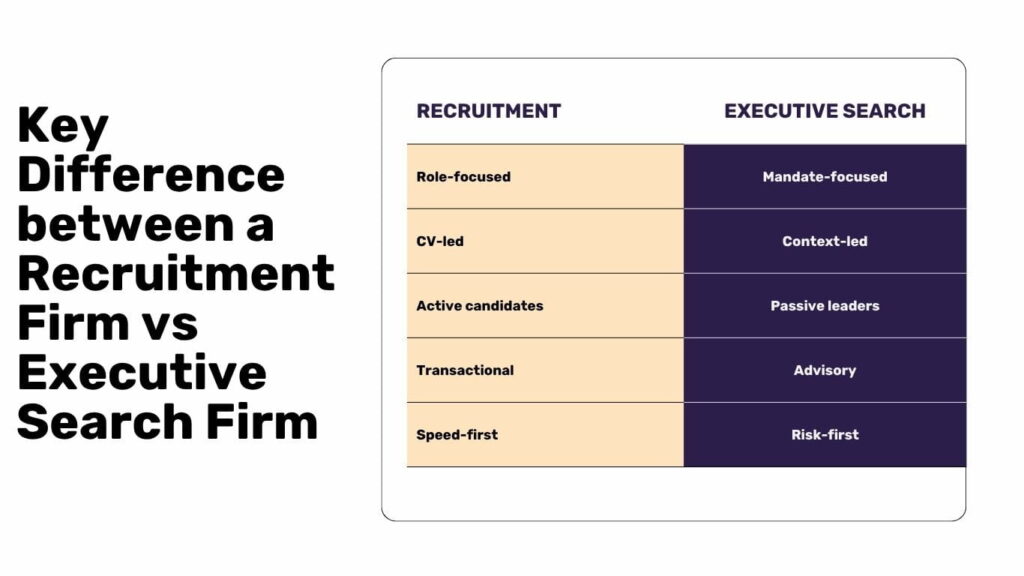
Once Boards internalise this difference, leadership hiring outcomes change materially.
When Recruitment Is Enough & When It Isn’t!
Recruitment works when:
- Leadership risk is low
- The role is well understood
- The organisation is stable
Executive search becomes critical when:
- Hiring CEOs, CXOs, or Board members
- The business is at an inflection point
- Strategy, culture, or governance is evolving
- Failure is expensive
Final Thought On Executive Seach Or Recruitment
Leadership hiring isn’t procurement.
The moment organisations stop asking:
“How fast can we hire?”
And start asking:
“Who should lead us through what comes next?”
outcomes change dramatically.
By moving beyond the assumption that senior leadership hiring is simply a faster or more expensive version of recruitment, organisations begin to see executive search for what it truly is — a structured, risk-managed approach to leadership decisions.
At Pipal Tree Services, our focus has always been on partnering with Boards and CXOs to identify mission-driven, purpose-aligned leaders who can translate organisational vision into real, measurable impact — especially when the stakes are high and the margin for error is low.
If you’d like to discuss how a structured executive search approach can strengthen your leadership hiring outcomes, I’d be happy to have a conversation.
You can reach me at [email protected] and we can have a conversation over a cup of coffee.
.