

Table of Contents
What Is Talent Mapping in India?
Talent mapping is the structured, ongoing discipline of understanding an organisation’s leadership capability (internally and externally) before the question of filling a specific role arises.
It operates across 3 levels:
1. Internal bench assessment (who is genuinely ready now versus in 12–18 months),
2. External market intelligence (where the best leaders in your sector are and what it would take to engage them), and
3. Future needs forecasting (what leadership capability the business will need that it does not currently have).
If you are thinking that talent mapping is succession planning, it is NOT – Talent mapping is what makes succession planning honest and real.
Every leadership transition in India follows one of two patterns.
1st: A board or founder identifies a gap 6 to 12 months before it becomes critical, maps the internal bench, benchmarks against the external market, and makes a considered decision – external hire, internal development, or structured transition. The new leader walks in with context, authority, and time to build.
2nd: A senior leader resigns, retires, or is asked to leave. The organisation scrambles. A search begins under pressure. The mandate is defined in days rather than weeks. The chances of the wrong candidate getting appointed is more because the right one was not already in conversation. Eighteen months later, the role reopens.
The difference between these two patterns is not luck. It is talent mapping.
This guide covers what talent mapping actually is in the context of Indian leadership hiring, why the distinction between talent mapping and succession planning matters, how it connects to the executive search process, and the five-step framework that turns it from a slide-deck exercise into a genuine leadership intelligence capability.
What Talent Mapping Actually Is And What It Is Not
Talent mapping is not a spreadsheet of names.
It is the structured, ongoing discipline of understanding your organisation’s leadership capability – internally and externally – well before the question of filling a specific role arises.
In practice, it operates at three levels simultaneously.
Internal Talent Intelligence
Who are your current high-potential leaders
What roles are they genuinely ready for now, versus in 12–18 months with the right exposure
Where are the single points of failure – roles where one departure creates an immediate crisis with no credible internal successor?
External Market Intelligence
Who are the strongest leaders in your sector, function, and geography?
Where are they currently placed?
What is the compensation reality for the roles you will need to fill?
Which organisations in India develop the profiles you want?
Future Needs Forecasting
Given your business strategy for the next three to five years – new geographies, new product lines, scaling headcount, PE investment, IPO – what leadership capability will you need that you do not currently have?
Pipal Tree Insight : The Most Important Distinction
Succession planning asks: "who takes over when this person leaves?" Talent mapping asks: "what does our leadership capability look like against what the business needs to become?" The first is reactive framing with a proactive label. The second is genuinely strategic.
Why Talent Mapping Has Become Non-Negotiable in India
India’s leadership market has a structural tension that most boards are still underestimating.
Demand for strong CXO and senior leadership talent has never been higher – driven by PE-backed growth, GCC expansion, IPO pipelines, MNC India operations scaling rapidly, and the professionalisation of family businesses happening simultaneously across the mid-market.
And yet the supply of genuinely transformational leaders is constrained. The best of them are deeply embedded in their current roles, not looking, and not reachable through job boards or contingency recruiters. Reaching them requires relationships, credibility, and time – none of which exist when the search begins in crisis.
According to Deloitte India’s Talent Readiness Study 2025, covering 156 organisations across manufacturing, services, and life sciences, 78% of Indian organisations have now institutionalised formal succession management frameworks, up from 72% the prior year.
But the same study found that only 9% of those organisations use AI or data tools in their succession management process, and 74% report minimal data use overall.
The gap this reveals is significant: most Indian organisations have succession plans, but very few have the market intelligence to know whether those plans are realistic.
A name on a succession slide is not talent mapping.
It is a hypothesis.
Talent mapping is what tests that hypothesis against reality.
“The organisations that call us when a role opens are starting from zero – no shortlist, no market intelligence, no relationships with the passive candidates they actually need.
The ones that engaged us six months earlier are starting with all three.
The outcome difference is not the quality of the search.
It is when it started”
Leadership Trends
4 Forces Making Talent Mapping Urgent in India Right Now
PE investment is reshaping leadership timelines
Private equity and growth equity investment into India’s mid-market is running at record levels.
USD 33 billion in PE-VC investment was deployed in India in 2025.
Every PE investment triggers a governance and leadership audit within the first 100 days. Investors do not wait for natural succession – they accelerate it.
Organisations without a mapped leadership bench discover this at the worst possible moment: when the mandate is set by the investor’s timeline, not the organisation’s readiness.
The GCC expansion is creating new leadership demand curves
India now hosts more than 2,117 Global Capability Centres employing 2.36 million professionals.
GCCs are not just adding headcount – they are adding leadership complexity. The mandate for a GCC technology or operations leader in 2026 is fundamentally different from what it was in 2020.
Organisations that haven’t mapped the evolving talent pool for these roles are consistently surprised by how long it takes to find the right profile.
Our GCC Leadership Hiring guide covers the specific assessment challenge in detail.
The IPO pipeline is creating board-level governance pressure
A company preparing for an RHP filing needs leadership that reflects the governance of a public company – not the governance of the private company it was two years ago.
The CFO, CXO layer, and board composition all face scrutiny. The organisations that manage this smoothly are the ones that started the talent and board mapping exercise 12–18 months before the DRHP was filed.
The ones that scramble are the ones that discovered the gap during merchant banker due diligence.
CXO hiring risk is highest post-hire, not during assessment
This is the insight that most talent planning frameworks miss.
CXO hiring rarely fails during executive assessment or stakeholder interviews – the real risk emerges post-hire, when leadership effectiveness is tested by scale, ambiguity, and the organisation’s evolving operating model.
Organisations with no prior mapping enter a new leader’s first 90 days with no baseline against which to measure integration.
Organisations with a talent map already know what success looks like at 12 months, because they defined it before the search began.
Talent Mapping vs Succession Planning: The Distinction That Matters
These terms are used interchangeably in most Indian organisations. They should not be.
| Dimension | Succession Planning | Talent Mapping |
| Primary question | Who replaces this person? | What does leadership capability look like vs what the business needs to become? |
| Trigger | Anticipated departure or vacancy | Strategic planning cycle |
| Scope | Specific role | Organisation-wide + external market |
| Output | Names on a list | Intelligence – internal bench + external landscape |
| Risk it addresses | Continuity | Strategic capability gaps |
| Validity | Until the named successor leaves | Ongoing – refreshed every 6–12 months |
The Critical Failure Mode
Organisations name an internal successor, develop them for 18 months, and then discover – when the external market is finally mapped – that the internal candidate is significantly below the standard of what’s available externally, or that the role has evolved beyond what the named successor was developed for.
Talent mapping doesn’t replace succession planning.
It makes succession planning honest.
How Talent Mapping Connects to Executive Search
When an executive search begins from zero i.e.
– No prior market mapping,
– No intelligence on the passive talent pool,
– No benchmarking of the internal candidate against external options,
The search in this case is longer, the mandate definition is weaker, and the final shortlist is more likely to reflect who the search firm could reach quickly rather than who the best available candidates actually are.
When an executive search begins from a talent map, three things change:
-
The Mandate Is Sharper
Benchmarking internal capability against the external market reveals what the role actually requires. The organisations that write the most unrealistic role specifications are almost always the ones that haven’t done prior market mapping. They define the job description in a vacuum and then wonder why the shortlist surprises them.
-
The Search Is Faster
A talent map identifies where the strongest passive candidates are before the search mandate is even signed. The first weeks of a retained search - which in a cold start are spent on market orientation and initial outreach - are compressed or eliminated. At Pipal Tree, we target 14 days to first candidates on retained mandates, a timeline that becomes reliably achievable when the talent landscape is already understood.
-
The Shortlist Is Better
A cold search produces whoever is reachable in the time available. A search preceded by talent mapping produces the best available candidates, because the mapping has already identified who they are and built the early-stage relationship required to engage them. The distinction between these two shortlists is not always visible on paper. It becomes visible in year two of the new leader’s tenure.
The Talent Mapping Process at a Glance
The 5 steps below follow a logical sequence – each one builds on the last. The flow below shows how business strategy translates into a functioning leadership pipeline.
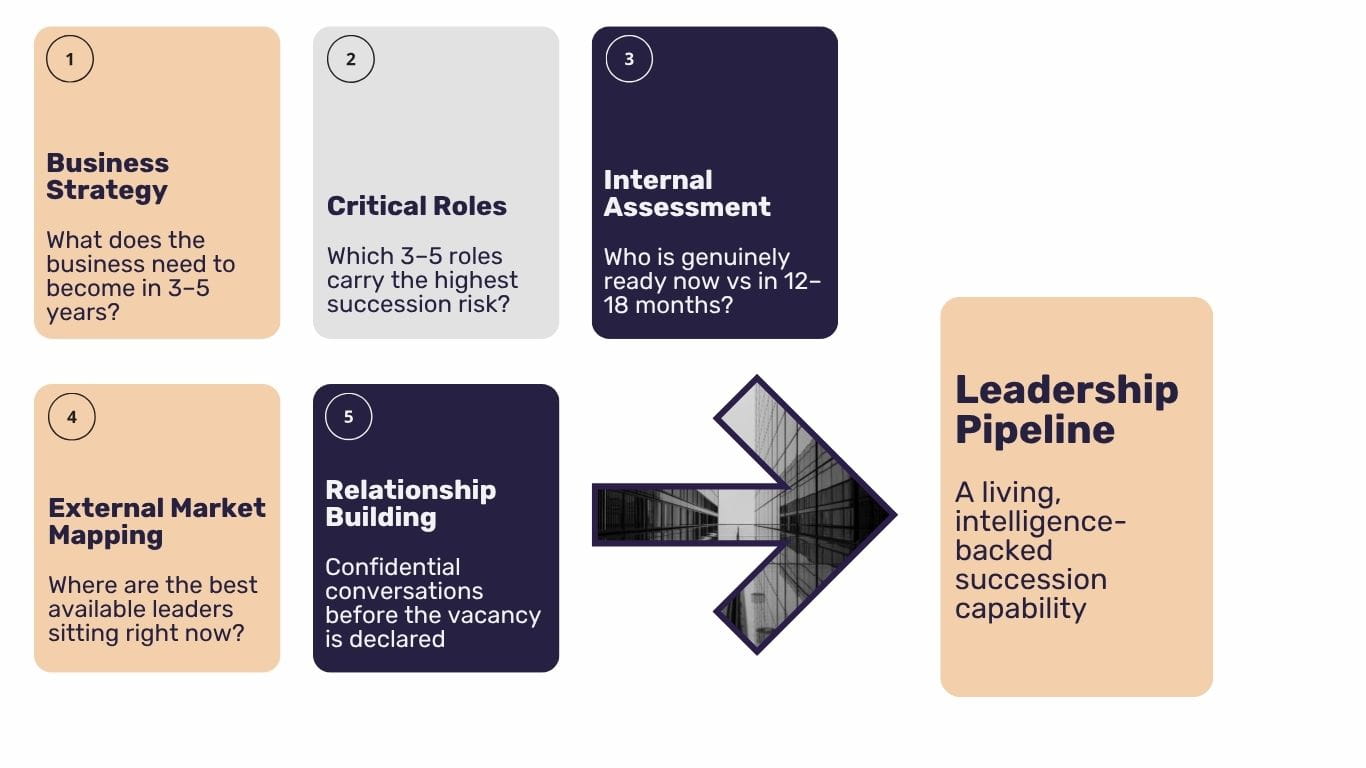
The 5 Step Talent Mapping Framework
Step 1: Define the Critical Roles - Not All Roles
Talent mapping everything is talent mapping nothing. Start with the roles where a sudden departure would create an immediate business impact:
- The India MD at a mid-market MNC manufacturer.
- The CFO at a family business preparing for PE investment.
- The engineering leader at a GCC scaling from 200 to 500 people.
- The CRO at a growth-stage B2B company approaching Series B.
These are the roles where mapping pays back the investment within the first search cycle. For most mid-market organisations, 3 to 5 critical roles is the right scope for an initial mapping exercise.
Step 2: Assess Internal Bench Strength Honestly
Most internal talent reviews err toward optimism - they assign "ready now" or "ready in 12 months" ratings that reflect what managers want to believe rather than what the evidence supports.
According to Deloitte India’s Talent Readiness Study 2025, 89% of companies actively develop identified successors, with 86% using job rotations to build leadership depth.
What the study doesn’t capture is how many of those successor assessments have been tested against the external market.
A rigorous talent mapping process tests internal bench strength against external benchmarks: not "is this person ready?" but "are they ready relative to what’s available externally at this compensation level?
Step 3: Map the External Talent Landscape
This is the step that most succession planning exercises skip entirely and most talent mapping articles describe inadequately.
External mapping is not a LinkedIn search. It is a structured exercise in identifying which organisations in India currently develop the profile of leader you need, where those leaders are in their career trajectories, what they earn, and what it would take to initiate a meaningful conversation.
For a manufacturing India MD role, this means mapping talent across Indian industrial conglomerates, other MNC subsidiaries in adjacent sectors, and sector-specific talent pools.
For a GCC technology leader, this means understanding which GCCs in India have produced the specific combination of global credibility and India depth the role requires.
Step 4: Build Relationships Before You Need Them
The leaders you will want to hire in 18 months are somewhere specific right now. They are not looking. They will not respond to a cold InMail from a recruiter they do not know. But they will respond to a thoughtful, confidential conversation with a search partner who has earned credibility in their professional network - if that conversation happens before urgency creates pressure.
This is where the intelligence gathered in Steps 1–3 becomes commercially valuable.
What does this leader want their next chapter to look like?
What would make them consider a move they have not yet considered?
What would they need to see in a mandate to feel the opportunity was worth the disruption of leaving a role they are comfortable in?
These questions cannot be answered by a database or an AI tool. They require conversations, built over time, that only search practitioners with genuine market relationships can have.
Step 5: Review and Refresh Every 6–12 Months
A talent map has a shelf life. The Deloitte India study found that 86% of organisations use job rotations to develop successors - and those rotations change the internal bench picture every time they happen.
External candidates move roles, accept promotions, or become unavailable. Market compensation benchmarks shift. The talent map accurate in January may be misleading by October.
The organisations that derive the most value from talent mapping are the ones that treat it as a continuous intelligence function, not a one-time project. The cadence for most mid-market organisations: a full refresh annually, with a lighter review of the critical-roles list every six months.
“The talent map does not find the candidate. It earns the right to make the call.
By the time we reach out to the right person, we already know what they have built, where they are in their career, and what it would take to make the conversation worth their time.
The search itself is the last thirty days of a process that began twelve months earlier.”
Common Mistakes Companies Make in Talent Mapping
Talent mapping is straightforward in principle and consistently mismanaged in practice. These five mistakes account for the majority of failed talent mapping exercises we have seen across Indian organisations of all sizes.
Mistake 1: Treating It As A One-Time Project
The most common failure mode.
A board commissions a talent mapping exercise, receives a slide deck, and considers the job done. Twelve months later, the map is stale – candidates have moved, the internal bench has changed, and compensation benchmarks no longer reflect the market.
The organisations that derive real value from talent mapping treat it as a continuous intelligence function, not a deliverable. The cost of starting an executive search from scratch after a stale map has failed to surface the right candidate – is always higher than the cost of keeping the map current.
Mistake 2: Ignoring External Benchmarks
Internal talent reviews are only as valuable as the external standard they are tested against.
A succession plan that assesses internal candidates without benchmarking them against what’s available externally is an internal opinion, not market intelligence.
We routinely see organisations that were confident in their internal succession plan change course entirely once the external mapping is complete. Getting the role definition right before the search begins – including what the external market considers standard for this function and seniority – is covered in our guide to executive job descriptions for senior India roles.
Mistake 3: Mapping Too Many Roles
The instinct to be comprehensive produces a map that covers everything and monitors nothing.
When every leadership role is on the map, no role receives the depth of intelligence it deserves.
The right scope for most mid-market organisations is three to five roles where a sudden departure would create an immediate and significant business impact.
Start there, derive the value, then expand.
Mistake 4: Confusing Succession Planning With Talent Mapping
Naming an internal successor is not the same as understanding the leadership landscape. Succession planning answers the continuity question.
Talent mapping answers the strategic capability question.
The difference is covered in the comparison table earlier in this guide – but the practical consequence of confusing the two is that organisations believe they have a talent strategy when they have a name on a slide.
When the search eventually opens, they discover the name was a hypothesis. For the fuller picture of what specialist executive search brings to this process, our guide to the top executive search firms in India covers what to look for in a search partner.
Mistake 5: Failing To Refresh The Map Regularly
A talent map has a shelf life of six to twelve months.
In India’s current market – where PE investments are reshaping companies, GCC mandates are evolving, and senior professionals are being actively courted – the external landscape changes faster than most organisations expect.
The candidate who was available and interested nine months ago may have accepted a promotion, been counter-offered, or started building something of their own.
Refresh cadence is not optional; it is the mechanism that keeps the map from becoming a false sense of security.
Pipal Tree Insight : The Pattern We See Most Often
Organisations that treat talent mapping as a one-time exercise are the ones that call us with urgent, pressure-driven mandates. The timeline they face is not the result of bad luck. It is the accumulated cost of six to twelve months of map staleness, combined with a vacancy they did not see coming but could have. The organisations that call us to begin a mapping exercise are the ones whose next search will take fourteen weeks, not six months.
Where Talent Mapping Has the Most Impact: India-Specific Contexts
Family businesses approaching professionalisation
The CFO transition in an Indian family business – from a trusted finance head to a professional CFO – is one of the most consequential leadership decisions the promoter will make.
The right candidate for this role is almost never looking. They are 5+ years into a stable role at another company that has already navigated this journey.
Mapping the available candidate pool 12–18 months before the transition is triggered is what makes the difference between a 16-week search and a 6-month one. Our Family Business CFO Transition guide covers the specific hiring dynamics in detail.
MNC manufacturers hiring India leaders
The India MD or Country Head for a global manufacturer is a role where the search consistently stalls – six to nine months, strong candidates declining, offers not landing – when the search begins without prior market mapping.
The manufacturing-to-commercial bridge profile that these roles require is rare. Knowing where those profiles exist before the vacancy is declared compresses a search that otherwise takes too long to serve the business. Our guide to how global companies hire senior leaders for India operations covers the broader context.
GCCs scaling from execution to strategic leadership
GCC leadership hiring in 2026 is a different problem from GCC hiring in 2020. The centres have evolved; the leadership mandate has evolved faster.
Mapping the available talent pool for a GCC VP Engineering or Head of AI Research role requires understanding which GCCs in India have genuinely built the capability these profiles represent – not just who has the right title on LinkedIn.
Growth-stage companies approaching Series B and beyond
At Series A and early Series B, founders often find that the leaders who built the business to this point are not the leaders who can scale it to the next stage. Talent mapping at this inflection point – across functional heads, CXO layer, and board – gives boards and investors a clear picture of where the capability gaps are and how long it will realistically take to close them through either internal development or external hiring.
How Pipal Tree Approaches Talent Mapping
Our talent mapping practice is built on the same market intelligence, passive candidate relationships, and sector-specific knowledge that underlies our executive search work.
The two capabilities reinforce each other – every search adds to our understanding of the talent landscape, and every talent mapping engagement makes the eventual search sharper.
We work with CHROs, founders, boards, and PE investors on talent mapping exercises covering manufacturing and industrial leadership, GCC and technology leadership, family business professionalisation, and CXO succession planning for companies on IPO timelines. For the executive search process and Board Member hiring, these mapping capabilities are integrated into every retained mandate.
To discuss where your organisation’s leadership bench stands relative to what the business needs to become over the next three years, reach out to Rahul Bahuguna at [email protected].
Frequently Asked Questions On Talent Mapping in India
What is the difference between talent mapping and succession planning?
Succession planning asks who takes over a specific role when it becomes vacant. Talent mapping asks what the organisation’s overall leadership capability looks like relative to what the business needs to become. Succession planning is a subset of talent mapping – and it is made meaningfully more reliable when grounded in actual market intelligence rather than internal assumptions.
How long does a talent mapping exercise take?
A focused talent mapping exercise covering three to five critical roles typically takes six to ten weeks – including internal bench assessment, external market mapping, compensation benchmarking, and initial relationship-building with key passive candidates. It is not a one-time exercise; the value compounds when refreshed every 6–12 months.
Who should lead the talent mapping process internally?
The CHRO or senior HR leader should own the internal bench assessment. The external market intelligence and passive candidate engagement – which require market access, trusted relationships, and sector-specific knowledge – are most effectively handled by a retained executive search partner with genuine depth in the relevant sector and geography.
How does talent mapping connect to the executive search process?
A talent mapping exercise conducted 12–18 months before a likely leadership transition compresses the eventual search significantly, sharpens the mandate definition, and improves shortlist quality. See our guide to how executive search works for the full process context. The organisations that achieve the fastest and strongest outcomes in executive search are almost always the ones that did not start the search when the vacancy was declared.
Does talent mapping make sense for mid-sized Indian companies, or only large organisations?
It makes most sense for mid-sized companies – precisely because they have fewer resources to absorb the cost of a long, failed search. A mid-market manufacturer, a PE-backed services company, or a family business approaching professionalisation has more to lose from a six-month leadership gap than a large conglomerate with redundant capability. The talent mapping investment is calibrated to the number of critical roles, not the size of the organisation.
What should we look for in an executive search partner for talent mapping?
The right partner has genuine market presence – relationships with passive candidates built over years of search work in your sector, not just a database. They can tell you specifically where the best available candidates for your critical roles are today, what they earn, and what it would take to engage them. Hold any search partner to this standard before signing an engagement: if they cannot answer those questions at the outset, they are describing talent mapping as a service without having the underlying intelligence to deliver it.
These FAQs cover the most common questions if you are working on to hire senior leaders for India
For a more comprehensive breakdown, including questions on fees, timelines, guarantees, and how the executive search process works step by step, visit our detailed Executive Search FAQ.
Why Pipal Tree is one of the top executive search firm in India
97% placement success rate across hundreds of leadership mandates.
50+ years of combined search experience across our founding team.
80% repeat engagement rate > our clients come back because our process works.
We combine the best practices of a global search firm with the entrepreneurial responsiveness and senior-partner involvement of a boutique consultancy.
The Right Time to Map Is Before You Need to Hire
Reactive recruitment fills positions.
Proactive talent mapping builds organisations that are never caught without a leader when they need one most.
The best time to map the talent landscape for your most critical roles is before the question of filling them becomes urgent. By the time the urgency arrives, the window for the right conversation with the right candidate has often already closed.
If you are a CHRO, CEO, board member, or founder thinking about where your leadership bench stands relative to what your business needs to become in the next three years, we would welcome the conversation.
So let’s talk!.
Write to me at [email protected]

Rahul Bahuguna
“With over two decades of experience across executive search, digital strategy, and business consulting, Rahul brings a unique entrepreneurial perspective as Director & Co-Founder of Pipal Tree Services. At Pipal Tree, Rahul leverages his background in strategy, market intelligence, and digital transformation to guide mission-aligned executive search and board mandates. He specializes in building long-term client partnerships, leading complex leadership searches, and shaping Pipal Tree’s distinct positioning at the intersection of talent and purpose. His ability to combine strategic insight with practical execution makes him a trusted advisor to organizations seeking leaders who can drive meaningful, sustainable change.”