

How Do You Hire a CPO (Chief Product Officer) for a Startup?
Hire a CPO by first confirming the role is real, that product strategy has become a company-level decision the founder can no longer own alone.
After that comes the step of assessing candidates on the decisions they have made, not the roadmaps they have run: what they killed and why, which bets they defended to a board, and which product calls moved activation, retention, or revenue.
A CPO sets the roadmap and owns the reasoning behind it;
A VP Product executes one already set.
The title has become one of the most misapplied in Indian startups. We have seen case of the title handed to a strong VP Product but without the mandate that comes with it, or filled by a big-company import before product-market fit exists.
Both are expensive mis-hires, and both come from confusing the title with the role.
This guide gives founders, boards, and venture investors a framework for what a startup CPO actually is, how the right profile shifts from seed to growth stage, and how to assess one – or recognise when the role should not be opened yet.
Table of Contents
Two mistakes define almost every failed CPO hire in an Indian startup, and they pull in opposite directions.
The first: a strong VP Product is promoted to CPO after two or three years of reliable, well-organised shipping. Nothing changes except the title – not the mandate, not the authority, not the reporting line.
At the next board meeting, an investor asks what the product vision is for the coming eighteen months and how it holds up against a better-funded competitor.
The founder answers.
The newly titled CPO was never asked to think at that altitude, and nothing about the promotion changed what she was actually accountable for.
The second: a polished product leader joins from a well-resourced global technology company, with a sharp prioritisation framework and a beautifully built roadmap deck.
Within two quarters, engineering has stopped trusting the roadmap, and the company is no closer to knowing whether anyone outside the founder’s own network wants the product. The frameworks were real.
The environment they were built for was not this one.
Both are real.
Both are common.
Neither is a startup CPO.
The confusion is understandable – a strong VP Product is often the most capable person in the product function, and a big-company product leader has genuine pedigree. But the CPO role asks for a set of capabilities that neither roadmap-execution experience nor scaled-environment experience reliably develops.
Getting the hire right starts with being precise about what the role actually is, how it differs from a VP Product and a CTO, and how the right profile changes as a company moves from seed to growth stage – which is what this guide works through.
It builds on our guide to CTO vs CPO vs CPTO: Which Leadership Structure Is Right for Your Company?
What Is a Chief Product Officer?
The Chief Product Officer is the senior executive accountable for product strategy, vision, and execution. In a startup, the CPO holds the roadmap, owns the trade-offs, and carries accountability for whether the product moves the numbers that matter. What separates the role from a strong product manager or VP Product is altitude: the CPO is not there to run the roadmap well, but to decide what the roadmap should be and why – and to defend that reasoning to the board.
At startup stage, four responsibilities carry the weight:
#1. Product Strategy & Roadmap Ownership
Setting direction, not just sequencing a backlog.
#2. Product-Market Fit & Go-To-Market
Owning whether the product finds its market, and how it reaches it.
#3. Cross-Functional Authority
#4. Commercial & Board Accountability
Why Product Leadership Decides Whether a Startup Survives
Product leadership is usually treated as a growth lever, the function that makes a good business better.
That framing understates it.
In most startups that fail, the product decisions made months or years earlier are the reason the cash eventually ran out, not a separate problem from it.
Building something the market did not urgently need, entering at the wrong moment, or scaling before the economics worked are product calls before they are financial ones – and they sit squarely inside the CPO’s mandate, or the founder’s, if no CPO exists yet.
Poor product-market fit (43%), bad timing (29%), and unsustainable unit economics (19%) were the leading root causes behind startup failure in CB Insights’ analysis of post-mortems from 431 shut-down companies – the underlying reasons capital ran out, not simply the fact that it did. (CB Insights, “Why Startups Fail”)
Nor is this only a seed-stage risk. Two-thirds of product-market-fit failures were early-stage companies that never found a market – but a meaningful number of Series B and later companies failed on fit too, having raised on early traction that never widened into a real market. A company can raise capital and still be building something nobody urgently needs.
The Indian market is now pricing this in directly.
As funding tightened through 2025, investors shifted from rewarding growth to demanding proof of fit. Reporting on Tracxn data via TechCrunch, seed-stage funding fell around 30 percent even as early-stage funding rose – with capital increasingly flowing to founders who could demonstrate stronger product-market fit, revenue visibility, and unit economics.
In that environment, product leadership is not a back-office function. It is close to what the next round is underwritten against.
CPO vs VP Product vs CTO: The Distinction That Matters Most
The most common product-leadership mis-hire in a startup is not hiring the wrong person on skill. It is hiring a strong VP Product, giving them a CPO title, and expecting company-level product strategy to appear – when nothing in the mandate, the authority, or the reporting line has actually changed.
The two vignettes that open this guide are the two patterns that account for most startup CPO mis-hires.
The confusion is understandable – a strong VP Product is often the most capable person in the product function. The problem is not competence.
The problem is that the CPO role asks for a set of capabilities that roadmap-execution experience does not, on its own, develop.
| Dimension | VP Product | Chief Product Officer |
| Scope | Executes a defined roadmap | Sets the roadmap and the reasoning behind it |
| Authority | Operates within product strategy | Sets product strategy; reports to CEO / board |
| Cross-functional | Coordinates with engineering and design | Owns the engineering–design–growth trade-offs |
| Metrics | Ships features on time | Owns activation, retention, and revenue outcomes |
| Board exposure | Rarely presents | Defends roadmap and product bets to the board |
| Relationship to CTO | Not applicable | Owns what and why; CTO owns how, technically |
CPO vs CTO: Who Owns What
This is the single most common source of confusion in Indian startups, and it is worth stating plainly. The CPO owns product decisions and product outcomes – what to build, for whom, in what order, and whether it worked. The CTO owns technical architecture and engineering execution – how it is built, how it scales, and how the team delivers it. In a healthy startup, these are two peers who disagree productively, not one person wearing both hats, and not a hierarchy where one reports to the other by default.
Where a company genuinely needs both functions under one leader, that is a distinct role – the CPTO.
Also read: CTO vs CPO vs CPTO: Which Leadership Structure Is Right for Your Company?
I have sat across the table from founders who promoted their best product manager to Chief Product Officer and could not understand, six months later, why the board still had no answer on where the product was headed. The manager had not changed. The mandate never did either – only the title did.
A CPO who cannot say no to a founder’s pet feature is not a Chief Product Officer, whatever the offer letter says
Should a Startup Hire a CTO or a CPO First?
This is one of the most common questions founders bring to a leadership search, and the honest answer is a decision framework rather than a fixed rule.
The right first hire depends on where the company’s binding risk actually sits.
-
Hire a CTO first when the core risk is technical feasibility - deep-tech, infrastructure, or AI/ML-heavy products where "Can we build this at all" precedes "What should we build".
It is also the right call when a founder already carries strong, informal product judgment, and the real gap is engineering leadership rather than product direction.
-
Hire a CPO first when the core risk is market and product-fit ambiguity - the team can build competently, but has not yet converged on what to build or for whom.
This is common in founding teams that are strong commercially or operationally but lack a natural product instinct at the top
-
Neither yet is often the honest answer before product-market fit.
A strong senior product manager or founder-led product, paired with a capable engineering lead, is frequently the right-sized answer before either C-suite title is warranted.
The pattern seen most often is that Series A and Series B startups hire a CTO before a CPO, because technical execution risk is usually funded and staffed before product-strategy risk becomes the binding constraint.
But the reverse is increasingly common in AI-native products, where the product bet – what the AI should do, and for whom – is the real risk, not the engineering.
3 Questions to Answer Before Writing the Job Description For CPO
The clarity of a CPO search is set before the first candidate is approached or even before you get writing the job description for the role. Three questions, answered honestly, do more to determine the outcome than any sourcing strategy when it comes to hiring a CPO.
Question 1: What decisions can this person actually make without founder sign-off?
Not the authority described in the offer letter – the operational authority in practice.
For example :
Can the CPO kill a feature the founder is attached to?
Reprioritise the roadmap without a meeting?
Own the product-metric targets outright?
Senior candidates probe this carefully, because they have seen peers join on an inflated mandate and leave within eighteen months when the reality was narrower.
Question 2: Who do Design and Growth report to, and does Product have real authority over the roadmap?
A CPO with responsibility for product outcomes but only influence, not authority over the functions that shape those outcomes, is set up to under-deliver.
Reporting-line ambiguity is among the most common reasons strong product leaders decline offers, because they read it as a predictor of whether they will actually be able to operate.
Question 3: What does success look like at 6 and 12 months?
Generic definitions attract generic candidates.
A brief that says take activation from 22% to 40% within two quarters, or ship and validate the second product line by year-end, attracts candidates who have done precisely that – and repels those who have not.
The specificity is the filter.
The Startup CPO’s Mandate: 3 Domains
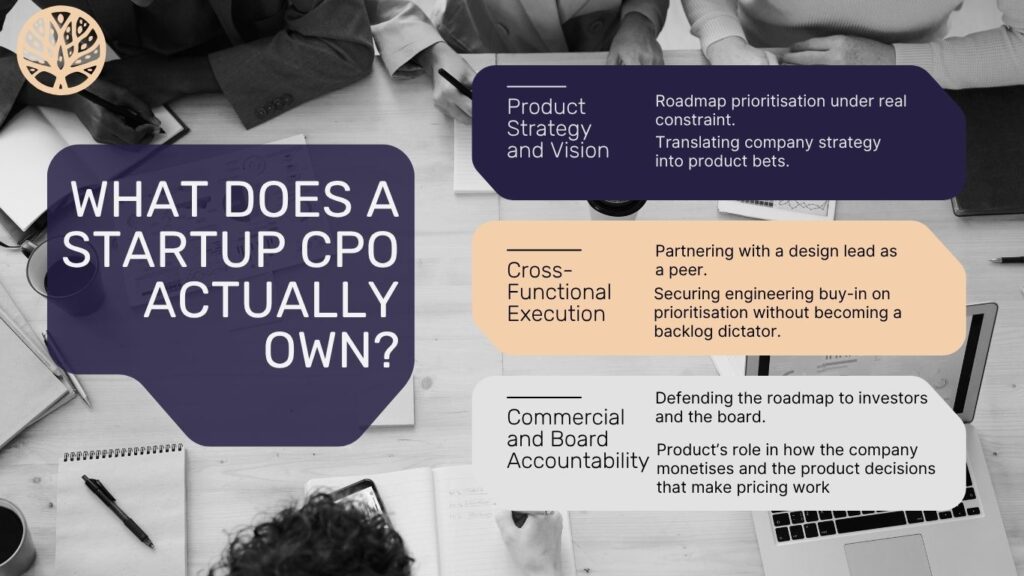
The startup CPO’s role groups into three domains – product strategy and vision, cross-functional execution, and commercial and board accountability.
Each contains demands that a startup specifically creates, and that most roadmap-execution backgrounds do not fully develop.
Domain A: Product Strategy and Vision
A1. Roadmap prioritisation under real constraint
Not a wishlist ranked by effort and impact scores, but genuine trade-off decisions with a named opportunity cost – building this means not building that, and here is why that is the right bet given where the company is going. In a startup, the constraint is real and the cost of the wrong bet is measured in runway.
Assessment Question To Hire A CPO
Describe a product bet you killed or deprioritised despite internal pressure to build it. What was your reasoning, and with hindsight, were you right?
A2. Translating company strategy into product bets
The CPO converts an abstract company strategy – win the mid-market, become the system of record, expand into an adjacent segment – into a sequence of product decisions that actually get the company there. This is the work that most clearly separates a CPO from a VP Product.
Domain B: Cross-Functional Execution
B1. Design partnership
Not managing designers, but partnering with a design lead as a peer – holding a shared standard for product quality and user experience without collapsing design into a service function that simply executes product’s wireframes.
B2. Engineering trust
Securing engineering buy-in on prioritisation without becoming a backlog dictator. The CPO who can win an engineering team’s confidence that the roadmap reflects real reasoning – rather than the loudest customer or the founder’s latest idea – is a fundamentally different asset from one who simply hands down a list.
B3. Growth and go-to-market alignment
Product-led growth mechanics, activation funnels, and ownership of the metrics that growth and marketing teams are also measured against. In a startup, product and growth are not separable, and the CPO must operate across that seam rather than throwing features over a wall.
Assessment Question To Hire A CPO
Give me an example of a product decision that improved a growth or retention metric the growth team owned. How did you align the two teams, and what was the outcome?
Domain C: Commercial and Board Accountability
C1. Defending the roadmap to investors and the board
Translating product bets into business outcomes a board actually cares about – and holding the line on a considered bet under the pressure of a board that may want faster, safer, or more visible results. A CPO who cannot articulate the commercial logic of the roadmap will find it steadily overruled.
C2. Pricing and packaging input
Product’s role in how the company monetises – packaging, tiering, and the product decisions that make pricing work – rather than treating monetisation as purely a commercial-team problem downstream of whatever product ships.
C3. Product-market fit iteration
The specific skill of reading signal and knowing when to pivot versus persist, backed by a repeatable way of interpreting evidence rather than instinct alone. Given that poor product-market fit is the single largest root cause of startup failure, this is often the most valuable thing a startup CPO does.
Assessment Question To Hire A CPO
Describe a time you concluded the product was not working and changed direction.
What signal drove the decision, and how did you separate it from noise?
Stage-Specific Guidance: The Right CPO Changes With the Company
The single most common strategic error in startup product hiring is treating CPO as one role.
The right profile and whether the role is warranted at all, depends heavily on the company’s stage.
A CPO who is ideal at Series B can be actively wrong at seed, and a scrappy Series A product leader can hit a ceiling by growth stage.
| Stage | Product Leadership Need | Right CPO Profile |
| Seed | Founder-led product; rarely needs a CPO yet | If hired at all, a hands-on 0-to-1 builder – not a strategist with a team |
| Series A | Searching for or deepening product-market fit; needs judgment more than process | A CPO who still writes specs and talks to users directly, not only runs roadmap reviews |
| Series B | Scaling what works; multi-product or multi-segment expansion begins | A CPO who can build a product org while still owning strategy |
| Growth | Multiple product lines, board accountability, monetisation sophistication | A true C-suite peer – board-ready, commercially literate, managing other product leaders |
Seed Stage
The product vision is usually the founder’s, and it should be. Hiring a CPO here often removes the founder from the product conversation prematurely - the classic mistake. If a senior product hire is warranted, it is a builder who can turn the founder’s vision into a shipped product, not a strategist who needs a team and a mandate to be effective.
Series A Stage
The company can build, but has not fully converged on what to build for whom. This is where product judgment matters more than product process. The right CPO is still close to the work - writing specs, talking to users, making calls - not managing a layer of PMs from a distance.
Series B Stage
What works is being scaled, and expansion into new products or segments begins. The CPO now has to build a product organisation - hiring and structuring PM teams - while continuing to own strategy. The profile shifts from individual product judgment toward organisational leadership without losing the former.
Growth Stage
Multiple product lines, real board-level accountability, and monetisation complexity require a CPO who operates as a genuine C-suite peer. The risk at this stage is the opposite of the seed-stage mistake: keeping a strong Series A–calibre CPO in the seat past their capability ceiling.
In practice : Growth-Stage Fintech | Series C, three product lines
A CPO who had been exceptional since Series A - close to users, fast, instinctive - was kept in place through a Series C round and a second product line launch. The board began asking for monetisation modelling and cross-product prioritisation the CPO had never had to do at this scale, and had no team of product leaders reporting in to help carry it. The company spent two quarters compensating for a gap everyone could see but nobody had planned for. Key insight: Loyalty to a proven operator is not the same as fit for the next stage.
AI Product Leadership: The New Baseline Expectation
The definition of a competent product leader has shifted. A startup CPO hired today is expected to bring fluency in building AI-native products – not as a specialist add-on, but as part of the baseline. Five expectations now sit inside the standard CPO profile.
- AI-native product thinking – building products where AI is the core mechanism, not a feature bolted onto an existing workflow.
- LLM integration judgment – knowing when a large language model is the right tool versus deterministic logic, and understanding the cost, latency, and reliability trade-offs.
- AI product strategy – roadmapping under genuine capability uncertainty, where the underlying model may improve mid-roadmap.
- AI experimentation discipline – running structured evaluations for probabilistic systems, not just conventional A/B tests on deterministic features.
- Human-in-the-loop design – knowing where to keep a human decision point for trust, safety, or accuracy, rather than pursuing full automation for its own sake.
Assessment Question To Hire A CPO
Describe an AI feature you shipped, killed, or scoped down because of a reliability or trust concern. What did you change, and why?
A Note on GCC Product Leadership
The startup CPO profile described here is distinct from a Chief Product Officer in a Global Capability Centre. A GCC product leader typically inherits an existing India engineering organisation and must win a genuine product mandate against a global headquarters product team, rather than building the function from a founder’s vision. The context, the authority dynamics, and the assessment criteria differ meaningfully - a subject we cover separately in our guide to product leadership in Indian GCCs.
Five Red Flags in Startup CPO Candidates
The Feature Factory Leader
Ships quickly and keeps the team busy, but cannot articulate why any of it matters or how it connects to strategy. Motion without direction. Strong for a delivery-focused product role; wrong for a CPO seat meant to set direction.
The Framework Consultant
Fluent in every prioritisation model, with a polished deck for each - but has never actually shipped under real resource constraints. Strong on how product should work in theory; untested on making hard calls when the runway is short.
The Big-Tech Import
Excellent instincts, calibrated for the scale, budget, and specialisation of a large technology company the startup does not resemble. Struggles to operate lean, to wear several hats, and to decide without the supporting infrastructure they are used to.
The Frustrated Founder
A former CEO or co-founder who treats the CPO seat as a temporary stop on the way back to founding something, rather than a genuine partnership. The commitment is conditional, and it usually shows within the first year.
The Design-Only Product Leader
Strong product sense and genuine taste, but weak on the commercial and metrics ownership the role demands. An excellent Head of Design; the wrong choice for a CPO who must own activation, retention, and revenue outcomes to the board.
When NOT to Hire a CPO
A retained search firm advising against a hire is unusual, but the most common reason a startup CPO search fails is that the role should not have been opened yet. Four situations signal that a CPO is premature.
- The founder still owns every meaningful product decision. A CPO hired into that reality becomes a figurehead or leaves. Fix the willingness to delegate first.
- Product-market fit has not been established. Strategy leadership is premature when the core question is still whether anyone wants the product at all.
- Only one product manager exists. There is no team to lead yet; a strong senior PM, or the founder, is the right answer – not a Chief.
- Engineering drives product decisions by default. This is usually a process gap to close, not a reason for a C-suite title.
Each of these connects back to the earlier CTO-or-CPO-first question: the honest answer is often neither, not yet. Naming that early saves a startup an expensive, demoralising mis-hire.
How Pipal Tree Approaches Startup CPO Searches
Pipal Tree Services works with founders and venture-backed companies on product-leadership mandates, assessing candidates against the full CPO role this guide describes – strategy, cross-functional authority, and commercial accountability – rather than against a generic product-leadership checklist. We are equally willing to tell a founder that the role should wait, or that a strong VP Product is the right hire for now, because a well-defined search benefits everyone involved, including the candidate who eventually says yes.
To hire a CPO, reach out at [email protected]
“Founders ask us to find a Series B CPO for a Series A company more often than you would expect – someone who can run a fifteen-person product organisation before the company has proven anyone wants what it is building.
The right hire is almost always smaller and closer to the ground than the org chart founders imagine. Knowing that difference is most of the search.”
Frequently Asked Questions on Hiring a Startup CPO
When should a founder stop acting as the Chief Product Officer?
The trigger is rarely a stage or a headcount number – it is a set of signals. When product decisions are bottlenecking on the founder’s calendar, when the founder can no longer personally talk to every important user, or when the company is expanding into a second product line or segment at the same time, the founder’s direct ownership of product starts to cost more than it contributes. The right moment to bring in a CPO is when the founder’s product judgment needs to be scaled through someone else, not replaced.
What is the difference between a CPO and a VP Product?
A VP Product executes a defined roadmap well; a CPO sets the roadmap and owns the reasoning behind it, reports to the CEO or board, and is accountable for product-led business outcomes rather than delivery velocity. The titles are often used loosely, but the mandate, authority, and altitude are genuinely different – and hiring for the wrong one is the most common startup product mis-hire.
Does a Series A startup need a full CPO, or is a strong Head of Product enough?
Frequently a strong, hands-on Head of Product is the right hire at Series A, particularly if the founder still carries strong product judgment. A full CPO is warranted when product strategy has become a company-level constraint the founder can no longer own directly – when the roadmap needs an owner who sets direction, not just runs the process.
What should CPO compensation look like at a startup in India?
It varies widely by stage and funding, and the defining feature is the cash-versus-equity mix rather than the cash figure alone. At seed and Series A, cash is typically more modest – often in the range of ₹60 lakh to ₹1.5 crore – with meaningful equity, commonly between 0.5% and 2%, carrying the real upside. At Series B, total cash compensation more often sits in the ₹1.5–3 crore range alongside a smaller but still significant equity grant. At growth stage and in well-funded companies, a genuine C-suite CPO can command ₹3 crore-plus in total compensation, with equity weighted lower as cash rises. The right structure aligns the CPO’s upside with the product outcomes they are accountable for, rather than matching a corporate base-salary benchmark.
How is a startup CPO mandate different from a CPO at an established company?
A startup CPO usually builds the product function and often the product strategy itself, works founder-adjacent, operates with limited resources, and is compensated heavily in equity. A CPO at an established company typically inherits an existing organisation, a defined product portfolio, and established processes, and the role leans more toward scaling and optimisation than 0-to-1 creation.
Can a strong engineering leader transition into a CPO role?
Sometimes, with important caveats. A strong CTO or engineering leader who has genuinely owned product decisions – not just built what product specified – can make the transition. But product strategy, user and market judgment, commercial ownership, and cross-functional authority over design and growth are distinct competencies that engineering leadership does not automatically develop. Assess for demonstrated product judgment, not just proximity to product.
How long does a CPO search typically take?
A well-run retained search for a startup CPO typically takes 12 to 16 weeks from kick-off to an accepted offer, with the 60 to 90 day notice period standard at this level applying before the leader joins. Because strong CPO candidates are passive and the talent pool is contested, the search depends on mapping and approaching the right people rather than reviewing applications.
These FAQs covers the most common questions we hear when it comes to hiring a CPO for a startup in India.
For a more comprehensive breakdown, including questions on fees, timelines, guarantees, and how the process works step by step, visit our detailed Executive Search FAQ.
Why Pipal Tree is one of the top executive search firm in India
97% placement success rate across hundreds of leadership mandates.
50+ years of combined search experience across our founding team.
80% repeat engagement rate > our clients come back because our process works.
We combine the best practices of a global search firm with the entrepreneurial responsiveness and senior-partner involvement of a boutique consultancy.
Start With the Mandate, Not the Job Description
A CPO hired at the right moment, with real authority and a mandate matched to the company’s stage, can be the difference between a product that finds its market and one that never does. A CPO hired too early, without founder buy-in, or a stage ahead of where the company actually is, becomes an expensive distraction the company spends a year working around.
The startup CPO is one of the most consequential and most frequently mis-hired roles in a young company – because the profile is confused with both the VP Product and the CTO, and because the role is often opened before the company is ready for it.
Before writing a job description, the conversation worth having is which of the three domains your company genuinely needs at CPO level right now, at your stage – and whether a strong Head of Product, or simply the founder’s continued ownership, is the better answer for now.
If you are planning a product-leadership appointment, a short conversation about what the market looks like for your specific stage, product category, and city – before the search begins – is usually worth having. We have that conversation with founders regularly, with no obligation attached, because a well-defined search benefits everyone involved, including the candidate who eventually says yes.
So let’s start!
Just talk.
Write to me at [email protected]

Rahul Bahuguna
“With over two decades of experience across executive search, digital strategy, and business consulting, Rahul brings a unique entrepreneurial perspective as Director & Co-Founder of Pipal Tree Services. At Pipal Tree, Rahul leverages his background in strategy, market intelligence, and digital transformation to guide mission-aligned executive search and board mandates. He specializes in building long-term client partnerships, leading complex leadership searches, and shaping Pipal Tree’s distinct positioning at the intersection of talent and purpose. His ability to combine strategic insight with practical execution makes him a trusted advisor to organizations seeking leaders who can drive meaningful, sustainable change.”

[…] When workers feel undervalued, they become “active-passive”—they might not be applying today, but they are more likel…. […]