

What Is GCC Leadership Hiring in India?
GCC leadership hiring in India is the process of identifying and assessing senior leaders to establish, scale or transform a Global Capability Centre.
The right profile depends on the GCC’s mandate: a delivery centre requires a different leader from an innovation hub or a strategic, multi-function centre.
Beyond functional expertise, GCC leadership hiring increasingly requires assessment of strategic-operational balance, India–HQ cultural fluency, innovation capability, talent leadership and the authority to operate across organisational boundaries.
Table of Contents
Two companies.
Same sector.
GCCs in the same city, launched within six months of each other.
Three years later, one is a processing centre that headquarters would close tomorrow if the India contracts weren’t so difficult to unwind.
The other is generating product innovations that are being adopted globally. One of its India-originated ideas reduced the parent company’s customer acquisition cost by 18%.
Another is now being productised for external sale.
We have engaged with GCC leadership for both kinds of organisations. The single most consistent difference between the centres that transform and the ones that stall is not budget, location, or mandate.
It is the first leadership hire, who was hired, how the decision was made, and what qualities were actually being evaluated.
Hiring the leader for a Global Capability Centre in India is the single decision that most shapes whether the centre becomes a strategic asset or an expensive processing shop.
Yet it is the decision international companies most often get wrong – assessing candidates against a pre-built job description, a familiar pedigree and a compressed timeline, rather than against the mandate the GCC actually has to deliver.
This guide
This is not a guide to setting up a GCC in India – our 2026 GCC Setup Guide covers the structural, legal, and operational questions.
This guide is written for the CHRO, regional managing director or founder at a US or European company making that hire. It sets out what GCC leadership hiring in India really involves, the seven dimensions that separate a transformational leader from an operational one, and how to assess for them before you commit.
The Leadership Gap That Is Holding India GCCs Back
India’s GCC sector is in an extraordinary growth phase. According to Zinnov-NASSCOM GCC Landscape 2026 study, 2,117 GCCs now operate in India, employing 2.36 million professionals and generating USD 98.4 billion in annual revenue. More than 170 new GCCs were set up in 2025 alone.
And yet, leadership is the sector’s most acute constraint. EY’s GCC Pulse Report 2025 found that almost 80% of GCCs have less than 10% of leadership roles based in India. Despite a 40% annual growth in global leadership roles over the last five years, leadership pipelines are not keeping pace with the operational growth of the centres they are supposed to lead.
The data on what happens when leadership is wrong is equally clear. Some research have shown that roughly 30% of GCC country heads leave within 30 months of joining.
This is not a market attrition statistic – it is a hiring quality statistic.
Most of these early exits are not because the person was weak. They are because the mandate was under-defined, the authority structure was unclear, or the role was fundamentally miscalibrated between what the leader was hired to do and what the organisation was actually ready for.
The consequence of a wrong first GCC leader is not just losing the individual. It is 18 to 24 months of momentum loss, a damaged employer brand in India’s tight senior talent market, and a headquarters that has lost confidence in the centre – often permanently.
Delivery Centre vs Innovation Hub: the Decision That Shapes the Hire
The most important conversation to have before defining the GCC leadership profile is a question that most international companies believe they have already answered: what is this GCC actually for?
The two models, delivery centre and innovation hub, require fundamentally different leaders. The failure to choose between them clearly before the search begins is one of the most consistent predictors of a wrong hire. 64% of GCC site leaders now hold dual mandates combining global business unit ownership with site leadership, which signals that the industry itself is navigating this tension.
| Dimension | Delivery Centre | Innovation Hub |
| Primary mandate | Execute on HQ-defined roadmap efficiently | Co-own product and strategy decisions with HQ |
| Leader profile | Strong operator, process-driven, delivery-focused | Transformer, builder, strategically credible with HQ |
| Leader title | Head of Engineering / Director of Operations | VP Engineering / MD / CTO India |
| Reporting | Solid line: Global VP Engineering or COO | Solid line: India MD or CEO. Dotted: Global CTO |
| Talent it attracts | Execution leaders. Loses architects and innovators over time | Builders and decision-makers. Higher comp and autonomy expectations |
| Breaks when | India team outgrows delivery mandate and wants strategic ownership | HQ isn’t genuinely ready to share product or strategy decisions |
Pipal Tree Insight - The Honest Conversation to Have Before the Search
The organisations that most consistently get GCC leadership hiring wrong are the ones that want an innovation hub but hire a delivery centre leader because their governance structure isn’t yet ready to give India real authority.
The leader arrives, quickly understands the gap between the stated and the actual mandate, and exits within 18 months.
Decide which model you are building before you define the profile.
Then build the governance structure that matches the model - before or during the search, not after.
What Makes a Successful GCC Leader?
A successful GCC leader in India combines three capabilities that rarely appear together:
-
The ability to operate credibly between global headquarters and an India team.
-
The mindset to build an innovation-oriented culture rather than an execution-only one.
-
The personal standing to attract and retain senior Indian engineering and business talent in a market where the best people have several options.
When it comes to GCC leadership hiring in India, most international companies assess the first and miss the second and third entirely.
Why Companies Get GCC Leadership Hiring Wrong in India
4 mistakes recur across almost every failed GCC leadership hire and all four are set before the first candidate is ever met.
Most GCC leadership hires that fail do not fail at the interview.
The leader was capable.
What failed was the way the search was set up, before anyone was assessed.
These four mistakes account for the majority of them.
Mistake 1: Assessing Leaders for Pedigree Rather Than Transformational Capability
International companies understandably gravitate toward candidates with impressive institutional affiliations – large tech companies, prestigious consulting firms, recognisable MNC brand names.
The logic is sound in theory: strong institutional experience should predict strong individual performance.
In GCC leadership searches, it doesn’t.
Running an established operation and building a new one are different jobs.
A leader who is excellent at scaling a proven process can be exactly wrong for a centre expected to create capability the parent company does not yet have. This is why the delivery-centre-versus-innovation-hub decision has to come first: it determines which kind of leader “good” even means.
Pedigree tells you where someone has been. It does not tell you whether they can build what you need next.
Mistake 2: Misreading India's Title Inflation
Titles in the Indian market do not map cleanly onto global equivalents. A “Director of Engineering” in one company can sit three levels below the same title in another.
Boards that judge seniority by title alone consistently mis-level candidates – overpaying for an inflated title, or screening out the right leader because theirs looked junior. Reading real seniority takes looking past the title to the scope, the P&L exposure and the size of the decisions the person actually owned. (Setting the right title for your own first hire is a separate decision, covered in What to Call the First GCC Hire below.)
A search partner with deep India market knowledge identifies this pattern immediately. A company hiring in India for the first time typically does not.
The same problem appears at VP and MD level. As we explore in our CEO vs MD vs Country Head guide, title and authority are not the same thing in Indian corporate structures.
The GCC leadership search must probe for actual mandate scope in previous roles – not just the title held.
Mistake 3: Starting The Search Before The Mandate Is Defined
Most searches begin with an executive job description.
The stronger ones begin with a mandate – an explicit statement of what the leader will own, what they are accountable for, and what authority they carry.
Under-define the mandate and every later stage inherits the ambiguity: the profile is vague, the assessment is unfocused, and the leader discovers the real scope only after joining.
This is the most consequential of the four, and we set out how to write that mandate in The Assessment Process that follows.
Mistake 4: Compressing the Search Timeline Under Launch Pressure
A GCC launch runs to a board-committed date, and the leadership search is the part that gets squeezed to fit it. But the strongest GCC leaders are rarely on the market – reaching them takes a mapped, relationship-led approach that cannot be forced into a four-week window
A serious GCC executive search is a structured 12–16 week process.
Compress the timeline and you do not get a faster search; you get a smaller pool, skewed toward whoever happens to be available and looking.
The fix is sequencing: start the leadership search before the launch clock starts, not after it is already running.
GCC Leadership Hiring
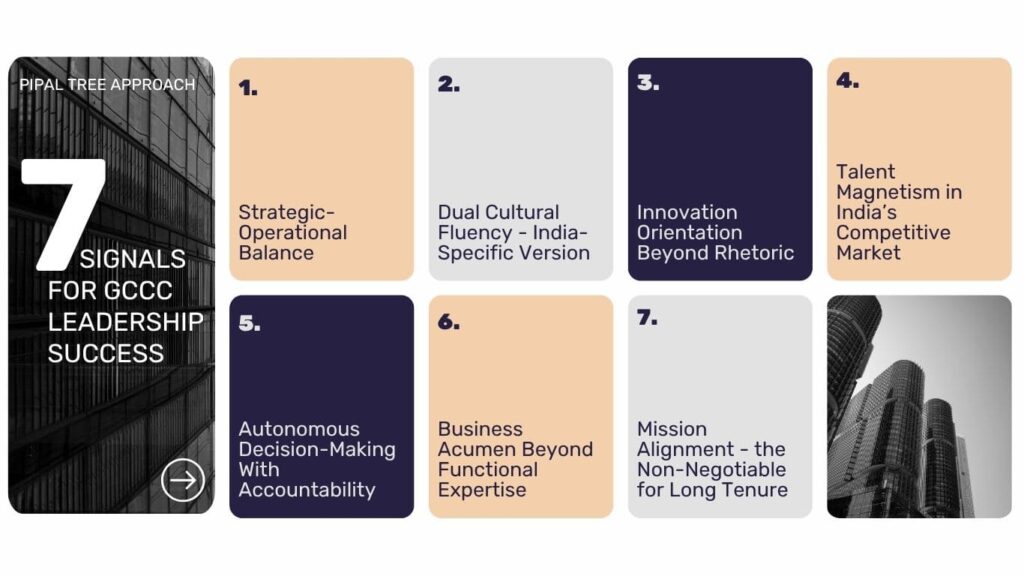
The 7 Dimensions to Assess When Hiring a GCC Leader in India
Based on the GCC leadership searches we have run across technology, engineering, finance, and operations functions, seven dimensions consistently distinguish leaders who transform from those who merely execute.
All seven can be assessed before an offer is made.
Most companies assess two or three out of these and hope for the best.
Strategic-Operational Balance
GCC leaders must build infrastructure while simultaneously positioning the centre for strategic contribution. The ones who skew entirely operational, they build processing centres that never evolve. The ones who lead entirely with vision and neglect operations, they create inspiring cultures where nothing reliably ships.
How to assess it
Ask candidates to describe a 3-year vision for this GCC and the 90-day plan to start moving toward it. Transformational leaders toggle fluently between time horizons.
Execution-focused leaders give you excellent 90-day plans and vague 3-year aspirations.
Vision-only leaders give you compelling 3-year narratives and impractical 90-day plans.
Dual Cultural Fluency - India-Specific Version
Red flag
Leaders who speak negatively about either culture (“HQ doesn’t understand India’ or ‘Local teams aren’t strategic enough’) haven’t developed genuine dual fluency. They have a preferred culture and a tolerated one.Innovation Orientation Beyond Rhetoric
Every GCC leader we have ever interviewed claims to value innovation. The question is whether they have actually created conditions where it happens systematically or whether innovation in their previous roles was a headquarters initiative that their team executed.
What we look for
Specific examples of innovations originating from their India team that were adopted by headquarters.
Systematic approaches to creating the conditions for innovation – innovation time allocations, structured experimentation, a culture where failed experiments are celebrated as much as successful ones.
Language of ownership: “my team proposed…” and “we proved the concept…” rather than “we implemented innovations…”
Talent Magnetism in India’s Competitive Market
India’s senior engineering and business talent has never been more in demand. As per the EY GCC Pulse 2025, Mid-to-senior talent is expected to make up 77% of all GCC hiring by 2025, up from 63% in 2023. The leaders who can attract and retain this talent in a market where every major global technology company is competing for the same pool are not common. They are people builders – leaders whose teams describe specific things they learned and built during their time there.
Specific things to check
Voluntary attrition rate in their last GCC role against industry benchmarks.
The number of people in their teams from three years ago who were subsequently promoted or took on expanded roles. Whether references describe them as someone people specifically sought out to work with or simply a capable manager.
Autonomous Decision-Making With Accountability
GCC leaders must act decisively without constant HQ approval. The alternative is seeking permission for every significant decision, that creates bottlenecks that frustrate the India team and signal to HQ that the leader doesn’t genuinely own their domain.
What we probe for
Situations where the leader made a significant decision that HQ didn’t initially support.
How they managed the risk.
What happened.
What they learned.
The best answers show comfort with calculated risk, clear reasoning despite incomplete information, and ownership of both the decision and its outcome – not attribution to circumstances or HQ when things went wrong.
Business Acumen Beyond Functional Expertise
Leaders who understand only their function build excellent functions that may end up solving the wrong business problems. GCC leaders must connect their centre’s work to business outcomes – revenue, customer acquisition, competitive positioning, strategic differentiation – not just operational metrics.
Ask this question
“Explain how your current GCC’s work impacts the parent company’s P&L or competitive position.”
Execution leaders talk about transaction volumes, uptime metrics, and SLA compliance. Transformational leaders talk about how their work reduced customer churn by a measurable percentage, or how a platform they built enabled a new product line.
Mission Alignment - the Non-Negotiable for Long Tenure
The leaders who stay and build are the ones who came for the mission, not the title. The leaders who leave within 30 months – at the rate of one-in-three, are disproportionately those who took the role because it was the right next career step, not because the specific opportunity genuinely interested them.
The question that reveals this
“Why this role at this company? Why now?”
A leader who has done genuine due diligence on your organisation, who can articulate what specifically excites them about this mandate and why they want to build this GCC rather than a GCC generically – that leader is signalling the kind of commitment that 36-month tenure requires.
The Assessment Process: How to Evaluate Against the Seven Dimensions
Most international companies run two to three 60-minute interviews, collect impressions from multiple stakeholders, and make a decision based on aggregate confidence.
This works great for senior hires where functional competence is the primary variable.
This is inadequate when it coms to GCC leadership hiring where transformational capability, dual cultural fluency, and mission alignment are the actual predictors of success.
A well-structured GCC leadership assessment has five stages.
-
Stage 1: The Strategic Brief (Before Any Candidate Is Seen)
Before writing a job description, answer these questions with genuine specificity:
- What does success look like at 12 months, 24 months, and 36 months?
- What specific transformation is this leader responsible for driving?
- What capabilities must be built that don’t exist today?
- What is the actual authority structure - not the aspirational one in the announcement?
The answers to these questions often surface the governance conversation that needs to happen internally before the search begins. We have started GCC leadership searches where the first stakeholder alignment session revealed that HQ and the India sponsor had materially different views of what the leader was being hired to do. Resolving this before the search is cheaper than resolving it after a hire has been made.
-
Stage 2: The 30-Minute Qualification Screen
The purpose of the initial screen is not to assess all seven dimensions. It is to establish whether the candidate has the baseline experience to qualify for deeper assessment, and to generate specific hypotheses about which dimensions need probing in subsequent conversations.
- Opening question: “Walk me through your career - tell me about the transitions, not the titles. Why did you make each move?” Thoughtful moves driven by learning and impact. Exclusively upward-mobility framing without substance about what was built is a signal
- GCC-specific probe: “If you were building a GCC from scratch today, what would you do differently than most companies do?” This reveals strategic thinking, awareness of common failure patterns, and whether their perspective is grounded in real experience or theoretical.
- Cultural fluency probe: “Describe a situation where cultural differences between HQ and India created a significant operational challenge. How did you navigate it?” Generic answers indicate theoretical understanding. Specific examples with nuanced reflections indicate genuine experience.
-
Stage 3: Deep-Dive Interviews Across Three Stakeholder Perspectives
Structured across three separate 90-minute sessions, each conducted by a different interviewer probing complementary dimensions:
- Session 1 (Hiring Manager):
Strategic-operational balance and business acumen. Ask candidates to take you through a situation where they had to build something new while maintaining existing operations. Ask how they measure their GCC’s contribution to the parent company’s P&L. Ask about a significant decision made with limited data. - Session 2 (Senior HR / Cultural): :
Dual cultural fluency and innovation orientation. Ask for specific stories of navigating cultural misunderstandings. Ask how they create conditions for innovation and request a concrete example of an idea that originated from their India team. Ask how they would describe their leadership style differently to HQ versus India stakeholders. - Session 3 (CHRO or Peer):
Talent magnetism and mission alignment. Ask what their voluntary attrition rate was in their last GCC role and why they believe it was at that level. Ask who they’ve hired who subsequently got promoted or took on expanded responsibility. Ask - specifically and directly - why this role and why now.
- Session 1 (Hiring Manager):
-
Stage 4: The 90-Day Transformation Plan Case Study
Give candidates a realistic scenario based on your actual GCC situation and ask for a structured 90-day plan. Evaluate for: stakeholder mapping and listening-first approach before action, specific metrics and milestones, cultural change approach alongside operational priorities, and communication strategy for both HQ and the India team. The best responses balance ambition with realism. All vision and no concrete actions, or all operations and no cultural change thinking, are both signals worth noting.
-
Stage 5: Reference Checks That Go Beyond Confirmation
Standard reference checks confirm what you already believe. Well-designed reference checks surface information that changes how you onboard the leader or identify potential misalignments before they become problems.
The five questions that matter:
- What is this person’s greatest developmental area, and how did it show up in their work?
- Describe a significant failure or setback they faced - how did they handle it?
- How would their team describe their leadership style?
- If you hired this person, what would you need to know to set them up for success?
- On a scale of 1–10, how likely are you to work with this person again - and why not higher?
What to Call the First GCC Hire?
There is no universal title for the first GCC leader in India. The appropriate title depends on three variables:
- The mandate the person has been given,
- The reporting structure they sit within and
- The signal the title needs to send – both to the India team and to the external talent market.
Getting this wrong has practical consequences.
A leader hired as “Head of Engineering India” into a role that actually requires P&L accountability, board interaction, and strategic co-ownership with HQ will struggle to establish the authority the role demands.
The title shapes how the India team, external partners, and future talent candidates perceive the scope of the position – before a single conversation has taken place.
| GCC Model | Typical Title | Authority Signal |
| Delivery Centre | Head of Engineering India | Operational head. Delivery accountability. Reports into Global VP Engineering or COO. |
| Shared Services GCC | GCC Head | Functional head across multiple processes. Cost centre accountability to global COO or CFO. |
| Technology GCC | VP Engineering India | Technical direction and team leadership. Direct relationship with Global CTO. Architecture authority. |
| Multi-Function GCC | India Site Leader | Cross-functional authority across the full India operation. P&L or cost centre scope depends on mandate. |
| Strategic Innovation Hub | India Managing Director | Full strategic and operational authority. Board interaction. Statutory MD designation under Companies Act relevant here. |
| Enterprise GCC | GCC Country Head | End-to-end country accountability. Direct access to Global CEO. Regional or global mandate possible. |
The Two Title Mistakes International Companies Make Consistently
Mistake 1: Title Inflation
Giving a delivery centre leader an MD or Country Head designation to attract stronger candidates, without backing that title with the actual authority it implies.
Strong candidates evaluate whether the mandate behind the title is real within the first ninety days. When it is not, the mismatch becomes the primary driver of the exit conversation at month eighteen.
Mistake 2: Title Compression
Giving a strategic innovation hub leader an 'Engineering Head' or 'Director' title to manage internal compensation band expectations, when the role actually requires P&L accountability, board interaction, and external representation of the company in India.
In India's corporate market, the external title carries significant weight - with regulators, with large enterprise clients, and with the senior talent you need to attract. Underweighting the title underweights the role.
One India-specific note for international companies: the Managing Director designation under the Companies Act 2013 carries specific statutory obligations and authorities that differ from the generic use of 'MD' as a seniority label.
For GCCs with India-incorporated entities, the statutory MD designation requires board appointment and carries defined authority and liability. Whether the GCC leader should hold the statutory MD title versus a commercial title requires a conversation with India legal counsel before the offer letter is drafted.
The Principle
Choose the title that accurately represents the authority and mandate you are giving the leader – not the title that makes the compensation conversation easier internally or the candidate pool seem wider.
The right title attracts the right candidates.
The wrong title creates a mismatch that compounds from day one.
The India GCC Leadership Talent Market in 2026
The best GCC leaders in India are not looking — and the pipeline is thinner and more expensive than the sector’s headline growth suggests.
The scale of India’s GCC sector creates a false sense of abundance. The workforce grew from roughly 1.2 million in 2022 to nearly 1.9 million in 2025, but leadership depth has not kept pace with headcount.
Four realities shape any GCC leadership search in this market.
The Best Candidates Are Not Looking
The leaders most worth hiring are, almost by definition, already succeeding somewhere else.
They do not apply to postings or sit in databases. Reaching them depends on structured talent mapping across the India market and a relationship-led approach — which is also why the compressed timeline in Mistake 4 fails so reliably.
This is the core structural argument for retained search in GCC leadership mandates: not that retained executive search firms are better at finding candidates, but that the best candidates are only accessible through a specific kind of approach that job postings and contingency recruiters cannot replicate.
The Leadership Pipeline Is Thinner Than It Appears
A 1.9-million-person sector sounds like a deep bench, but the number of leaders who have actually built a GCC, rather than run one someone else built, is small, and demand for them is climbing.
EY reports mid-to-senior talent will make up around 77% of all GCC hiring by 2025, up from 63% in 2023. The competition for genuine builders is far sharper than the aggregate numbers imply.
Compensation Has Inflated Significantly
GCC leadership compensation in India has risen materially over the past three years, driven by competition from both new GCC entrants and established ones that are now promoting India-based leaders to global roles. International companies that benchmark against what they paid for a similar profile in 2021 or 2022 will consistently find themselves 20–30% below market on first approach.
The specific compensation benchmarks are in the following section. The broader point is that the conversation that needs to happen with HQ before the search begins is about market-rate compensation in India 2026, not a compressed version of what the role would cost in the company’s home market.
| GCC Scale | Base Salary | Variable | Total Cash CTC |
| 50–200 employees (new or early-stage) | ₹80L – ₹1.5Cr | 30–50% of base | ₹1.04Cr – ₹2.25Cr |
| 200–500 employees (scaling) | ₹1.2Cr – ₹2.5Cr | 40–60% of base | ₹1.68Cr – ₹4Cr |
| 500+ employees (mature / strategic) | ₹2Cr – ₹4Cr+ | 50–75% of base | ₹3Cr – ₹7Cr+ |
The Cluster Geography Reality
Leadership talent clusters unevenly.
Bengaluru has the deepest pool of senior technology and product leadership.
Hyderabad and Pune are strong for engineering and finance functions.
Chennai has significant depth in operations and manufacturing-adjacent GCCs.
Mumbai has the strongest financial services and BFSI GCC leadership pool.
The right city for your GCC matters for the leadership search: if you are in Pune but need a leader with deep Bengaluru technology network connections, plan for the relocation conversation upfront.
What Actually Attracts the Right GCC Leader
Compensation is necessary but not sufficient for the transformational leaders you are trying to reach.
The leaders who join GCCs and build them into strategic assets consistently cite four non-financial factors as significant in their decision:
- Mandate clarity and genuine authority – a clear articulation of the transformation they are being asked to drive, with real decision-making power to act on it. Authority on paper that requires HQ approval for every significant decision is not authority.
- Direct access to HQ leadership – regular, substantive exposure to the parent company’s senior leadership, not filtered through regional layers. The leaders who build the most valuable GCCs are the ones who can advocate directly for the India centre’s capabilities.
- Quality of the team they inherit – and honest information about what that team looks like. Leaders who arrive expecting one situation and find another become candidates again within 18 months.
- Innovation licence – explicit permission to experiment, including permission to fail on controlled experiments. GCCs where the leader must justify every departure from the existing playbook to HQ do not produce transformational leaders. They produce cautious ones.
“The GCC leaders who stay are the ones who came because the mission genuinely interested them. The ones who leave within 18 months are disproportionately those who came because it was the right career step.
Compensation matters!
But in the conversations I have with GCC leaders who have been in their roles for three years and are building something real, compensation is never the leading reason they stayed.”
Four Common Scenarios For GCC Leadership Hiring and How to Navigate Them
-
Scenario 1: “We Are Setting Up Our First GCC in India and Don’t Know the Market”
This is the scenario where India market intelligence matters most and is least available internally. The specific challenges: you don’t know which talent pools to target, you don’t have a sense of market-rate compensation, you may not know which company names on a resume represent genuine experience versus inflated title, and you don’t have the existing India relationships to reach passive candidates.
The practical consequence is that without a search partner with deep India GCC experience, the shortlist you generate will be drawn from the active talent pool - people who are available because they are looking, often for reasons that a well-run background check would surface.
A specialist India search firm closes the information asymmetry: compensation benchmarks, target talent pools, market map of the available universe, and the outreach credibility to engage passive candidates who would not respond to an unfamiliar international company’s direct approach. -
Scenario 2: “Our First GCC Leader Didn’t Work Out - How Do We Hire Differently?”
This is one of the most common scenarios in our GCC leadership work, and it requires honest post-mortem before the second search begins. In our experience, first GCC leadership failures trace to one of three root causes: the mandate was under-defined and the leader was optimising for the wrong outcomes; the authority structure didn’t match the mandate description and the leader couldn’t operate at the level they were hired for; or the cultural fit was miscalibrated and the leader couldn’t navigate the specific HQ-India dynamic of this organisation.
Before beginning the second search, name which of these actually happened. Then change something substantive: the mandate definition process, the governance structure, the assessment methodology, or the onboarding support.
A second search run the same way as the first will not produce a materially different outcome. -
Scenario 3: “We Have a Strong Internal Candidate Who Hasn’t Run a GCC Before”
Internal candidates with the right foundational capabilities and a genuine track record of building teams can succeed in GCC leadership roles without prior GCC-specific experience. The assessment must be rigorous and honest: do they have the dual cultural fluency, the innovation orientation, and the strategic-operational balance the role requires?
If yes, invest in a structured learning plan: site visits to mature GCCs, executive coaching from an experienced GCC leader, an advisory board for the first 12 months, and a co-leadership arrangement with an experienced GCC advisor for the first six months.
If the honest assessment reveals gaps in these dimensions, the internal candidate conversation is better handled as an investment in their development toward a future role than as the hiring decision for this one.
-
Scenario 4: “The Ideal Candidate Is Based Internationally and Won’t Relocate Full-Time”
The hybrid model - two weeks per month in India, remainder remote - can work for GCC leaders with deep prior India experience and established networks. It rarely works for first-time GCC operators in India, because building culture, establishing credibility with the local team, and navigating the informal dynamics of India’s organisational life requires physical presence in the first 18 months.
If the candidate has previously built significant relationships and credibility in India, the hybrid model is worth exploring with clear success metrics and a review checkpoint at 12 months. If they are learning the India context while also being absent half the time, the conditions for a successful transition are not in place.
When to Bring in a Specialist GCC Executive Search Partner
Based on our work across GCC leadership mandates, there are five scenarios where the ROI of a specialist retained search partner is unambiguous.
You are entering India for the first time.
The information asymmetry about the India talent market is too significant to overcome through internal sourcing. Compensation benchmarks, title inflation patterns, passive candidate access, and cultural context all require dedicated India market expertise.
You need a transformational leader, not an operational one.
The role is mission-critical and you need to get it right the first time.
The cost of a wrong GCC leadership hire – 30% of GCC country heads leave within 30 months – is not just the replacement search. It is the 18–24 months of momentum loss, damaged employer brand, and headquarters confidence deficit that the wrong hire creates.
Your previous GCC leadership hire didn’t work.
You need different access to a different talent pool and an objective third-party assessment that your internal process didn’t provide.
You lack the internal bandwidth for a rigorous 12–16 week search process.
A well-run GCC leadership search requires dedicated senior practitioner time. If your CHRO is managing three other mandates simultaneously, the GCC search will be compressed in exactly the ways that produce suboptimal outcomes.
How Pipal Tree Approaches GCC Leadership Search
Our approach for GCC leadership hiring reflects what this guide describes: a structured process that begins with mandate clarity before a single candidate is engaged, a market map of the passive talent pool before a shortlist is presented, and assessment against the seven dimensions rather than functional competence alone.
We are a retained practice – we do not run contingency processes for GCC leadership mandates, because the best GCC leaders are not accessible through any other model. We bring India-specific market intelligence that most global search firms cannot replicate: which leadership profiles are genuine versus title-inflated, where the best candidates in each GCC function and geography are currently settled, and what it takes to move them.
“An execution-focused leader hired into a transformation mandate doesn’t fail at execution. They succeed at it. The GCC runs smoothly, processes are tight, SLAs are met. What doesn’t happen is anything that wasn’t already happening.
Transformation requires a fundamentally different kind of person and most assessment processes aren’t designed to find them.”
Frequently Asked Questions On GCC Leadership Hiring In India
How long does a GCC leadership search in India typically take?
A well-run retained GCC leadership search typically takes 12 – 16 weeks from engagement to accepted offer.
This is not a three-week job posting exercise.
The timeline reflects the passive nature of the best candidates, the multi-stakeholder assessment process, and the reference checking and offer negotiation stages. Companies that compress this timeline under launch pressure consistently get a shortlist drawn from active job-seekers rather than the settled, passive leaders who have actually transformed GCCs.
Should the GCC leader be an Indian national or a global executive?
Nationality is less important than demonstrated experience in both India and an international context. The most effective GCC leaders we have placed have been Indian nationals who spent meaningful time working in the US or Europe, Indian diaspora professionals returning to India, and occasionally international executives with deep prior India operating experience.
What consistently fails is an international executive with no prior India experience trying to lead a GCC from outside – or an India-based leader who has never had substantive international exposure and cannot bridge effectively to HQ.
What is the right reporting line for a GCC head?
This depends entirely on the mandate. As our CEO vs MD vs Country Head guide sets out, the reporting line must match the authority level the role actually carries. If the GCC is a delivery centre, solid line to a global VP Engineering or COO is appropriate.
If it is an innovation hub with co-ownership of global product decisions, the India leader should have solid line access to the global CEO or a senior global executive with real authority to act on the India organisation’s strategic contributions. Misaligned reporting lines are one of the most consistent causes of first-year GCC leadership exits.
How do we retain a strong GCC leader once we’ve hired them?
The single most important retention factor is delivering on the mandate that was described during the search. Leaders who leave within 18 – 24 months almost always cite a gap between what they were told they had authority to do and what they discovered they could actually do. Retention starts before joining: in the specificity of the mandate definition, the honesty about the organisational starting point, and the governance structure that genuinely supports the transformation the leader was hired to drive.
What does a GCC leadership executive search cost?
A retained executive search for a GCC leadership role in India typically costs 20 – 33% of the candidate’s first-year total CTC. For a GCC head at ₹1.5 – 2 crore CTC, this represents a fee of ₹30–66 lakh. Our detailed guide on executive search fees in India covers the full fee structure, what the fee covers, and how to evaluate whether the investment represents value.
These FAQs cover the most common questions when it comes to GCC leadership hiring in India.
For a more comprehensive breakdown, including questions on fees, timelines, guarantees, and how the process works step by step, visit our detailed Executive Search FAQ.
Why Pipal Tree is one of the top executive search firm in India
97% placement success rate across hundreds of leadership mandates.
50+ years of combined search experience across our founding team.
80% repeat engagement rate > our clients come back because our process works.
We combine the best practices of a global search firm with the entrepreneurial responsiveness and senior-partner involvement of a boutique consultancy.
The Decision That Sets the Trajectory
Every GCC leadership decision sets the trajectory for the centre for at least three years.
The right leader attracts talent you couldn’t access otherwise, creates culture that compounds, and builds the credibility with headquarters that earns the centre increasing strategic trust and authority. The wrong leader does the reverse – and the damage to employer brand, team morale, and HQ confidence persists long after they are replaced.
If you are planning a GCC leadership search in India – whether as a first entry, a scaling hire, or a replacement – start with the mandate definition conversation before the candidate profile conversation.
The former shapes the latter in ways that determine whether the search finds a transformational leader or a well-credentialed executor.
So let’s start with a conversation.
No pressure.
Just talk.
Write to me at [email protected]
Because India’s GCC market is moving fast. The companies that get the leadership decision right are building something durable. The ones that get it wrong are planning their second search while their competitors are running their first innovation.

Rahul Bahuguna
“With over two decades of experience across executive search, digital strategy, and business consulting, Rahul brings a unique entrepreneurial perspective as Director & Co-Founder of Pipal Tree Services. At Pipal Tree, Rahul leverages his background in strategy, market intelligence, and digital transformation to guide mission-aligned executive search and board mandates. He specializes in building long-term client partnerships, leading complex leadership searches, and shaping Pipal Tree’s distinct positioning at the intersection of talent and purpose. His ability to combine strategic insight with practical execution makes him a trusted advisor to organizations seeking leaders who can drive meaningful, sustainable change.”