

What Makes a Top Executive Search Firm in India?
The best executive search firms in India share three capabilities that rarely appear together:
- The market intelligence to reach senior leaders who are not looking and the credibility to engage them seriously,
- The advisory depth to align boards and leadership teams around a shared mandate before the search begins, and
- The assessment rigour to evaluate cultural and contextual fit, not just functional competence.
Most firms do the first reasonably well. Very few do all three consistently.
This guide covers the types of firms operating in India’s executive search market, what actually separates the exceptional ones from the merely competent, and how to choose the right partner for a CXO or board-level mandate.
Table of Contents
India’s leadership hiring landscape is at an inflection point.
With CXO-level hiring surging nearly 10% in FY2025, over 1,800 Global Capability Centres now operating across the country, and boards demanding leaders who can navigate AI disruption, ESG mandates, and global complexity simultaneously, the role of executive search has fundamentally changed.
It’s no longer enough to simply find qualified executives. Organisations need leaders who can transform — who bring the rare combination of domain mastery, cultural alignment, and the strategic vision to navigate what comes next. This is exactly what the top executive search firms in India are built to deliver.
This guide explores the executive search landscape in India as it stands today:
- The forces reshaping leadership demand,
- The different types of search firms operating in the market,
- What sets the truly exceptional ones apart, and
- How Pipal Tree Services has developed a distinctive, mission-aligned approach that addresses the blind spots in traditional executive recruitment.
If you’re evaluating specific firms and need a step-by-step selection framework, we recommend reading this guide alongside our detailed companion piece: The Complete Guide to Choosing the Right Executive Search Firm in India, which covers evaluation criteria, red flags, and the questions you should ask before signing an engagement.
The Forces Driving Executive Search Demand in India
Understanding why organisations increasingly turn to top executive search firms in India requires understanding the shifts in India’s business environment.
The AI Leadership Imperative
Every C-suite role is being redefined by artificial intelligence. Boards no longer want CTOs who merely “understand” AI – they want CEOs who can lead AI-powered transformation, CFOs who leverage predictive analytics for capital allocation, and CHROs who can navigate the human implications of automation.
Today’s leaders must simultaneously execute the current business while fundamentally reimagining it.
Succession Planning Goes Mainstream
Indian family businesses and mid-market companies are formalising succession planning at an unprecedented rate.
Whether transitioning from founder-led to professionally managed structures or preparing for generational handovers, these organisations need executive search partners who understand both legacy values and contemporary leadership requirements.
The Talent Paradox
Here’s the paradox: while leadership demand is surging, the supply of truly transformational executives remains constrained. The most impactful leaders aren’t updating their profiles on job boards — they’re deeply engaged in their current roles.
This is precisely why top executive search firms prioritise passive talent for leadership roles.
Reaching these individuals requires professional credibility, industry relationships, and a fundamentally different engagement approach.
The GCC Revolution
India now hosts more than 1,700 Global Capability Centres which account for over half of the global total. These GCC are employing close to 2 million professionals, contributing over $64 billion in annual revenue. By 2030, this is projected to exceed 2,400 centres and $100 billion.
But the real story isn’t the numbers, it’s the nature of these centres. GCCs have evolved from back-office cost centres into strategic innovation hubs driving product engineering, AI research, and global business operations for their parent companies.
This evolution has created a leadership vacuum. GCC heads now need to bridge global headquarters expectations with India’s operational realities – a role requiring cross-cultural fluency, innovation leadership, and the ability to manage complex matrix structures.
The Cost of Getting It Wrong
Research indicates that nearly 40% of senior executive hires fail within the first 18 months. A failed CXO appointment can cost an organisation 2–5x the executive’s annual compensation when factoring in lost momentum, cultural disruption, and missed opportunities.
Who Are the Top Executive Search Firms in India? Understanding Your Options
India’s executive search market includes several distinct categories of firms.
Understanding these categories helps organisations identify the right type of partner for their specific needs.
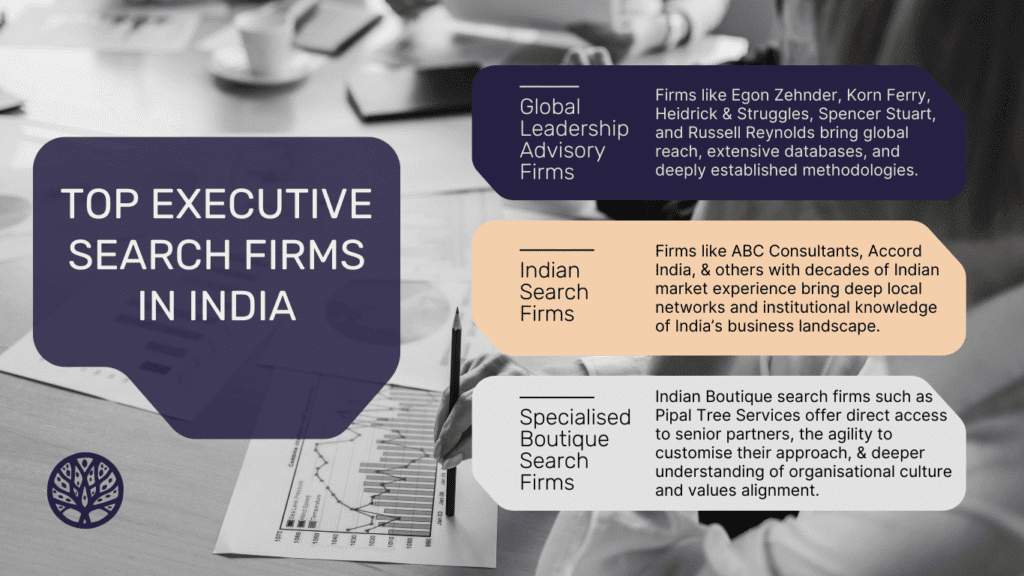
Global Leadership Advisory Firms
Firms like Egon Zehnder, Korn Ferry, Heidrick & Struggles, Spencer Stuart, and Russell Reynolds bring global reach, extensive databases, and deeply established methodologies. They are well-suited for multinational organisations requiring cross-border searches and typically focus on large enterprise mandates. Their India operations serve major MNCs and large Indian conglomerates, and they bring the advantage of seamless international coordination when a search spans multiple geographies.
Best for: Large multinational corporations, Fortune 500 companies, global cross-border searches, publicly listed companies with governance requirements.
Established Indian Search Firms
Firms like ABC Consultants (founded in 1969), Accord India, and others with decades of Indian market experience bring deep local networks and institutional knowledge of India’s business landscape. They understand the nuances of Indian corporate culture, family enterprise dynamics, and regional talent markets in ways that can be difficult for newer or internationally headquartered firms to replicate.
Best for: Large Indian conglomerates, companies requiring deep regional networks, organisations where understanding India’s business ecosystem is the primary advantage needed..
Specialised Boutique Search Firms
This is the fastest-growing and most dynamic segment of India’s executive search market. Boutique search firms offer direct access to senior partners throughout the search, the agility to customise their approach to each client’s unique context, and often deeper investment in understanding organisational culture and values alignment.
The best boutique executive search firms like Pipal Tree Services, combine the methodological rigour of global firms with an entrepreneurial responsiveness that larger organisations find difficult to match.
Best for: Organisations that value personalised attention, mission-critical searches where cultural alignment is as important as functional competence, high-growth companies, and GCC leadership hiring. This includes, international MNC organisations where understanding India’s business ecosystem along with personalized attention is needed.
What Actually Separates the Top Executive Search Firms in India
Beyond the categories above, what distinguishes the truly exceptional firms from the merely competent? Having worked across hundreds of leadership mandates, we’ve identified five capabilities that consistently separate firms that deliver transformational hires from those that simply fill positions.
-
They Assess for Mission & Culture Alignment, Not Just Competence
The most common reason executive hires fail isn’t lack of skills - it’s cultural and values misalignment. A candidate may have a stellar track record yet still fail because their leadership philosophy clashes with the organisation’s operating model.
We at Pipal Tree Services, firmly believe that finding leaders who align with an organisation’s mission requires a fundamentally different assessment approach than evaluating functional expertise alone.
-
They Bring Market Intelligence, Not Just Candidate Names
Top firms provide genuine market intelligence: compensation benchmarking, competitive landscape analysis, talent availability assessments, and insights on which organisations develop strong functional leaders. This advisory dimension transforms the relationship from transactional recruitment to strategic partnership.
-
They Invest in Post-Placement Success
The search doesn’t end with an accepted offer. Top executive search firms in India invest in structured onboarding support and integration check-ins throughout the critical first year. This dramatically improves retention and accelerates time-to-impact for placed executives.
-
They Understand the Nuanced Difference Between Search and Recruitment
One of the most common (and expensive) mistakes CXOs and Boards make is treating executive search and recruitment as interchangeable. This distinction might seem obvious, but it’s frequently misunderstood.
Recruitment firms work to fill roles. Executive search firms like Pipal Tree Services are designed to manage leadership risk. We as a search partner will
- Challenge poorly defined roles
- Push back on unrealistic expectations
- Surface misalignment early
- Act as an advisor to the Board
-
They Have a Clear Point of View on Retained vs. Contingent Models
The engagement model matters. Retained search provides dedicated focus, comprehensive research, and the confidentiality that senior searches demand. Contingent models serve different needs.
Understanding which model, retained search vs. contingent search fits your situation is critical
The Pipal Tree Approach: Mission-Aligned Executive Search
At Pipal Tree Services, we built our practice around a specific observation:
traditional executive search overemphasises what a candidate has done and underemphasises who they are as a leader,
experience, and track record are necessary but not sufficient predictors of success in a new organisational context.
Our mission-aligned approach was developed to address the 3 dimensions where we see most leadership placements fail:
1. Autonomy Expectations Mismatch
A leader accustomed to autonomous decision-making will struggle in an organisation with centralised governance — and vice versa. We systematically map the autonomy profile of both the role and the candidate.
2. Strategic Mandate Ambiguity
Many placements fail because the leader and the organisation had different understandings of the role’s purpose. Is this a transformation role or an optimisation role? We invest heavily in crystallising the mandate before beginning the search.
3. Cultural Operating Model Incompatibility
Every organisation has unwritten rules about how decisions get made, how conflict is resolved, and how success is defined. Our assessment framework explicitly evaluates this dimension, something most firms leave to “gut feel.”
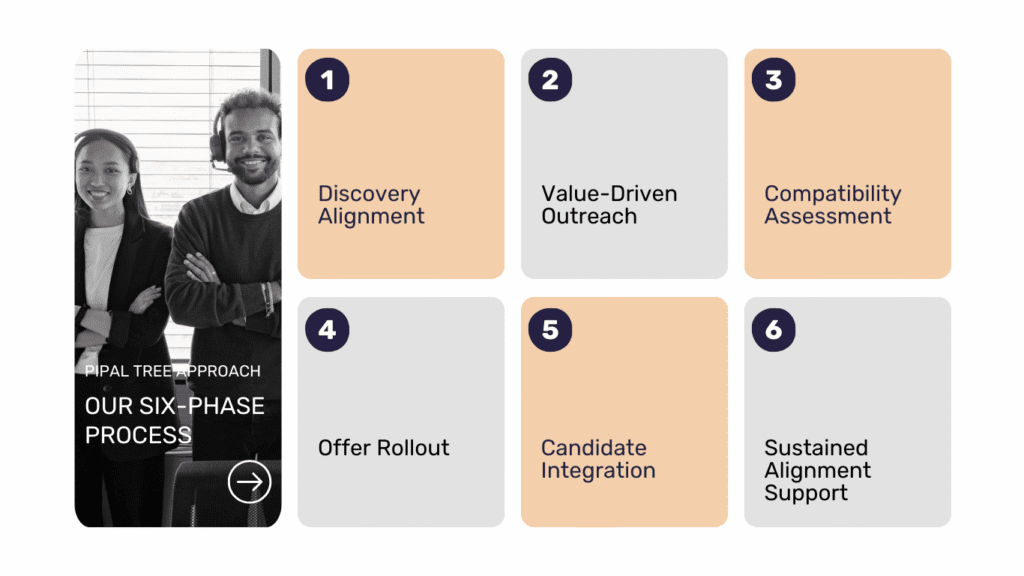
Pipal Tree Six-Phase Process
-
Discovery Alignment
We meet your leadership team to understand not just the role, but your organisational DNA - values, decision-making culture, and strategic priorities. -
Value-Driven Outreach
Confidential, research-driven engagement with high-potential leaders assessed for both functional capability and mission alignment. -
Compatibility Assessment
Structured interview design and assessment frameworks that reveal authentic leadership qualities beyond traditional credentials. -
Offer Rollout
Values-centred negotiation guidance that establishes shared vision from day one. -
Candidate Integration
Coordinated transition management honouring organisational culture and leadership vision. -
Sustained Alignment Support
Structured check-ins at 30, 60, 90, 180, and 365 days to ensure integration success.
Industry-Specific Executive Search: Where Sector Expertise Matters Most
The top executive search firms in India bring sector-specific intelligence that fundamentally changes the quality of leadership hires. Here is where we see the greatest demand and the most nuanced challenges.
Global Capability Centres
With India projected to host 2,400+ GCCs by 2030, leadership hiring for these centres has become a specialised discipline. GCC heads need to manage complex matrix structures, bridge cultural divides between global headquarters and India operations, and increasingly drive innovation — not just execution. .
Industrial, Manufacturing & EPC
International MNC manufacturing companies, especially in the EPC space with engineering and design units in India, face a dual challenge: finding leaders who can drive Industry 4.0 digital transformation while maintaining operational excellence and safety standards. These searches require deep understanding of both technical capabilities and the cultural dynamics of industrial and manufacturing environments.
Technology, Media & Digital
The explosion of AI, SaaS, and platform businesses has created intense demand for CTOs, VP Engineering, and Chief Product Officers who can scale engineering organisations while driving product-led growth.
Financial Services
From fintech disruption to regulatory transformation, hiring for financial services, demand leaders who combine deep domain knowledge with governance maturity and digital fluency.
Life Sciences & Healthcare
Regulatory complexity, R&D leadership, and the balance between innovation and compliance make leadership hiring for life sciences and healthcare one of the most specialised search domains. Country managers, R&D heads, and regulatory affairs directors require a combination of scientific credibility and commercial acumen that is exceptionally rare.
Consumer & Retail
Omnichannel transformation, the D2C explosion, and supply chain modernisation are reshaping leadership requirements in consumer and retail. Organizations go to consumer goods executive search firms to find leaders who understand both the digital economy and the complexities of India’s diverse consumer market.
Higher Education
India’s higher education sector is undergoing profound transformation. With 19 international universities now approved to establish campuses under UGC’s 2023 regulations and over 300 global institutions forming academic partnerships with Indian HEIs, competition for quality academic and administrative leadership has intensified. Institutions need leaders who can navigate this new regulatory landscape, build research excellence, attract global faculty, and modernise institutional governance.
“The most expensive leadership hire isn’t the one with the highest salary – it’s the one who looks perfect on paper but clashes with your organisation’s culture within six months”
The C-Suite Roles in Highest Demand Across India
Understanding which leadership roles are seeing the greatest demand helps organisations plan their search strategy proactively rather than reactively.
| Role | Why Demand Is Surging | Key Competencies for 2026 |
| CEO | AI-driven transformation mandates; succession planning formalisation; global expansion | Digital fluency, stakeholder management, governance readiness, transformation experience |
| CFO | Pre-IPO preparation; AI-powered financial planning; ESG reporting requirements | Strategic capital allocation, investor relations, predictive analytics, regulatory navigation |
| CTO | AI/ML integration; product-to-platform transitions; GCC technology leadership | Engineering scale-up, AI strategy, security, team building across geographies |
| COO | Operational efficiency with digital transformation; manufacturing modernisation | Process excellence, supply chain innovation, Industry 4.0, change management |
| CHRO | AI workforce planning; DEI mandates; talent retention in competitive markets | People analytics, culture transformation, employer branding, leadership development |
| GCC Head | Rapid GCC expansion; shift from cost centre to innovation hub | Cross-cultural leadership, matrix management, innovation governance, talent scaling |
At Pipal Tree Services, being one the top executive search firms in india, we run dedicated search practices across the full C-suite, including CEO, CFO, CTO, COO, CHRO, CMO, CIO, and CRO mandates, as well as other senior leadership positions. Each practice brings role-specific assessment frameworks, compensation benchmarking, and candidate networks built over years of focused engagement.
Defining the right competencies upfront is what separates a successful search from an expensive mistake. Our role-specific insights help organisations sharpen their leadership mandate before the search begins.
5 Leadership Hiring Trends Shaping India in 2026
1. Skills-Based Hiring Replaces Pedigree-Based Hiring
Boards are asking fundamentally different questions:
What did this executive actually build?
How did they lead when the plan failed?
What broke under their watch, and how did they fix it?
This shift toward evaluating demonstrated capability rather than career tenure and brand-name employers is changing how the best search firms evaluate candidates.
2. ESG and Governance Are Non-Negotiable Leadership Competencies
Environmental, social, and governance credentials have moved from peripheral to central. Boards seek CXOs who can balance performance with responsibility, navigate regulatory scrutiny, and earn trust from employees, regulators, investors, and communities simultaneously.
3. Distributed Leadership Models Are Expanding the Talent Map
Hiring in tier-2 cities surged over 20% year-on-year in 2025, overtaking metro hiring growth. Cities like Pune, Ahmedabad, Coimbatore, and Jaipur are becoming serious leadership bases. This geographic expansion is reshaping how executive search firms source and evaluate candidates.
4. AI-Augmented Search Is Enhancing Human Judgment
Over 70% of executive search firms globally are expected to integrate AI-driven talent intelligence tools by 2026. But the most successful outcomes emerge when data-led insights are combined with deep human evaluation. AI enhances candidate identification; human judgment drives the assessment that ultimately determines leadership fit.
5. Startups Are Competing Head-to-Head with Established Firms for CXO Talent
India’s startup ecosystem now competes aggressively for senior leadership, offering equity-based packages and purpose-driven roles. This intensifies competition across the entire market — established companies, GCCs, and startups are all fishing in the same leadership talent pool. For founders, the critical question is whether to continue building their leadership team independently or to bring in a search partner who understands the unique dynamics of leadership hiring for startups.
Frequently Asked Questions
How many executive search firms operate in India?
India has hundreds of firms offering executive recruitment services, but the number specialising in genuine retained executive search at the C-suite and board level is significantly smaller. The top executive search firms in India are likely to be 30–50 firms with established reputations and verifiable track records.
This includes both global firms with Indian offices and homegrown Indian search firms like Pipal Tree Services.
What is the typical cost of executive search in India?
Retained executive search fees are typically structured as a percentage (usually 20–35%) of the placed executive’s first-year total compensation, paid in instalments across the search lifecycle.
While this represents a higher upfront investment than contingent recruitment, the long-term ROI is substantially greater when considering the cost of a failed senior hire.
How long does an executive search typically take in India?
Qualified candidates are typically presented within 2–3 weeks of engagement launch. Average time to accepted offer ranges from 6–10 weeks depending on role complexity, geographic scope, and decision timelines. Quality search requires adequate time for thorough research, assessment, and cultural evaluation.
Should we choose a global search firm or an Indian search firm?
This depends on your specific needs. Global firms excel at cross-border searches and bring internationally benchmarked methodologies. Indian headhunting firms such as Pipal Tree Services bring deeper local market understanding and more personalised service. Many organisations find that specialised boutique firms offer the best combination of rigour, market knowledge, and client attention.
What makes GCC leadership hiring different from regular executive search?
GCC leadership roles demand a unique combination of cross-cultural fluency, matrix management capability, innovation governance, and the ability to bridge global strategy with local execution. These roles require search consultants with specific expertise in the GCC operating model — understanding how global headquarters interact with India operations is critical to assessing candidate fit.
Can executive search help with writing effective leadership job descriptions?
Absolutely. Defining the role with precision is a critical first step in any successful search. At Pipal Tree Services, we see job descriptions not as static documents, but as strategic leadership briefs.
We partner closely with our clients to translate internal expectations into market-ready, outcome-led executive job descriptions that resonate with senior, passive candidates and support effective executive search.
These are some of the most common questions we hear from organisations exploring executive search for the first time.
For a more comprehensive breakdown, including questions on fees, timelines, guarantees, and how the process works step by step, visit our detailed Executive Search FAQ.
Final Thoughts
In the world of leadership hiring,
reactive recruitment fills positions;
proactive executive search builds legacies.
Whether you’re a multinational establishing a Global Capability Centre, a family enterprise formalising succession, or a high-growth company preparing for its next phase, choosing the top executive search firms in India is one of the most consequential decisions you’ll make.
At Pipal Tree Services, we help organisations find leaders who don’t just fit the role, they transform it.
Our mission-aligned approach combines deep market intelligence, structured leadership assessment, and sustained post-placement support to ensure your next hire becomes your next competitive advantage.
If you’d like to discuss how we can strengthen your leadership team, reach out to me at [email protected].
Because the best time to find your next leader is before you need one.

Sonia Sharma
"With over 25 years in talent leadership—including 20+ years in executive search—Sonia brings valuable dual perspective as Pipal Tree's founder. Her career spans both consultancy roles at prestigious firms (Korn/Ferry International, Accord India, Stanton Chase) and corporate leadership. Sonia specializes in executing confidential, high-stakes searches for global and Indian multinationals."