

What is Consumer Goods CXO Hiring in India
Consumer goods CXO hiring in India is the process of identifying and assessing senior leaders for consumer businesses facing increasingly complex channels, technology shifts and changing consumer behaviour. At CEO, CFO and CHRO level, the search increasingly requires capabilities beyond traditional FMCG experience — including omnichannel strategy, digital fluency, channel economics, data-driven decision-making and the ability to lead organisational change.Table of Contents
India is poised to become the world’s third-largest consumer market by 2026, trailing only the United States and China.
A $2.4 trillion household consumption surge, powered by rising incomes, rapid urbanisation, and a 400-million-strong middle class, is transforming the size, shape, and speed of India’s consumer economy.
For boards and hiring committees at consumer goods companies, this transformation carries a direct and urgent implication: consumer goods executive search in India must be fundamentally rethought, because the CXO profiles that built today’s businesses are not the ones that will capture tomorrow’s growth.
Easing inflation and benign commodity prices are expected to improve gross margins, creating room for reinvestment in brand-building and innovation. But how, where, and why brands advertise is being fundamentally reworked.
Quick commerce is no longer a metropolitan convenience play – it is a strategic channel reshaping distribution economics. Private label competition has crossed from cyclical nuisance to permanent structural threat.
AI-powered agentic commerce is shifting product discovery from human decision-making to machine intermediation.
And traditional mass media, for decades the default growth engine, is losing its grip on consumer attention.
These are not operational challenges to be delegated. They are board-level strategic shifts that demand a fundamentally different kind of CEO, CFO, and CHRO than what most consumer goods companies have in place today.
This guide examines how each of these three roles is being redefined, what boards should be looking for, and how to structure a consumer goods executive search in India that finds leaders built for 2026, not 2016.
5 Forces Reshaping Consumer Goods CXO Hiring in India
Quick Commerce: From Urban Convenience to Strategic Channel
What began as a metro convenience experiment, 10-to-30-minute deliveries for forgotten items, has become one of the most consequential distribution shifts in Indian consumer goods.
Quick commerce is no longer confined to Tier 1 cities. An estimated 25% of quick commerce spending now comes from mid-to-low-affluent consumers in Tier 2 and Tier 3 towns, signalling that convenience and immediacy are becoming universal expectations, not urban premiums.
For consumer goods companies, this has implications far beyond logistics.
Packaging formats, SKU rationalisation, inventory placement, and brand visibility are all being redesigned for a world where the consumer’s shelf is a mobile screen.
A CEO who still thinks of distribution as a general trade versus modern trade equation is operating on an obsolete map.
A CFO who cannot model the unit economics of dark store fulfilment and last-mile delivery is missing the fastest-growing cost centre in the business.
A CHRO who cannot build a supply chain talent pipeline for a 30-minute-delivery world is a liability.
Agentic Commerce and AI-Driven Product Discovery
For the past decade, the central commercial challenge in consumer products was winning at the point of human decision – shelf placement, digital advertising, influencer reach. That assumption is now being undermined at its foundation.
A growing share of purchase decisions would be moving from humans to AI agents acting on consumers’ behalf.
What makes this consequential is not the technology itself, but what it optimises against.
A human shopper can be influenced by packaging, brand association, and emotional advertising.
An AI agent evaluates price, availability, ratings, and the machine-readability of a brand’s digital infrastructure.
Agentic commerce moves from a world of brand persuasion to a world of algorithmic selection.
Companies whose digital product data, pricing architecture, and platform integration are not optimised for machine-first discovery will find themselves invisible to the fastest-growing purchase channel.
Private Label as a Permanent Structural Competitor
The FMCG sector has managed private label competition for decades by treating it as a recession-era phenomenon.
That reading has been comprehensively disproven.
Modern retailer and platform-owned labels are building genuine brand equity, investing in packaging design and product innovation, and in many categories outperforming national brands on quality perception among younger consumers.
This demands, executives who know how to compete on brand meaning rather than category presence, who can make hard portfolio choices rather than protect every SKU, and who understand that the innovation pipeline must move faster than the private label development cycle.
Assessment processes for consumer goods CXOs need to probe this directly.
Boards must ask: can the candidate point to specific decisions they have made in response to private label pressure, beyond running a price promotion?
Vague answers are an important data point.
The Digital Advertising Reckoning
Traditional mass media is no longer the default growth engine. Fragmented attention spans, platform fatigue, and generational shifts in media consumption are forcing consumer goods leaders to fundamentally rework their media mix.
Digital-first, performance-led, and personalised engagement is becoming the norm.
This is not simply a channel shift – it is a mindset shift from reach to relevance.
The CEO who built their career on mass media brand-building may not be the right leader for a company where 60% of the marketing budget must now demonstrate measurable, attributable returns.
The CFO must evaluate performance marketing with the sophistication they bring to capital expenditure.
The CHRO must recognise that marketing leadership now requires fluency in data analytics, programmatic buying, and content ecosystems – competencies that barely existed in FMCG hiring frameworks five years ago.
Technology as a Competitive Weapon in Consumer Goods
Automation, analytics, and AI-led demand forecasting are no longer optional efficiency tools. They are core competitive differentiators.
Companies that can sense demand faster, predict consumption patterns more accurately, and optimise supply chains dynamically will be better insulated from volatility and positioned to capture growth pockets in India’s fragmented consumer landscape.
For boards conducting consumer goods executive search in India, the question is no longer “is this leader comfortable with technology?”
It is: “can this leader use technology as a competitive weapon?”
Comfort means approving IT budgets.
Weaponising technology means restructuring how the company senses demand, reaches consumers, and allocates resources — and holding the leadership team accountable for outcomes that are technology-dependent.
The Consumer Goods CEO in India
From Volume Architect to Ecosystem Strategist
For most of the past two decades, the ideal consumer goods CEO in India was a volume architect, someone who could
– build distribution networks,
– manage trade relationships,
– drive market share through advertising, and
– deliver predictable quarterly growth.
That profile is not obsolete, but it is no longer sufficient.
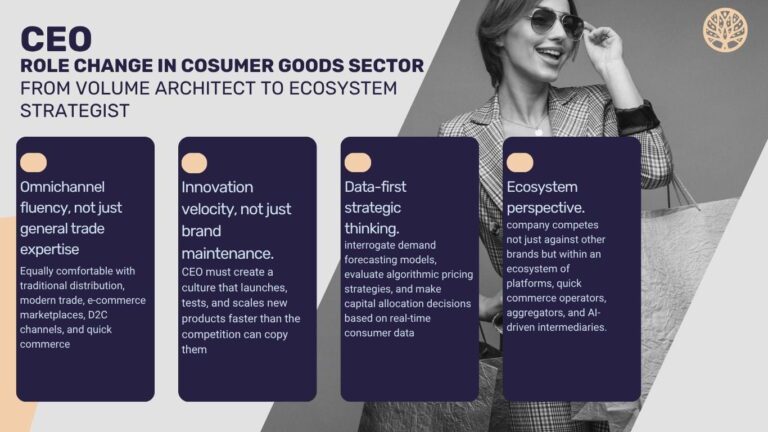
What the Consumer Goods CEO Role Now Demands
Omnichannel fluency, not just general trade expertise
The CEO must be equally comfortable with traditional distribution, modern trade, e-commerce marketplaces, D2C channels, and quick commerce — and must allocate resources based on where the consumer is moving, not where the company has historically been strong. A CEO who treats quick commerce as a “digital team initiative” rather than a board-level strategic priority is already behind.
Innovation velocity, not just brand maintenance.
In a market where private label competitors can replicate product innovations in months, the CEO must create a culture that launches, tests, and scales new products faster than the competition can copy them. This requires a fundamentally different relationship with risk than the one that defined consumer goods leadership for the past generation.
Data-first strategic thinking.
The consumer goods CEO must interrogate demand forecasting models, evaluate algorithmic pricing strategies, and make capital allocation decisions based on real-time consumer data. This is not about being a technologist - it is about treating data as a core input to decision-making, not a report generated by a support function.
Ecosystem perspective.
The CEO must understand that their company competes not just against other brands but within an ecosystem of platforms, quick commerce operators, aggregators, and AI-driven intermediaries. Winning requires partnerships, platform strategies, and commercial models that the traditional FMCG playbook does not cover.
What Boards Should Probe in Consumer Goods CEO Assessments
- Can the candidate articulate a clear view on how quick commerce will reshape their category in the next three years and what strategic bets they would make?
- Have they personally led a significant channel diversification, not delegated it to a CDO or e-commerce head?
- Can they explain how they would compete against a well-funded private label competitor in their core category – beyond running a price promotion?
- Do they have a view on agentic commerce, and how their brand would remain discoverable when purchase decisions are mediated by AI agents?
The leaders who will succeed in India’s consumer goods market will answer with specifics drawn from decisions they have already made, not frameworks they have read about.
For a deeper exploration of how the CEO role is evolving across sectors, see our analysis on The Evolving Role of the CEO in the Age of AI.
The Consumer Goods CFO in India
From Financial Steward to Growth Architect
The consumer goods CFO has traditionally been the guardian of margin discipline. In India’s consumer market of 2026, this role is being expanded in ways that demand a fundamentally different competency profile for a CFO.
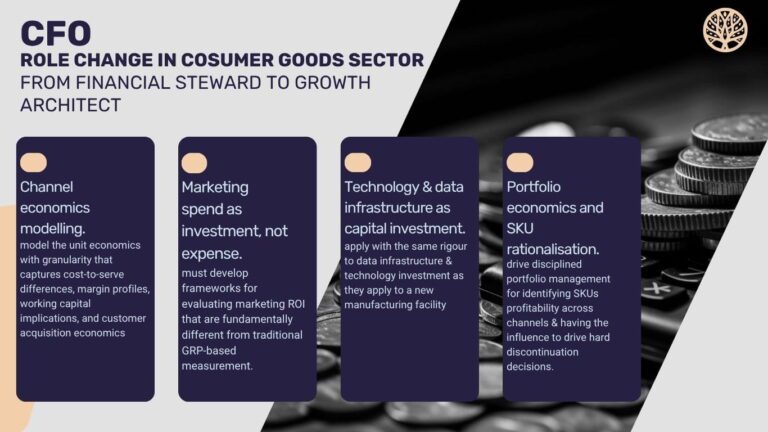
What the Consumer Goods CFO Role Now Demands
Channel economics modelling.
The Consumer Goods CFO must model the unit economics of every channel — general trade, modern trade, e-commerce, D2C, and quick commerce, with granularity that captures cost-to-serve differences, margin profiles, working capital implications, and customer acquisition economics. Quick commerce introduces cost structures (dark store operations, last-mile delivery subsidies, platform commissions) that traditional FMCG financial models were not designed to capture.
Marketing spend as investment, not expense.
As advertising shifts from mass media to performance-led digital, the CFO must develop frameworks for evaluating marketing ROI that are fundamentally different from traditional GRP-based measurement. Attribution models, customer lifetime value, and the blended economics of brand-building versus performance marketing. A CFO who still treats the marketing budget as a discretionary expense to be cut in tight quarters is destroying long-term competitive position.
Technology and data infrastructure as capital investment.
AI-led demand forecasting, supply chain optimisation, and agentic commerce readiness all require significant investment in data infrastructure. The CFO must evaluate these data infrastructure investments with the same rigour they apply to a new manufacturing facility - understanding that the payoff may be measured in competitive advantage and cost avoidance rather than direct revenue attribution.
Portfolio economics and SKU rationalisation.
With private label competition intensifying and channel proliferation increasing complexity, the CFO must drive disciplined portfolio management - identifying which SKUs are genuinely profitable across which channels and having the organisational influence to drive hard discontinuation decisions.
What Boards Should Probe in Consumer Goods CFO Assessments
- Ask the candidate to walk through how they would evaluate a ₹50 crore investment in quick commerce infrastructure versus expanding general trade distribution. The sophistication of the answer reveals whether they can model new-channel economics.
- Probe how they have managed the tension between short-term margin delivery and long-term brand investment. A Consumer goods CFO who has only ever optimised for quarterly EPS may not be the right fit for a company investing through a structural transition.
- Test their fluency with technology investments. Can they articulate the business case for a demand sensing platform? Do they understand the difference between an ERP upgrade and a data infrastructure investment?
The Consumer Goods CHRO in India
From Talent Administrator to Workforce Architect
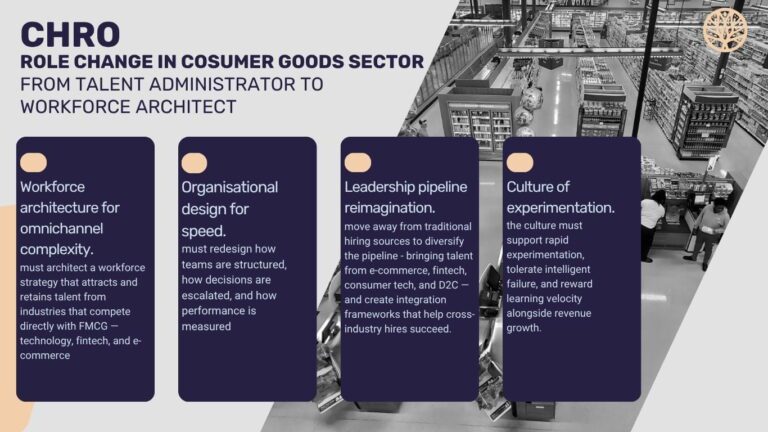
What the Consumer Goods CHRO Role Now Demands
Workforce architecture for omnichannel complexity.
The consumer goods company needs talent across capabilities that barely existed in FMCG five years ago: data science, performance marketing, commerce technology, dark store operations management, platform analytics, and AI/ML engineering. The CHRO must architect a workforce strategy that attracts and retains talent from industries that compete directly with FMCG — technology, fintech, and e-commerce platforms that typically offer higher compensation and a more compelling employer brand for digital talent.
Organisational design for speed.
Traditional FMCG structures - regional sales hierarchies, brand management silos, linear supply chain functions - were built for annual planning cycles and quarterly reviews. Quick commerce demands structures that respond in hours, not quarters. The CHRO must redesign how teams are structured, how decisions are escalated, and how performance is measured.
Leadership pipeline reimagination.
The industry has historically recruited from a narrow pipeline: campus hires from tier-1 B-schools, lateral hires from other FMCG companies. This produces leaders excellent at managing established operations but potentially lacking the digital fluency and platform-thinking the market now demands. The Consumer Goods CHRO must diversify the pipeline — bringing talent from e-commerce, fintech, consumer tech, and D2C — and create integration frameworks that help cross-industry hires succeed.
Culture of experimentation.
In a market where private labels replicate innovations rapidly and agentic commerce may change how consumers discover products, the culture must support rapid experimentation, tolerate intelligent failure, and reward learning velocity alongside revenue growth. This is a profound shift for an industry that has historically rewarded consistency and risk aversion. The CHRO must architect this transformation.
What Boards Should Probe in Consumer Goods CHRO Assessments
- Describe the last significant cross-industry hire you championed and how you ensured their successful integration. CHROs who have never hired outside the FMCG ecosystem may struggle to diversify the pipeline.
- What is your employer branding strategy for digital talent? Why would a data scientist choose an FMCG company over a technology firm? If the answer relies solely on compensation matching, it suggests a lack of strategic talent positioning.
- How would you restructure a traditional brand management team to operate at quick-commerce speed? Look for specificity — decision-making authority, performance metrics, team composition – not generalities about “agility.”
Why Pipal Tree is one of the top executive search firms in India
→ 97% placement success rate across hundreds of leadership mandates.
→ 50+ years of combined search experience across our founding team.
→ 80% repeat engagement rate > our clients come back because our process works.
→ We combine the best practices of a global search firm with the entrepreneurial responsiveness and senior-partner involvement of a boutique consultancy.
The Capability Gap: Where Consumer Goods Leadership Is Most Exposed
Across India’s consumer goods sector, certain capability gaps appear with striking consistency. These are the areas where the current leadership generation is most likely to be underequipped.
-
Quick Commerce Strategy at the Board Level
Most consumer goods companies have quick commerce teams, but few have boards or C-suites that treat quick commerce as a strategic priority rather than a channel management task. The gap is not at execution level. It is at the strategic level — where capital allocation, portfolio design, and organisational structure decisions are made.
-
Data and Analytics Leadership
Consumer goods companies generate enormous volumes of consumer, sales, and supply chain data. The gap is not in data collection but in data leadership — executives who can translate data into competitive advantage. Many consumer goods CXOs approve analytics projects without understanding what the analytics should actually enable.
-
Private Label Competitive Strategy
The default response to private label competition — promotional intensity and trade investment — is a margin-destroying dead end. The capability gap is in brand strategy leadership that can identify where genuine differentiation is defensible and where the company should cede share rather than compete on price.
-
Cross-Industry Talent Integration
Companies that hire digital or technology leaders from outside FMCG frequently report integration failures within the first eighteen months. The gap is not in recruitment but in onboarding and cultural integration. Consumer goods companies know how to onboard FMCG leaders. They do not yet know how to onboard technology leaders.
What Boards Should Do Differently When Hiring Consumer Goods CXO in India
Rewrite the Specification Before You Start the Search
The biggest mistake boards make is using the outgoing CXO’s profile as the template for the replacement. The India consumer market has changed structurally since the current CEO, CFO, or CHRO was appointed. The quality of the job description & specification determines the quality of the search outcome.
Look Beyond the FMCG Talent Pool.
The leaders who will succeed may not come from traditional FMCG backgrounds. The CEO might come from an e-commerce platform company. The CFO might have experience in a D2C or quick commerce business. The CHRO might have built organisational capability in a technology company that scaled rapidly. Boards that limit their search to the usual FMCG-to-FMCG pipeline will miss the candidates who bring the capabilities the market now demands.
Assess for Decisions Made, Not Frameworks Described
In CXO interviews, candidates are typically fluent in the right language — omnichannel strategy, digital transformation, data-driven decision-making. The differentiation is not in language fluency. It is in the specificity of decisions actually made.
Ask: What trade-off did you make between general trade and quick commerce investment? How did you restructure the marketing team when digital exceeded 50% of the budget? What cross-industry hire did you champion, and how did you ensure their success?
Design Compensation for the Talent You Need, Not the Role You Had
If the next CFO needs D2C or e-commerce background, the compensation must reflect that talent pool’s expectations. If the next CHRO needs technology sector experience, they will compare the offer against tech packages, not FMCG benchmarks. These are some of the reasons that top executives decline job offers.
Invest in Post-Placement Integration
When hiring a CXO from outside FMCG, the risk of early failure is materially higher. The cultural operating norms, decision-making rhythms, and stakeholder dynamics in consumer goods are genuinely different from technology, e-commerce, or fintech.
Structured onboarding support — regular check-ins, cultural translation, early-warning mechanisms — can be the difference between a transformative hire and a costly miss.
“The consumer goods CEO who built their career on mass media and general trade distribution was the right leader for a different India. The India of today demands a leader who can compete across five channels simultaneously while an AI agent decides whether your brand even gets considered”
How to Choose the Right Executive Search Partner for Consumer Goods CXO Hiring in India
Not every executive search firm is equipped to handle the complexity of consumer goods CXO hiring in a market undergoing the structural transformation India is experiencing. When evaluating search partners for your next CEO, CFO, or CHRO appointments, separate search firms that will work on these mandates will waste your time. For a comprehensive evaluation framework, see our Guide to Choosing the Right Executive Search Firm in India.
-
Consumer Goods Industry Expertise
Your search partner must understand how India’s consumer goods ecosystem actually works — the general trade dynamics, modern trade negotiations, quick commerce economics, private label competitive pressures, and the regulatory landscape for food, beverage, and packaged goods. A generalist firm that searches across all industries will struggle to evaluate whether a candidate genuinely understands the nuances of Indian FMCG or is merely fluent in the vocabulary.
-
Cross-Industry Talent Access
As this guide has argued, the next generation of consumer goods CXOs may not come from within the FMCG talent pool. Your search partner must have networks that extend into e-commerce, consumer technology, D2C brands, fintech, and digital-first companies — and must know how to position a consumer goods mandate compellingly to candidates from these backgrounds. A firm that can only search within the traditional FMCG ecosystem will deliver the same candidates your competitors are evaluating.
-
Multi-Dimensional Assessment Depth
Consumer goods CXO assessment in 2026 must evaluate candidates across dimensions that standard interview processes do not adequately cover: omnichannel strategic thinking, private label competitive response capability, technology fluency, cultural adaptability for cross-industry hires, and the ability to operate across multiple channel economics simultaneously. Your search partner should bring a structured assessment methodology — not just reference checks and gut instinct. As we outlined in Executive Search or Recruitment: What CXOs & Boards Often Get Wrong, the distinction between rigorous search and reactive recruitment is the difference between finding the right leader and simply filling the role.
-
Post-Placement Integration Support
For consumer goods companies hiring CXOs from outside the FMCG ecosystem, the first twelve months are the highest-risk period. Your search partner should provide structured integration support — not just a congratulatory call after the start date. This means regular check-ins with both the new leader and the company at 30, 60, 90, 180, and 365 days, identifying early misalignment signals and facilitating course corrections before they become terminal.
How Pipal Tree Approaches Consumer Goods CXO Hiring in India
At Pipal Tree Services, our Consumer & Retail executive search practice is built on a principle that applies to every sector but is especially consequential in consumer goods: the search must start with a clear understanding of what the company needs to become, not what the role has historically been.
We have partnered with consumer goods companies across food and beverage, dairy, rice and spices, packaged water, and FMCG categories, placing Managing Directors, CEOs, COOs, CFOs, National Sales Heads, Head of Modern Trade, Marketing Leads, Supply Chain Heads, and Commercial Finance leaders.
Our client engagements span founder-led Indian companies professionalising for the first time, multinational subsidiaries scaling their India operations, and growth-stage companies building complete leadership teams.
We combine strategic mandate clarity with deep market intelligence, rigorous leadership assessment, and post-placement integration support.
Our 80% repeat engagement rate reflects a simple reality: we get the mandate right before we start the search. Among the top executive search firms in India, this commitment to mandate clarity over speed is what distinguishes our approach.
Why Pipal Tree for Consumer Goods Executive Search in India ✓ Purpose-driven alignment — We assess candidates for mission and cultural fit alongside functional competence, ensuring leaders who don’t just fill the role but transform it ✓ Cross-industry talent access — Our networks extend beyond FMCG into e-commerce, D2C, consumer tech, and fintech, giving you access to the non-traditional profiles the market now demands ✓ Deep leadership assessment — Multi-dimensional evaluation covering omnichannel capability, private label response, technology fluency, and cultural adaptability for cross-industry hires ✓ 12-month integration support — Structured check-ins at 30, 60, 90, 180, and 365 days, ensuring your new CXO succeeds beyond the placement |
5 Leadership Hiring Trends Shaping India in 2026
1. Skills-Based Hiring Replaces Pedigree-Based Hiring
Boards are asking fundamentally different questions:
What did this executive actually build?
How did they lead when the plan failed?
What broke under their watch, and how did they fix it?
This shift toward evaluating demonstrated capability rather than career tenure and brand-name employers is changing how the best search firms evaluate candidates.
2. ESG and Governance Are Non-Negotiable Leadership Competencies
Environmental, social, and governance credentials have moved from peripheral to central. Boards seek CXOs who can balance performance with responsibility, navigate regulatory scrutiny, and earn trust from employees, regulators, investors, and communities simultaneously.
3. Distributed Leadership Models Are Expanding the Talent Map
Hiring in tier-2 cities surged over 20% year-on-year in 2025, overtaking metro hiring growth. Cities like Pune, Ahmedabad, Coimbatore, and Jaipur are becoming serious leadership bases. This geographic expansion is reshaping how executive search firms source and evaluate candidates.
4. AI-Augmented Search Is Enhancing Human Judgment
Over 70% of executive search firms globally are expected to integrate AI-driven talent intelligence tools by 2026. But the most successful outcomes emerge when data-led insights are combined with deep human evaluation. AI enhances candidate identification; human judgment drives the assessment that ultimately determines leadership fit.
5. Startups Are Competing Head-to-Head with Established Firms for CXO Talent
India’s startup ecosystem now competes aggressively for senior leadership, offering equity-based packages and purpose-driven roles. This intensifies competition across the entire market — established companies, GCCs, and startups are all fishing in the same leadership talent pool. For founders, the critical question is whether to continue building their leadership team independently or to bring in a search partner who understands the unique dynamics of leadership hiring for startups.
Frequently Asked Questions On Consumer Goods CXO Hiring in India
Should we hire a consumer goods CEO from within FMCG or from an adjacent industry?
It depends on where the company is in its transformation. If the primary challenge is scaling a traditional FMCG business, an industry veteran brings invaluable trade relationships and operational experience. But if the strategic imperative is building omnichannel capability or competing against platform-backed private labels, a CEO with e-commerce, D2C, or consumer technology experience may bring the capabilities the company lacks. The best candidates often blend both — deep consumer understanding with digital and platform fluency.
How important is quick commerce experience for a consumer goods CEO in India?
Increasingly non-negotiable — at least as a dimension the CEO has actively engaged with. Quick commerce is projected to capture a substantial share of urban FMCG spend within 2–3 years. A CEO who treats it as a channel management task delegated to the e-commerce team is not prepared for the strategic implications it carries.
What is the right CFO profile for a consumer goods company navigating the shift to omnichannel?
Look for a CFO who has managed businesses with multiple channel economics simultaneously.
The critical capability is not traditional cost accounting but the ability to model profitability at the channel, customer, and SKU level across general trade, modern trade, e-commerce, and quick commerce. D2C unit economics or marketplace fee structure experience is increasingly valuable.
How do we attract digital and technology talent into a traditional FMCG company?
Compensation is necessary but insufficient.
The employer value proposition must include genuine decision-making authority, access to meaningful consumer data at scale, a visible career path beyond a “digital team,” and a culture that values experimentation. The Consumer Goods CHRO must architect this deliberately.
What makes consumer goods CXO hiring in India different from other sectors?
Three things make it distinctive.
First, the pace of channel disruption – quick commerce, agentic commerce, D2C, is faster in Indian consumer goods than almost any other sector.
Second, the private label threat requires a specific competitive capability that candidates from other industries may lack.
Third, the cultural gap between traditional FMCG operations and the digital-first capabilities the company needs means cross-industry hires carry higher integration risk – making post-placement support essential rather than optional.
A executive search firm that understands all three dimensions will deliver materially better outcomes than a generalist.
These FAQs cover the most common questions we hear from hiring teams from Consumer Goods Sector.
For a more broader questions on fees, timelines, and how the executive search process works, visit our Executive Search FAQ section.
Why Pipal Tree is one of the top executive search firm in India
97% placement success rate across hundreds of leadership mandates.
50+ years of combined search experience across our founding team.
80% repeat engagement rate > our clients come back because our process works.
We combine the best practices of a global search firm with the entrepreneurial responsiveness and senior-partner involvement of a boutique consultancy.
The Board’s Most Consequential Decision
India’s $2.4 trillion consumer market is not waiting for leadership teams to catch up. The companies that act now — redefining their CXO specifications, broadening their talent search beyond traditional FMCG pipelines, and investing in rigorous assessment and post-placement integration — will capture disproportionate share of the growth ahead.
If your board is evaluating its next CEO, CFO, or CHRO appointment for a consumer goods company in India, we can help. Our approach starts with defining the mandate before the search begins — ensuring you are searching for the right leader, not just filling the role the outgoing executive held.
Our mission-aligned approach combines deep market intelligence, structured leadership assessment, and sustained post-placement support to ensure your next hire becomes your next competitive advantage.
If you’d like to discuss how we can strengthen your leadership team, reach out to me at [email protected].
We can help define the mandate before the search begins. Because in a $2.4 trillion market, the most expensive mistake is not a bad quarter — it’s the wrong leader.

Sonia Sharma
"With over 25 years in talent leadership, including 20+ years in executive search. Sonia brings valuable dual perspective as Pipal Tree's CEO & founder. Her career spans both consultancy roles at prestigious firms (Korn/Ferry International, Accord India, Stanton Chase) and corporate leadership. Sonia specializes in executing confidential, high-stakes searches for global and Indian multinationals."