

What Are the Types of CFO, and Which One Does Your Business Need?
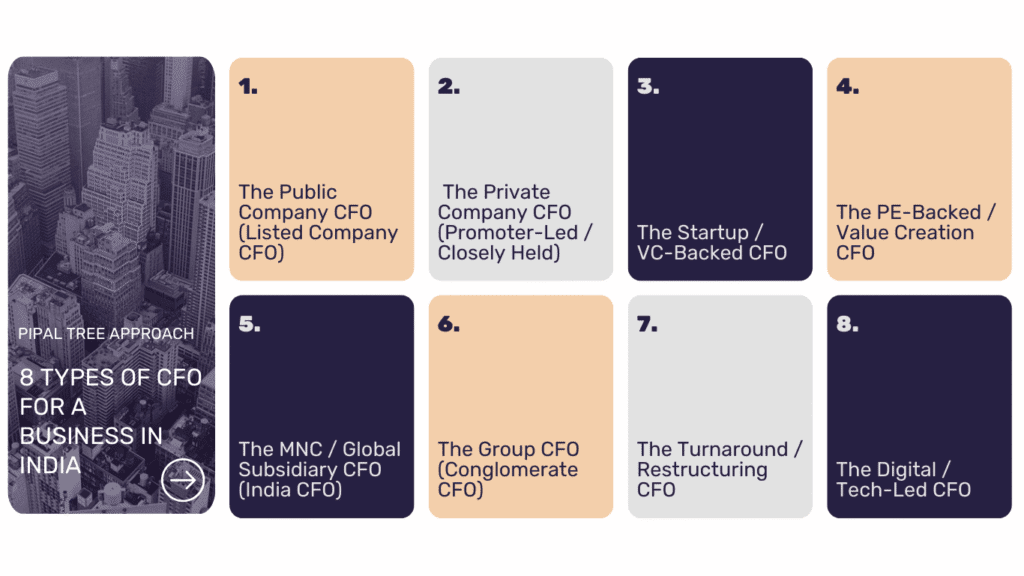
Indian businesses hire eight broad types of CFO – Public Company, Promoter-Led, Startup/VC-Backed, PE-Backed, MNC India, Group, Turnaround, and Digital. Each suits a specific ownership structure, growth stage and capital strategy, so the real decision isn’t finding the “best” CFO – it’s matching the right type to the moment your business is in.
Table of Contents
Why Indian companies must match CFO capability with ownership structure, business stage, and capital strategy
Hiring a CFO is no longer about finding the “best finance professional.”
It’s about finding the right type of CFO for your business model, ownership structure, and stage of evolution.
– A CFO who thrives in a listed company may fail in a PE-backed turnaround.
– A startup CFO may struggle in a promoter-led manufacturing enterprise.
– And a compliance-first CFO can slow down a growth-stage business.
Understanding the 8 distinct types of CFOs can help boards and founders think more clearly about fit, mandate, and timing – not just pedigree.
Why CFO Fit Matters More Than Ever
In India, the CFO role has expanded far beyond accounting and compliance. Today’s CFO may be expected to:
- Manage capital markets and investors
- Act as a strategic counterweight to the CEO
- Navigate complex regulation and taxation
- Drive cash discipline and value creation
- Prepare the company for IPOs, exits, or restructuring
Yet many CFO hiring failures happen because companies hire the wrong archetype for the moment they are in.
Before looking at resumes, it helps to step back and ask: What kind of CFO does our business actually need right now?
CFO Types: Which of These 8 CFO Types Does Your Business Need?
1. The Public Company CFO (Listed Company CFO)
Best suited for
Listed companies or IPO-ready businesses
Core role
- Investor relations and earnings credibility
- SEBI, Ind AS, and governance compliance
- Board and Audit Committee leadership
- Capital allocation, dividends, buybacks
What makes them effective
Public Company CFOs bring market confidence. They are trusted by analysts, investors, regulators, and auditors – and understand that perception, disclosure, and consistency matter as much as numbers.
When they’re the wrong fit
Early-stage, founder-driven, or fast-changing businesses where flexibility and speed matter more than predictability.
Also Read : How to Hire a CFO for a Manufacturing Company in India
In practice
Listed Manufacturing Company | ₹8,000+ Cr Market Cap
A listed manufacturing company facing margin volatility saw valuation pressure due to inconsistent disclosures. A seasoned Public Company CFO stabilized reporting, strengthened investor communication, and restored market confidence within four quarters.
Key insight
In Indian listed companies, a Public Company CFO's credibility can directly influence market capitalization.
2. The Private Company CFO (Promoter-Led / Closely Held)
Best suited for
Family-owned and closely held companies
Core role
- Cash flow and working capital control
- Banking relationships and credit management
- Tax optimization and structuring
- Trusted advisor to promoters
What makes them effective
Family Businesses CFO understand the informal realities of Indian business – balancing governance with pragmatism, and professionalism with promoter expectations.
When they’re the wrong fit
PE-backed or public-market-facing environments that require formal reporting, speed, and institutional discipline.
In practice
Family-Owned Industrial Group | 40+ years old
Strong revenues masked chronic cash flow issues due to long receivables, informal credit decisions, and weak MIS. A Private Company CFO imposed working capital discipline without disrupting promoter relationships, professionalized banking interactions, and introduced monthly cash forecasting. The working capital cycle improved by 25–30 days, and promoter dependence on short-term borrowing reduced significantly.
Key insight
In India, the most effective promoter-led CFOs succeed through trust, not authority.
3. The Startup / VC-Backed CFO
Best suited for
VC-funded startups (Series A–D)
Core role
- Runway management and burn control
- Fundraising support and investor reporting
- Unit economics and cohort analysis
- Building finance systems from scratch
What makes them effective
They combine financial rigor with storytelling, helping investors understand the business while enabling growth.
When they’re the wrong fit
Mature, asset-heavy, or highly regulated businesses requiring deep compliance and process stability.
In practice
Series C SaaS Startup | India + US customers
Rapid growth, rising burn, and increasing investor scrutiny ahead of the next funding round created pressure. A VC-Backed CFO clarified unit economics by cohort, extended runway by 9 months without slowing growth, and built investor-grade reporting. Metrics aligned to global SaaS benchmarks, enabling a successful Series D raise.
Key insight
VC-backed CFOs in India must combine financial rigor with founder-friendly communication.
4. The PE-Backed / Value Creation CFO
Best suited for
Private equity portfolio companies
Core role
- EBITDA improvement and cash conversion
- Tight MIS and performance dashboards
- M&A integration and carve-outs
- Exit readiness (IPO or strategic sale)
What makes them effective
They are results-driven, comfortable with aggressive targets, and aligned with time-bound value creation.
When they’re the wrong fit
Promoter-led businesses expecting loyalty over performance, or long-term stewardship without exit pressure.
In practice
PE-Owned Healthcare Platform | Buy-and-Build Strategy
Multiple acquisitions led to fragmented systems, margin leakage, and inconsistent reporting across units. A PE-Backed CFO standardized MIS across portfolio companies, drove EBITDA improvement of 400+ bps within 18 - 24 months, and prepared a clean data room that enabled a strategic sale at premium valuation.
Key insight
PE-backed CFOs in India operate with a clock—speed and execution matter more than perfection.
5. The MNC / Global Subsidiary CFO (India CFO)
Best suited for
Indian arms of global corporations
Core role
- Global reporting (IFRS / US GAAP) to Ind AS
- Transfer pricing and cross-border tax
- Internal controls and compliance with HQ standards
- Localization of global strategy
What makes them effective
They operate comfortably between global governance and Indian complexity, acting as interpreters between headquarters and local realities.
When they’re the wrong fit
Highly entrepreneurial or loosely structured Indian businesses that resist global processes.
Also read : How global companies hire senior leaders for India operations
In practice
Indian Subsidiary of a Global Engineering MNC
Frequent friction between global HQ expectations and Indian regulatory realities (tax, GST, transfer pricing) created audit escalations. An MNC India CFO aligned global reporting with Indian compliance, defended transfer pricing positions, and educated HQ on Indian market constraints. This reduced audit escalations, enabled smoother global reviews, and improved trust between India leadership and HQ.
Key insight
India CFOs in MNCs act as translators between global governance and local complexity.
6. The Group CFO (Conglomerate CFO)
Best suited for
Diversified business groups and holding companies
Core role
- Capital allocation across businesses
- Group treasury and debt structuring
- M&A, divestments, and portfolio rationalization
- Governance across subsidiaries
What makes them effective
They think like capital allocators, not accountants, and are deeply trusted by promoters or the board.
When they’re the wrong fit
Single-business companies needing hands-on operational finance leadership.
In practice
Diversified Indian Business House | Manufacturing, Logistics, Real Estate
Capital spread thin across unrelated businesses with uneven returns. A Group CFO reallocated capital to high ROCE businesses, centralized treasury and debt management, and supported selective divestments. Group ROCE improved materially, and debt costs reduced through consolidated negotiations.
Key insight
In Indian conglomerates, the Group CFO often shapes strategy as much as the Chairman's office.
7. The Turnaround / Restructuring CFO
Best suited for
Distressed, leveraged, or underperforming companies
Core role
- Liquidity crisis management
- Lender negotiations and restructuring
- Cost rationalization and asset monetization
- Insolvency and IBC processes
What makes them effective
They are calm under pressure, decisive, and deeply familiar with Indian banks, creditors, and legal frameworks.
When they’re the wrong fit
High-growth businesses where culture-building and expansion matter more than survival.
In practice
Leveraged Infrastructure Company | Banking Stress
Mounting losses, delayed payments, and strained lender relationships pushed the company toward insolvency. A Turnaround CFO managed liquidity on a weekly basis, negotiated with Indian banks and NBFCs, and led restructuring and asset monetization. The company avoided insolvency, completed debt restructuring, and stabilized operations.
Key insight
Turnaround CFOs in India must be deeply fluent in banking dynamics and creditor psychology.
8. The Digital / Tech-Led CFO
Best suited for
SaaS, fintech, platform, and tech-forward businesses
Core role
- Finance automation and real-time MIS
- Advanced analytics and forecasting
- ERP, dashboards, and data-driven decisions
- Close partnership with product and tech teams
What makes them effective
They use technology to turn finance into a strategic nervous system, not a reporting function.
When they’re the wrong fit
Traditional businesses without the appetite or readiness for digital transformation.
In practice
Fintech / Platform Business | High Transaction Volumes
Finance team overwhelmed by manual reporting; leadership lacked real-time visibility. A Digital CFO implemented automated dashboards and ERP, shifted from monthly to real-time MIS, and enabled data-driven decision-making. Close cycle reduced from 12 days to 4 days; leadership gained daily visibility into unit economics.
Key insight
India's next generation of CFOs are as comfortable with data and systems as they are with balance sheets.
How to Find the Right CFO for Your Business
Instead of asking “Who is the best CFO?“, boards should ask:
- What stage is our company at today?
- Who are our capital providers?
- What is the 12–24 month mandate for the CFO?
- Do we need stability, growth, value creation, or survival?
The right CFO is the one whose experience matches your moment, not just your ambition.
Finding the Right Fit: A Decision Framework
Selecting the right CFO type requires honest assessment across four dimensions:
- Regulatory Complexity
- Low Complexity: Private companies, early-stage startups → Consider VC-Backed CFO, Traditional Family Business CFO
- Medium Complexity: PE-backed companies, MNC subsidiaries → Consider PE-Backed CFO, MNC India CFO
- High Complexity: Listed companies, PSUs, financial services → Consider Public Market CFO, PSU CFO
- Capital Markets Sophistication
- No Capital Markets Exposure: Traditional businesses, small private companies → Consider Traditional Family Business CFO, Turnaround CFO
- Moderate Exposure: PE/VC-backed, pre-IPO → Consider PE-Backed CFO, VC-Backed CFO, Pre-IPO CFO
- High Exposure: Public companies, frequent capital raisers → Consider Listed Company CFO, Unicorn CFO, Post-IPO CFO
- Stakeholder Complexity
- Simple: Single promoter, founder-led, small investor base → Consider VC-Backed CFO, Traditional Family Business CFO
- Moderate: Multiple PE funds, family shareholders, MNC reporting → Consider PE-Backed CFO, Professionalizing Family Business CFO, MNC India CFO
- Complex: Public shareholders, government, multiple geographies → Consider Listed Company CFO, PSU CFO, MNC India CFO (JV)
- Growth Stage
- Mature/Stable: Established businesses, slow growth → Consider PSU CFO, Listed Company CFO, Traditional Family Business CFO
- Growth: Scaling businesses, 20-40% annual growth → Consider PE-Backed CFO, Pre-IPO CFO, Professionalizing Family Business CFO
- Hypergrowth: >40% growth, aggressive expansion → Consider VC-Backed CFO, Unicorn CFO, Platform CFO
Red Flags: Common Mismatches
Understanding mismatches is as important as understanding fits. Here are combinations that typically don’t work:
- Public Company CFO → Early-Stage Startup
Public company CFOs are accustomed to established systems, predictable rhythms, and comprehensive teams. Early-stage chaos and ambiguity can be paralyzing. - VC-Backed CFO → Traditional Family Business
Startup CFOs expect data-driven decisions and meritocratic cultures. Family dynamics and relationship-based decision-making can frustrate them. - MNC CFO → Indian Promoter-Led Company
MNC process orientation and committee-based decisions clash with entrepreneurial speed and individual decision-making. - Family Business CFO → PE-Backed Company
PE’s aggressive performance culture, leverage comfort, and exit timelines differ vastly from patient family capital. - Single-Country CFO → Multi-Geography Listed Entity
Complexity of transfer pricing, multiple regulators, and cross-border treasury can overwhelm domestic-only experience.
The Hybrid CFO: When You Need Multiple Skill Sets
Some situations demand CFOs with experience across multiple categories:
- PE-Backed Company Planning IPO
Ideal: CFO with both PE-backed and Pre-IPO/Listed company experience who understands PE value creation and exit preparation, can build IPO-ready infrastructure, and manages transition from private to public ownership. - Family Business Taking PE Investment
Ideal: CFO with both Family Business and PE-backed experience who navigates family sensitivities, implements PE-required governance, and bridges cultural gaps. - MNC India Planning Partial Exit
Ideal: CFO with both MNC and Listed/PE-backed experience who maintains global coordination, manages local listing or PE sale process, and handles transition to local majority ownership. - Unicorn Preparing for IPO
Ideal: CFO with VC-backed and Pre-IPO/Listed experience who understands hypergrowth economics, builds public company infrastructure, and manages VC-to-public investor transition
“The boards that succeed don’t ask ‘who’s the best CFO?‘
They ask ‘who’s the right CFO for our ownership structure, growth stage, and what we’re building toward?‘
That one shift in thinking changes everything about the search.”
Beyond the Resume: Cultural and Leadership Fit
Technical experience with the right CFO type is necessary but insufficient.
Consider these softer dimensions:
- Decision-Making Style: Does your organization value consensus or speed? Does the CFO’s style match?
- Communication Approach: Does the CFO communicate in board presentations, investor calls, or team meetings in a way that resonates with your culture?
- Risk Appetite: Is the CFO’s comfort with financial risk (leverage, working capital management, investment decisions) aligned with the organization’s tolerance?
- Change Management: If transformation is needed, does the CFO have a track record of driving change without destroying morale?
- Team Building: Will the CFO build versus buy talent? Is this approach compatible with your organization’s philosophy?
Making the Call: Questions for Board Discussions
When evaluating CFO candidates, boards should address:
- Where are we today?
What type of organization are we currently (ownership, regulatory environment, growth stage)? - Where are we going?
What transitions are planned in the next 3-5 years (IPO, PE exit, acquisitions, international expansion)? - What’s our biggest financial risk?
Is it compliance, liquidity, investor relations, or something else? Which CFO type is best equipped to manage this? - What’s our CEO’s superpower and gap?
Does the CEO need a finance partner who complements them or completes them? - What’s our board’s sophistication?
Do we need a CFO who can educate or one who can engage at a high level immediately? - What’s non-negotiable?
What experience or skills are absolute must-haves versus nice-to-haves?
Frequently Asked Questions on CFO Types in India
What are the 8 types of CFO?
The eight types exist because a CFO’s fit depends on ownership structure and stage, not seniority alone – a Listed-Company CFO and a Turnaround CFO solve completely different problems.
The Listed and Group CFOs manage capital markets and portfolio-level allocation; the Promoter-Led and MNC India CFOs bridge trust and global governance respectively; the Startup, PE-Backed, Turnaround and Digital CFOs are each built for a specific pressure — runway, value creation, survival or finance automation.
The art is matching the archetype to the problem in front of you.
How do I choose the right type of CFO for my business?
Start with four questions:
1. What stage the company is at,
2. Who your capital providers are,
3. What the CFO’s 12–24 month mandate is, and
4. Whether you need stability, growth, value creation or survival.
The right CFO is the one whose experience matches your current moment and regulatory complexity, not simply the most impressive résumé.
What is the difference between a family business CFO and an MNC CFO?
A promoter-led (private company) CFO succeeds through trust, cash-flow discipline and banking relationships, operating with pragmatism alongside the promoter.
An MNC India-subsidiary CFO operates between global reporting standards (IFRS/US GAAP to Ind AS), transfer pricing and HQ governance. The two environments reward different instincts, which is why moving a leader directly from one to the other often fails.
Can a listed-company CFO succeed in a startup?
Rarely without friction.
A Public Company CFO used to established systems and predictable rhythms often struggles with early-stage ambiguity, just as a VC-backed CFO can be frustrated by family-business decision-making. Some situations need a hybrid CFO with experience across both worlds, such as a PE-backed company preparing for an IPO.
What is a Group CFO and when does a business need one?
A Group (Conglomerate) CFO oversees capital allocation, treasury and governance across multiple businesses in a diversified group or holding company, thinking like a capital allocator rather than an operational accountant. A single-business company usually needs hands-on operational finance leadership instead, and only requires a Group CFO as the portfolio and subsidiary structure grows.
What happens if you hire the wrong type of CFO?
Hiring the wrong archetype for the moment is one of the most common reasons CFO hires fail: the person may be highly capable but mismatched to the ownership structure, regulatory environment or growth stage. The consequences range from slowed decision-making to missed capital-market opportunities. Defining the CFO type before the search, not after, is what prevents this.
These FAQs cover the most common questions we get asked when it comes to understanding what type of CFO to hire.
For a more broader questions on fees, timelines, and how the executive search process works, visit our Executive Search FAQ section.
For Search Firms and Recruiters: Refining Your Brief
Executive search becomes dramatically more effective with a precise CFO type definition. Rather than generic “CFO needed for growing company,” when creating a job description for the CFO role articulate:
- Primary CFO type needed (e.g., “PE-Backed CFO”)
- Secondary experiences valued (e.g., “with Pre-IPO experience preferred”)
- Deal-breakers (e.g., “must have managed debt restructuring”)
- Growth trajectory (e.g., “preparing for IPO in 24 months”)
- Stakeholder complexity (e.g., “3 PE funds plus founder on board”)
- Cultural nuances (e.g., “founder-led, fast-paced, comfortable with ambiguity”)
This specificity helps candidates self-select and allows you to benchmark compensation, evaluate experience relevance, and set realistic timelines.
Final Thought
CFOs are not interchangeable. They are contextual leaders, shaped by ownership, regulation, capital, and timing.
By understanding the 8 types of CFOs, founders and boards can move from reactive hiring to strategic leadership alignment and dramatically improve the odds of long-term success.
The CFO hire is arguably the most critical leadership decision a board makes after the CEO.
The right CFO can unlock value, navigate complex transitions, and build organizational capabilities that compound over time.
The wrong CFO can derail strategies, miss market opportunities, and create compliance or capital market disasters.
By understanding the eight types of CFOs and thoughtfully matching them to your organization’s ownership structure, regulatory environment, capital markets exposure, and growth stage, you dramatically increase the odds of finding not just a competent financial leader, but the right financial leader for your specific context.
The question isn’t “Who is the best CFO?” but rather “Who is the best CFO for us, right now, given where we’re going?”
Answer that question with precision, and you’ll have found your strategic finance partner.
About This Framework
This framework is designed for boards, PE/VC funds, and top executive search firms operating in the Indian business ecosystem.
It reflects the unique regulatory environment (SEBI, RBI, Companies Act, Ind AS), ownership structures (promoter-driven, family-owned, PE-backed), and capital markets realities of India.
For boards and search committees, we recommend using this framework as a starting point for discussion, then customizing based on your specific industry, geography, and organizational culture.
The best CFO hires come from clarity about what you truly need, not from chasing the most impressive resume.
At Pipal Tree Services, we specialize in CFO search and board advisory services that help Indian businesses find the right financial leadership for their unique context.
Our deep understanding of the Indian business ecosystem enables us to match organizations with CFOs who don’t just have the right credentials—but the right fit.

Sonia Sharma
"With over 25 years in talent leadership, including 20+ years in executive search. Sonia brings valuable dual perspective as Pipal Tree's CEO & founder. Her career spans both consultancy roles at prestigious firms (Korn/Ferry International, Accord India, Stanton Chase) and corporate leadership. Sonia specializes in executing confidential, high-stakes searches for global and Indian multinationals."

[…] dismantle these roadblocks. One global firm, for instance, used AI to anonymize résumés and scan job descriptions for biased language, resulting in fairer and more diverse shortlists. A leading tech giant deployed […]