

When to Hire a CHRO in India?
A company needs a CHRO when people decisions have become strategic and board-level – not simply when the HR team or workforce grows. An HR Head primarily owns execution of the people function; a CHRO owns the strategic people agenda as a business and leadership issue. The two are not the same role at different levels of seniority – they solve different people problems, at different altitudes.Table of Contents
A promoter-owned electrical components manufacturer we worked with came to us with a people problem it had never faced before.
For two decades it had been a focused B2B business – selling to OEMs and industrial buyers, with a workforce, a culture and an HR function built entirely around that world.
Now the promoter wanted to do two things at once: keep scaling the core B2B business, and stand up an entirely new B2C line selling directly to consumers.
The instinct was to hire “a senior HR person to handle the growth.”
But as we worked through the brief, it became clear the company was facing two different people challenges at two different levels.
Running B2B and B2C under one roof means two talent markets, two compensation logics, two employer brands, two cultures and two very different rhythms of work – and someone had to own that as strategy, across the group.
At the same time, the day-to-day HR machine still had to run, and run well.
The company didn’t have to choose between a CHRO and an HR Head. It needed both – because the business had two different people problems operating at two different altitudes.
A CHRO and an HR Head are not the same role at different levels of seniority. They solve different people problems, at different altitudes.
This is a guide for the founder, promoter or board director weighing a first CHRO – or trying to work out whether the business needs one at all, or simply a stronger HR Head.
When Does a Company Need a CHRO?
The trigger is strategic complexity in people decisions – not headcount.
A company needs a CHRO when people decisions have become strategic and board-level – not simply when the HR team or workforce grows.
That point usually arrives with scale and organisational complexity, rapid growth or M&A, the launch of a new business or vertical, a fragile leadership pipeline, culture or attrition risk, or a CEO who needs a genuine strategic partner on talent rather than an administrative HR function.
CHRO vs HR Head: A Question of Altitude
The difference is not seniority. It is the altitude at which the people problem sits.
The most common error we see is treating this as a hierarchy question – as though a CHRO is simply an HR Head with a larger title and a bigger team.
That framing is what leads companies to promote their way into a role they have not actually created.
The clearer way to think about it is altitude: the level at which the people problem sits, and therefore the level at which someone has to own it.
| Operational altitude – HR Head | Strategic altitude – CHRO |
| Hiring execution | Organisation design |
| Employee relations | Leadership pipeline |
| HR systems | Succession |
| Compliance | Culture |
| Payroll | Workforce strategy |
| Policy | Transformation |
| Day-to-day people operations | Board-level people agenda |
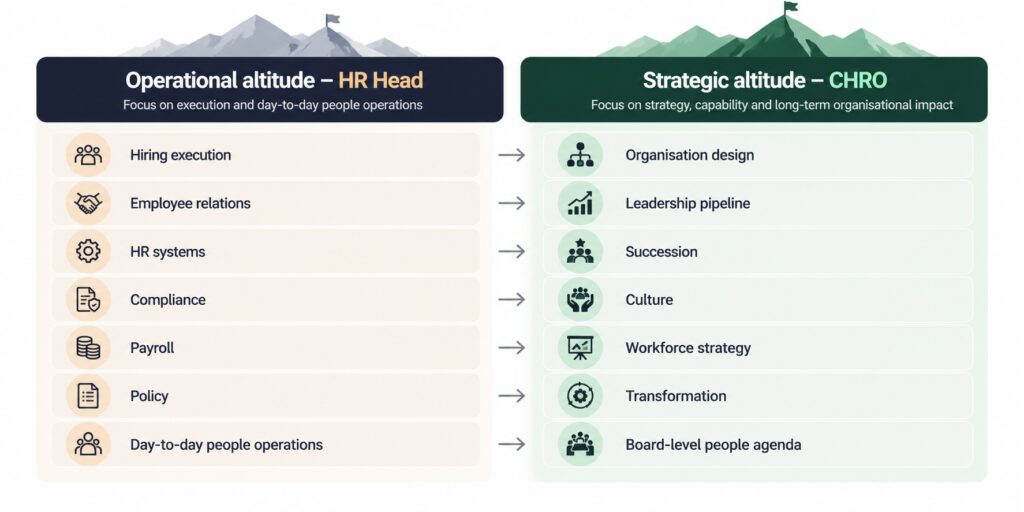
HR Head: primarily owns execution of the people function.
CHRO: owns the strategic people agenda as a business and leadership issue.
These are each role’s centre of gravity, not its fence.
A strong HR Head thinks strategically, and a strong CHRO cares a great deal about whether payroll runs cleanly.
The difference is not what each one is capable of noticing – it is what each one is accountable for owning.
Also read: Why HR, Talent Acquisition and Business Leaders Must Build Talent Together
“The mistake is treating this as a seniority question – as though a CHRO is just an HR Head with a bigger title.
They solve different problems. One owns whether the people function runs well.
The other owns whether the organisation is built to deliver the strategy.
A company that needs both and hires only one will feel the gap inside a year, and will usually blame the person rather than the design.”
What Is a Group CHRO and When Does a Business Need One?
When people strategy spans more than one business.
A Group CHRO is responsible for people strategy across multiple businesses or operating companies within a group. The role becomes particularly relevant when different businesses have distinct talent markets, cultures, operating models or leadership requirements, but still need a common approach to leadership, succession, organisation design and workforce strategy.
This is a familiar shape in India, where promoter-owned groups often run several businesses under one ownership structure. Especially when a new vertical, a consumer-facing launch or an acquisition can suddenly place two very different organisations side by side.
The manufacturer in the opening is a clean example.
A B2B industrial business and a new B2C consumer business do not just sell differently; they hire from different talent pools, pay on different logics, build different employer brands, and run at different speeds.
Left alone, they drift into two unrelated organisations that happen to share a promoter. Forced into one template, the consumer business gets strangled by industrial-era processes.
Holding both together – common leadership standards and succession discipline, different operating cultures – is a strategic-altitude responsibility, and it typically sits beyond the remit of an HR Head focused on functional execution.
The 7 Signs You Need a CHRO (Not Just a Bigger HR Team)
The signal is rarely that HR is overloaded. It is that the decisions the business now faces have moved above the altitude at which the people function currently operates.
Scale and organisational complexity.
The org has grown past the point where structure, spans and accountability can be worked out informally.
Rapid growth or M&A.
Integration, harmonisation and cultural alignment become live business risks, not HR projects.
A new business line or vertical.
A second business with a different talent market and culture needs people strategy owned across both.
A fragile leadership pipeline.
Key roles have no credible internal successor, and every senior gap becomes an external search.
Culture or attrition risk.
Senior and critical-talent attrition is starting to cost the business strategically, not just operationally.
Board or investor scrutiny of talent.
Leadership depth, succession and key-person risk have become board agenda items.
A CEO without a strategic partner on people.
The CEO is making organisation and talent calls alone, because there is no one at the table to make them with.
One of these on its own rarely justifies the hire.
Several of them together, all pointing above the operational line, usually does.
When You Do NOT Need a CHRO (Yet)
Sometimes the honest answer is a stronger HR Head – and a CEO who is not yet ready for a CHRO.
If the people function is straining on execution – hiring throughput, compliance, systems, employee relations – then the answer is a stronger HR Head or VP HR, not a CHRO. Appointing a strategic leader to fix an operational problem is expensive and, in our experience, it fails on both counts.
The harder case is the company where the people problems genuinely are strategic, but the CEO or promoter does not want them treated that way. A CHRO can only operate at strategic altitude if the organisation has actually created room at that altitude – a seat in the strategy conversation, access to the board, and real ownership of organisation and talent decisions.
A strategic CHRO cannot create a strategic people mandate where the CEO or promoter only wants an HR administrator.
Pipal Tree Insight
In Practice: The Company That Needed Both
The brief that arrived was for one senior HR leader.
What the business actually had was two people problems at two altitudes: a group-level strategy question created by running B2B and B2C together, and an operational people function that still had to run a growing manufacturing organisation every day.
The company hired a Group CHRO and an HR Head. The Group CHRO took ownership of people strategy across both businesses - organisation design for the new consumer vertical, leadership standards and succession common to the group, and the workforce strategy for two different talent markets.
The HR Head owned execution of the people function and reported into the Group CHRO, which kept one line of accountability rather than two competing ones.
The lesson was not that every company needs two hires. It was that the company stopped asking which title it needed, and started asking what altitude each of its people problems was operating at. The structure followed from that.
What Actually Changes When You Bring in a CHRO
Four shifts – and if none of them happen, you have changed a title, not a mandate.
| From | To |
| HR execution | People strategy |
| HR reporting | Workforce intelligence |
| Hiring | Leadership pipeline |
| Management discussions | Board-level talent decisions |
Each shift changes what the organisation expects the role to own.
HR reporting becomes workforce intelligence when the question moves from “What happened last quarter?” to “What capabilities will we be short of in two years?”
Filling vacancies becomes building a leadership pipeline when the organisation moves beyond meeting immediate hiring needs to identifying, developing and preparing successors for critical roles.
Management discussions become board-level talent decisions when leadership depth, succession risk and organisational capability are treated as business priorities rather than HR metrics.
The shift is not simply from a more junior HR leader to a more senior one.
It is from running the HR function to owning the people agenda as a strategic business responsibility.
Because the role is defined by the problem, the first question is not ‘What does a CHRO do?’ but ‘What people and organisational challenges must this leader own?’
“We see CHROs appointed into companies that never actually wanted a CHRO.
The title changes, the business card changes, and the mandate stays exactly where it was – hiring, payroll, compliance.
A year in, everyone concludes the CHRO did not work out.
The hire was rarely the problem.
The mandate was never created.”
What to Look For In a CHRO
The shift is from running the function well to owning the people agenda as a business issue.
Once the altitude question is settled, the profile follows from it: someone who has operated as a genuine business partner rather than a functional head, who can hold organisation design and succession as strategy, and who has the credibility to be heard in a board conversation.
The specific capabilities a modern CHRO needs – people analytics, ethics as AI expands across the enterprise, change leadership and skills forecasting – we cover in depth in 4 Essential CHRO Competencies.
How the CHRO Hire Goes Wrong
The failures we see are usually mandate problems dressed up as hiring problems.
Title inflation.
The HR Head is renamed CHRO and the mandate never changes – the failure we see most often.
The wrong reporting line.
A CHRO placed under a CFO or COO, with no direct access to the CEO or the board, cannot operate at the altitude the title implies.
A strategist hired into an administrative mandate.
Or the reverse: a strong operator hired to do strategic work they were never asked to do before.
Expecting one person to cover both altitudes.
In a business with real operational load and real strategic complexity, asking one leader to own both usually means the urgent work crowds out the important work.
Frequently Asked Questions on Hiring a CHRO in India
Does a mid-sized Indian company need a CHRO?
A mid-sized company does not need a CHRO simply because it has reached a particular revenue or employee threshold. The need usually emerges when people decisions have become strategic – through multiple businesses, rapid growth, leadership complexity, transformation, succession or significant talent risk.
What is the difference between a CHRO and an HR Head or VP HR?
An HR Head or VP HR primarily owns execution of the people function – hiring, employee relations, systems, compliance, payroll and policy.
A CHRO owns the strategic people agenda as a business and leadership issue – organisation design, leadership pipeline, succession, culture, workforce strategy and the board-level people agenda. The difference is altitude, not seniority.
What is a Group CHRO, and when do you need one?
A Group CHRO is responsible for people strategy across multiple businesses or operating companies within a group. It becomes relevant when different businesses have distinct talent markets, cultures, operating models or leadership requirements, but still need a common approach to leadership, succession, organisation design and workforce strategy – for example, a promoter-owned group running running multiple businesses or have acquired new different businesses.
Can a company have both a CHRO and an HR Head?
Yes, and in many growing businesses that is the right structure. If the company has genuine strategic people complexity and a substantial operational people load, one leader rarely covers both well. The usual design is a CHRO owning the strategic agenda with an HR Head owning execution and reporting into them – which keeps a single line of accountability rather than two competing ones.
Should the first CHRO be an internal promotion or an external hire?
It depends on whether the strategic capability already exists internally.
Promoting a capable HR Head works when that person has genuinely operated as a business partner and the mandate is being redefined with them. It fails when the promotion is a title change without a change in ownership. Benchmarking the internal candidate against the external market is the disciplined way to decide.
Who should a CHRO report to, and is a CHRO the same as a Chief People Officer?
A CHRO would typically report to the CEO, with appropriate access to the board or the relevant board committee, depending on the organisation’s governance structure; a CHRO buried under another function rarely has the standing to operate strategically. CHRO and Chief People Officer are often used for similar strategic people leadership roles, although the scope and title vary between organisations – CPO is more common in technology and newer businesses, CHRO in larger and more traditional ones. What matters is the mandate, not the label.
These FAQs covers the most common questions we hear when it comes to hiring a CHRO in India.
For a more comprehensive breakdown, including questions on fees, timelines, guarantees, and how the process works step by step, visit our detailed Executive Search FAQ.
97% placement success rate across hundreds of leadership mandates.
50+ years of combined search experience across our founding team.
80% repeat engagement rate > our clients come back because our process works.
We combine the best practices of a global search firm with the entrepreneurial responsiveness and senior-partner involvement of a boutique consultancy.
The Question Isn’t the Title - It’s the Altitude of the Problem
The CHRO decision is rarely settled by revenue, headcount or an org chart. It is settled by one honest assessment: has the people problem this business faces moved from operational execution to strategic leadership? The question isn’t whether the CHRO is more senior. It’s whether the people problem has moved above the level at which your current people function operates.
And sometimes – as with the company that opened this article – the honest answer is that both altitudes need owning, and both need someone to own them.
At Pipal Tree Services, we help founders, promoters and boards settle that question before the search begins – defining the altitude the role has to operate at, the mandate it will genuinely carry, and whether the business needs a CHRO, a stronger HR Head, or both. Our CHRO search practice is built around that discipline: the right people leader for the actual problem, not an impressive CV for an undefined role.
If you are weighing a CHRO – or wondering whether what you really need is a stronger HR Head – it is a conversation worth having before you write the brief.
Write to me at [email protected]

Rahul Bahuguna
“With over two decades of experience across executive search, digital strategy, and business consulting, Rahul brings a unique entrepreneurial perspective as Director & Co-Founder of Pipal Tree Services. At Pipal Tree, Rahul leverages his background in strategy, market intelligence, and digital transformation to guide mission-aligned executive search and board mandates. He specializes in building long-term client partnerships, leading complex leadership searches, and shaping Pipal Tree’s distinct positioning at the intersection of talent and purpose. His ability to combine strategic insight with practical execution makes him a trusted advisor to organizations seeking leaders who can drive meaningful, sustainable change.”