

The CHRO role has undergone a seismic shift. What was once primarily a steward of human capital has rapidly evolved into something far more complex – an architect of hybrid workforces, a guardian of AI ethics, and a strategic driver of enterprise transformation.
According to BCG’s research on the reinvention of the CHRO, today’s CHROs are fast becoming the designers of a workforce that integrates people with AI agents while advancing enterprise-wide capability building, organizational redesign, and cultural evolution. Meanwhile, HR Executive reports that in 2026, the conversation is shifting from AI disruption to demonstrable returns: where’s the ROI, and how do you grow without simply increasing headcount?
The stakes are enormous.
– Employee engagement has dropped to just 64% in 2026 (down from 88% in 2025, per DHR Global’s Workforce Trends Report),
– Burnout affects 83% of workers, and
– 70% of organizations are struggling to manage the pace of change effectively.
CHROs who cannot navigate this turbulence risk losing both talent and competitive advantage.
At Pipal Tree Services, we work closely with organizations seeking transformational CHRO talent through our executive search process. Our experience tells us that the HR leaders who will thrive in 2026 and beyond, are those who master these four critical CHRO competencies.
Here’s what sets them apart.
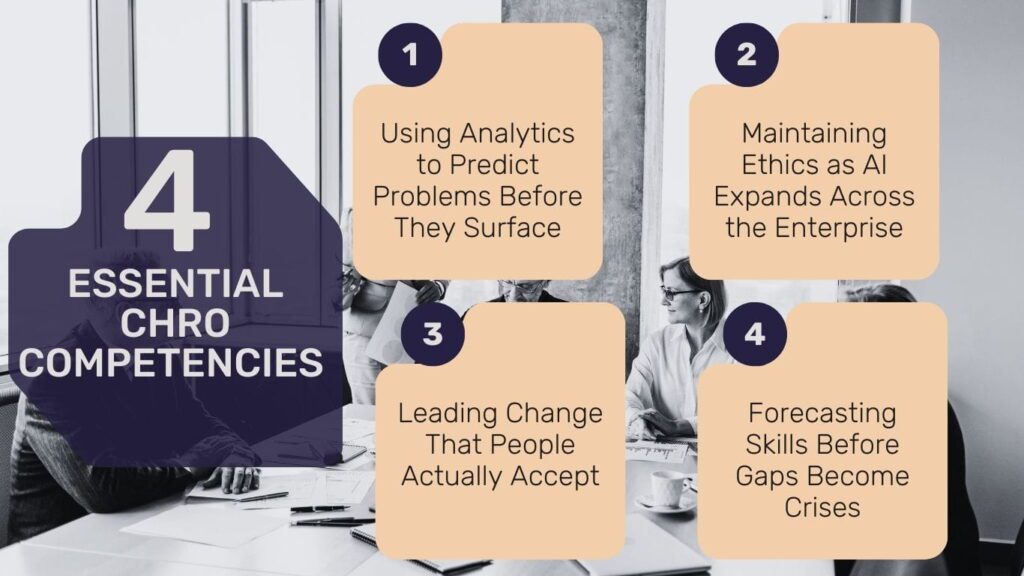
CHRO Competency 1: Using Analytics to Predict Problems Before They Surface
Most HR teams already track workforce trends. But simply collecting data isn’t enough. The real breakthrough comes when CHROs leverage AI-powered analytics to understand why trends happen, how they’re connected, and what to do next.
SHRM’s research on AI-powered analytics highlights that advanced analytics allow HR teams to move from reporting to influencing. AI-driven tools uncover hidden patterns and connections that traditional analysis often misses. One of the most valuable applications is quantifying the return on workforce investments by tracking retention, engagement, workforce health, and success factors like promotability. Then connecting all these metrics directly to business outcomes.
AI-powered analytics can help CHROs assess workplace culture in real time by evaluating employee sentiment, workload patterns, and organizational communications – rather than depending solely on periodic surveys.
Why This Matters for CHROs in 2026
The most compelling capability of predictive analytics is its power to detect cultural decline before it manifests in measurable performance drops. By the time engagement scores fall or turnover spikes, the underlying damage is already entrenched. Predictive tools can flag early warning signals, shifts in collaboration patterns, declining sentiment in team communications, changes in voluntary overtime, long before they appear on any dashboard.
Some organizations have grown so sophisticated that they can analyse interview and interaction data to predict when an employee might leave, down to specific timeframes. Yet only 18% of CHROs say their organization consistently uses data analytics to guide people decisions, according to Korn Ferry’s 2025 CHRO survey.
This gap between what’s possible and what’s practised represents a massive competitive opportunity.
For organizations building or scaling GCC leadership teams, predictive analytics are especially critical. Cultural alignment challenges across geographies make early detection of engagement drops essential – a lesson we see repeatedly in our executive search work.
What the Best CHROs Are Doing
- Building real-time culture dashboards that monitor sentiment, collaboration health, and engagement drivers, not just annual survey scores.
- Using predictive models to forecast skill needs and turnover risks before gaps become crises.
- Connecting people analytics directly to business outcomes, framing HR investments in the language of revenue, productivity, and competitive advantage.
- Investing in their own data literacy and their teams’ ability to interpret and act on analytical insights.

CHRO Competency 2: Maintaining Ethics as AI Expands Across the Enterprise
AI adoption has crossed a critical threshold. Visier’s 2025 Workforce Trends report makes the case clearly: embracing the AI-driven workforce is no longer optional but a necessity for organizations aiming to thrive. Companies that effectively embrace AI are positioned to lead, while those that resist risk being left behind.
But adoption without governance is dangerous. According to HR Dive, 92% of HR leaders indicate their function has already taken action to implement AI in HR, yet many overlook the equally important responsibility of safeguarding fairness and human-centric capabilities.
As Workday’s research reveals, nearly two-thirds (62%) of leaders report that their people, processes, and technology do not work together effectively a disconnect that amplifies ethical risks.
The Ethical Minefield CHROs Must Navigate
The ethical challenges of AI in HR are not hypothetical.
AI systems can perpetuate biases present in training data, leading to unfair outcomes in hiring, promotions, and performance evaluations. The well-documented case of Amazon’s scrapped AI recruiting tool which penalized resumes containing terms associated with women. This serves as a cautionary tale for every CHRO deploying AI-driven talent systems.
Meanwhile, Gartner’s 2026 Future of Work trends reveal a troubling pattern: CEOs are making bold moves based on AI’s promise rather than its proven impact.
Layoffs attributed to AI dominated headlines, yet fewer than 1% were actually driven by genuine productivity gains. This gap between perception and reality leaves CHROs managing significant fallout – skills gaps, morale erosion, and the risk of rehiring at premium costs.
The World Economic Forum reinforces this message: as people and technology continue to grow together, organizations bear a critical responsibility to ensure AI innovation remains responsible and ethical while keeping people at the centre.
Workers should feel empowered to ask not only “Can we automate this?” but “Should we?”
What the Best CHROs Are Doing
- Establishing comprehensive AI ethics frameworks that address fairness, transparency, and accountability, and updating them as technology evolves.
- Conducting regular audits of AI-driven HR systems for bias in hiring, performance management, and compensation decisions.
- Ensuring human oversight remains central to every AI-influenced people decision, maintaining the balance between machine intelligence and human judgment.
- Proactively communicating to employees how AI is being used in HR processes, building trust through radical transparency.
This ethical dimension is particularly important when hiring senior leaders. At Pipal Tree Services, our values-based leadership selection process ensures that every candidate demonstrates purpose-driven motivation and ethical alignment, qualities that are impossible for algorithms alone to evaluate.
"The CHRO who only manages people processes is already obsolete. In 2026, the leaders who win are the ones who predict culture shifts before they show up in exit interviews, hold the ethical line when AI makes it tempting not to, and build skills their organization doesn't even know it needs yet"
Rahul Bahuguna, Director Tweet
CHRO Competency 3: Leading Change That People Actually Accept
Change fatigue has become one of the defining workforce challenges of 2026. Gartner reports that 73% of HR leaders say employees suffer from change fatigue, and nearly 75% say managers are not equipped to lead that change effectively. Gallagher’s 2025 State of the Sector report now lists change fatigue among the top five barriers to organizational success – a first-time entry that arrived immediately in second place.
The business impact is tangible: among employees experiencing high change fatigue, only 43% plan to stay with their organization, compared to 74% among those with low fatigue. Perceptyx data shows that perceptions of how change is handled have declined for two consecutive years, even as change management has become the single strongest predictor of employee engagement.
Addressing Talent and Change Fatigue
In response to a fundamentally shifting employment deal, the best CHROs are changing their entire approach to leadership and culture. They are redefining leader expectations to focus on making change a routine process, not an extraordinary event, and ensuring culture is actively sustained to boost the performance of the current workforce.
This is a critical distinction.
Traditional change management treats each transformation initiative as a discrete project with a beginning and end. But when organizations face continuous disruption with
– AI rollouts
– restructuring
– evolving work models
– regulatory shifts
the project-based model breaks down.
Employees don’t have time to recover between waves of change before the next one hits.
Research offers compelling evidence: when HR manages change effectively, employees are 2.3 times more likely to report high performance in innovation and 38% less likely to say change fatigue is negatively impacting their effectiveness.
SHRM’s 2026 State of the Workplace confirms that employers now highlight effective leadership and management as their primary workplace need with 72% of HR professionals reporting that workers have higher expectations of employers than ever before.
As i4cp’s CHRO priorities research notes, culture readiness -a culture that treats change as manageable and opportunistic rather than threatening, is increasingly a defining competitive advantage. The CHROs who build this kind of organizational resilience are the ones who turn transformation from a source of exhaustion into a source of strength.
What the Best CHROs Are Doing
- Redefining leader expectations so that guiding teams through continuous change is a core competency, not an occasional requirement.
- Introducing change incrementally with purpose, clarity, and reinforcement – rather than overwhelming teams with sweeping transformations.
- Framing transformation as something done with employees, not to them – empowering teams to shape, influence, and contribute to change.
- Actively sustaining culture as a stabilizing force during periods of disruption, ensuring that stated values align with the day-to-day employee experience.
This is why our discovery alignment process at Pipal Tree Services goes far beyond technical fit. When we conduct CHRO searches, we specifically evaluate candidates’ ability to lead change in ways that sustain engagement, not deplete it.
CHRO Competency 4: Forecasting Skills Before Gaps Become Crises
Gartner predicts that by 2030, 50% of current HR activities will be AI-automated or performed by AI agents. The implications for workforce skills are staggering. Roles are being deconstructed into tasks, new competencies are emerging faster than training programs can keep pace, and the very definition of “work” is being rewritten in real time.
Yet most organizations remain dangerously reactive. Korn Ferry’s research reveals that only 18% of CHROs consistently use data analytics to guide people decisions, and Workday reports that a mere one-third of organizations believe they currently possess the skills they’ll need in the near future. This disconnect between accelerating skill demands and sluggish organizational response is a ticking time bomb.
From Reactive Gap Filling to Proactive Skill Forecasting
The most forward-thinking CHROs are shifting from traditional headcount planning to continuous skill forecasting. This means analysing internal workforce data alongside external labour market trends to anticipate which skills will become critical, and which will become obsolete, before the gaps are visible.
Leading organizations like Microsoft and Google have demonstrated what’s possible. They use predictive modelling to anticipate future skill requirements, identify emerging gaps early, and proactively reskill employees ahead of demand. The result is maintained adaptability without talent shortages or significant redundancy costs, even amid rapid market changes.
SHRM’s workforce planning research reinforces this approach, noting that one of the most powerful applications of advanced analytics is forecasting skill shortages and identifying skills that will become obsolete. By projecting talent needs five or ten years ahead, organizations can simulate multiple workforce scenarios – best case, worst case, and realistic middle ground, keeping HR prepared for whatever comes next.
As HR Executive’s analysis of the shift toward superagents makes clear, CHROs must anchor their decisions in holistic use cases and push for full outcomes, not isolated tools. In 2026 and beyond, HR’s real responsibility is to upskill people, prioritize investments, and give the organization confidence that everyone can reinvent their roles in the world of enterprise AI.
What the Best CHROs Are Doing
- Deconstructing roles into component tasks to identify where AI can augment or replace work and where human judgment remains essential.
- Building skills-based internal talent marketplaces that enable rapid redeployment as priorities shift.
- Investing in continuous learning ecosystems that integrate development into the flow of work, not as separate training events.
- Modelling multiple workforce scenarios to stress-test their skill strategies against different adoption speeds, regulatory environments, and market conditions.
The Common Thread: From Operational Leader to Strategic Architect
These four CHRO competencies don’t operate in isolation.
Analytics informs ethical AI deployment.
Ethical AI practices build the trust needed for employees to accept change.
Effective change management creates the organizational agility required for continuous skill development.
And strong skill forecasting feeds back into the analytics that drive better decisions.
The CHROs who master this interconnected competency set will be those who transform HR from a support function into a strategic engine. Future-ready CHROs are no longer simply responding to change, they are actively driving it, building organizations with culture readiness, AI readiness, and skills readiness as competitive necessities.
Organizations that get their CHRO hire right gain a leader who can navigate all four dimensions simultaneously.
Those that settle for an operational executor risk falling behind as the pace of transformation accelerates.
Finding Your Next Transformational CHRO?
At Pipal Tree Services, we specialise in identifying mission-aligned executive leaders who don’t just manage, they transform. Our proven executive search process goes beyond matching skills to job descriptions to find CHROs whose leadership philosophy, analytical mindset, and ethical commitment align with your organization’s purpose.
Let’s start with a conversation about your leadership needs and the transformation you’re navigating.
No pressure. Just talk.
Write to me at [email protected]

Rahul Bahuguna
“With over two decades of experience across executive search, digital strategy, and business consulting, Rahul brings a unique entrepreneurial perspective as Director of Pipal Tree Services. At Pipal Tree, Rahul leverages his background in strategy, market intelligence, and digital transformation to guide mission-aligned executive search and board mandates. He specializes in building long-term client partnerships, leading complex leadership searches, and shaping Pipal Tree’s distinct positioning at the intersection of talent and purpose. His ability to combine strategic insight with practical execution makes him a trusted advisor to organizations seeking leaders who can drive meaningful, sustainable change.”