

In Brief; India’s higher education sector faces unprecedented leadership challenges as 75+ international universities enter the market. This guide covers hiring strategies for Vice Chancellors, Deans, and academic leaders navigating NEP 2020, digital transformation, and global competition.
Table of Contents
Higher education leadership hiring in India has never been more critical.
As 15+ international universities prepare to enter the Indian market under UGC Regulations 2023, the competition for exceptional academic leaders-Vice Chancellors, Deans, Provosts, and senior faculty- has reached unprecedented intensity. Universities and colleges now face a fundamental question: Can we attract and retain the transformational leaders who will determine our institutional future?
The stakes are extraordinary:
For Students:
The quality of academic leadership directly impacts educational outcomes, research opportunities, and career prospects for millions of Indian students pursuing higher education.
For Institutions:
In an era where 15 international universities have already been licensed to operate in India – with 60 more expected – the right leadership team is the difference between thriving and becoming irrelevant.
For India’s Knowledge Economy: As the National Education Policy targets increasing Gross Enrolment Ratio from 26.5% to 50%, the leaders hired today will shape India’s emergence as a global higher education destination.
These new regulations have streamlined the process for foreign universities ranked in the top 500 globally to establish campuses in India, granting them significant academic autonomy. Special Economic Zones and GIFT City in Gujarat have emerged as key locations for these international campuses, alongside established education hubs in NCR and Bengaluru. With approximately 75 international universities having applied to enter India
– 15 already licensed
– and another 60 expected soon
the competitive landscape is transforming rapidly.
What makes this influx particularly significant is the value proposition these international universities bring: employability-driven programs in high-demand fields like IT, Cybersecurity, Engineering, Health Sciences, Business, and Management, delivered at significantly lower costs than studying abroad while maintaining global academic standards. Indian students can now access international quality education and research without leaving the country, fundamentally altering expectations across the sector.
This internationalization isn’t just changing options for students, it’s creating an unprecedented talent war. Indian educational institutions, both established and emerging, now compete not only with each other but with global brands for the same pool of exceptional academic and administrative leaders. The professionalization of higher education that was already underway has accelerated dramatically, fundamentally changing what educational institutes need from their leaders and how they attract, assess, and retain them.
This competitive pressure is reshaping leadership requirements, compensation expectations, and institutional strategies.
The stakes have never been higher:
Educational Institutions that secure transformational leadership will thrive in this new landscape, while those that don’t risk becoming increasingly marginalized.
The Talent Crisis in Indian Higher Education
With a number of international universities applying to enter India, competition for quality academic and administrative talent has intensified dramatically.
But the challenge isn’t just about numbers. It’s about finding leaders who can navigate a sector undergoing fundamental structural changes while maintaining academic excellence and institutional relevance.
What Makes Higher Education Hiring Different
There are several factors that make leadership hiring in this sector distinctly challenging:
The Interdisciplinary Imperative
Traditional department-based structures are giving way to interdisciplinary models. Many progressive institutions are experimenting with structures that have minimal departmental boundaries, allowing faculty to hold primary and secondary affiliations across subjects. This organizational shift demands leaders comfortable with ambiguity and collaboration across traditional academic silos.
Hiring for these roles requires assessing not just subject matter expertise but also the ability to think horizontally across disciplines, manage matrix relationships, and lead without traditional hierarchical authority.
Balancing Multiple Mandates
Academic leaders today must balance teaching excellence, research output, and administrative responsibilities, often simultaneously. The challenge for hiring teams is identifying candidates who can manage these competing demands without becoming overwhelmed.
We’ve seen successful institutions implement differentiated tracks at the hiring stage itself
– teaching-focused,
– research-focused,
– or balanced roles
with clear expectations set upfront. This transparency helps candidates self-select appropriately and reduces early attrition from role misalignment.
The Research vs. Teaching Equation
Indian higher education is evolving from primarily teaching-focused institutions to research-intensive universities competing on global parameters.
This shift is reflected in hiring priorities:
– increased emphasis on PhD qualifications,
– research publications, and
– the ability to secure grants and establish research centers.
However, this evolution creates tension. Institutions must hire for research credentials while ensuring teaching quality doesn’t suffer. The most successful hiring strategies we’ve observed acknowledge this tension explicitly and seek candidates who can contribute meaningfully to both dimensions.
Technology and Digital Transformation
The COVID-19 pandemic accelerated technology adoption in ways that permanently altered expectations. Today’s academic leaders must be comfortable with blended learning models, digital teaching tools, and AI integration into pedagogy and assessment.
Hiring for this requires assessing technological adaptability, not just current proficiency, but the mindset to continuously evolve with rapidly changing educational technology.
International Faculty Hiring: Opportunities and Challenges in India
As Indian educations institutions aspire to global recognition, hiring international faculty has become a strategic priority. This brings both opportunities and significant practical challenges.
Why International Talent Matters
International faculty bring several advantages:
- Global research networks and collaborative opportunities
- Exposure to diverse pedagogical approaches
- Enhanced institutional credibility in international rankings
- Cross-cultural perspectives that enrich the academic environment
Top institutions are pursuing international accreditations and benchmarking faculty compensation against global standards to attract this talent.
The Practical Barriers For International Faculty
Despite strategic intent, we consistently encounter obstacles that complicate international hiring:
- Regulatory Complexity: Visa and work permit processes remain inconsistent across consulates, creating uncertainty for both institutions and candidates. The lack of clarity on timelines and requirements can cause talented candidates to accept offers elsewhere while awaiting Indian documentation.
- Social Security Challenges: India’s lack of social security agreements with most countries creates financial disincentives. The mandatory 12% provident fund contribution on entire salary—withdrawable only at age 60, is a significant deterrent for international candidates planning shorter tenures.
- Spousal Employment: The difficulty securing work authorization for spouses is frequently cited as a deal-breaker, particularly for mid-career academics with families.
- Infrastructure and Ecosystem Concerns: Beyond regulatory issues, concerns about research infrastructure, administrative support, and quality of life considerations affect international candidates’ willingness to relocate.
Institutions succeeding in international hiring are those providing comprehensive relocation support, transparent communication about challenges, and demonstrable commitment to creating globally competitive research ecosystems.
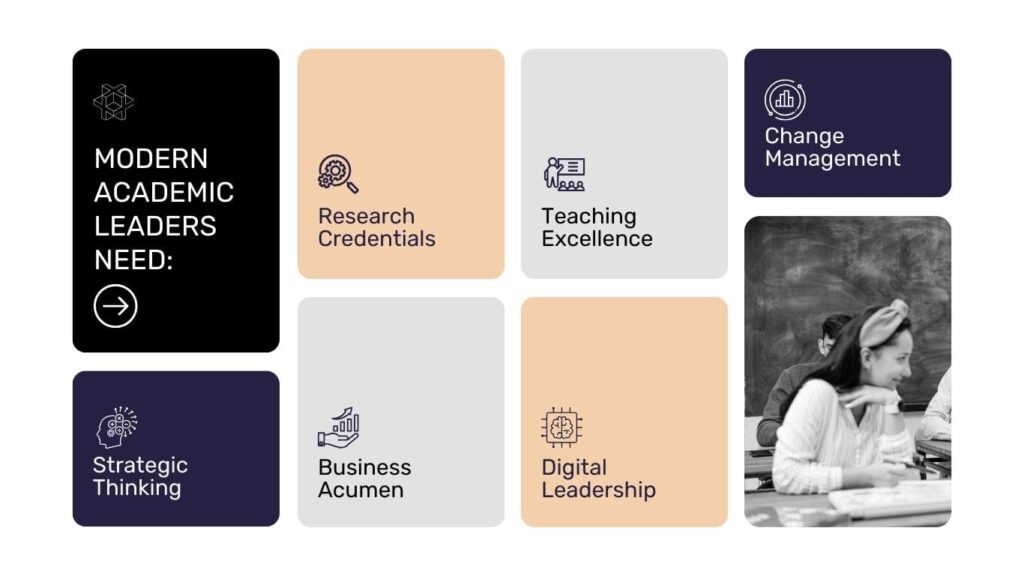
Redefining Leadership Competencies for Modern Academia Leaders
Traditional markers of academic leadership
– seniority,
– publication count,
– years of service,
are no longer sufficient.
Through our work, we’ve identified the competencies that distinguish exceptional academic leaders in India’s evolving higher education landscape.
Business Acumen in Academic Settings
Modern academic leaders increasingly function as business leaders.
Deans and directors now manage
– substantial budgets,
– develop revenue models,
– oversee P&L statements,and
– make strategic investment decisions.
We assess candidates not just on academic credentials but on their understanding of financial management, strategic planning, and resource allocation.
Can they think entrepreneurially while maintaining academic integrity?
Do they understand how to build sustainable academic programs?
Adaptive Leadership in Fluid Structures
With organizational structures becoming more fluid and project-based, leaders need different capabilities. We look for evidence of:
- Leading through influence rather than authority
- Managing ambiguity and rapid change
- Building coalitions across organizational boundaries
- Thinking systemically about complex institutional challenges
Digital Leadership
Beyond personal technology proficiency, effective leaders must champion digital transformation across their units. This includes:
- Understanding how technology enhances learning outcomes
- Making informed decisions about educational technology investments
- Leading faculty through technological transitions
- Balancing innovation with proven pedagogical approaches
Values-Driven Leadership
Institutional culture matters enormously in academic settings. We assess candidates for alignment with institutional values—whether that’s research excellence, inclusive education, innovation, or social impact.
The most successful hires are those who not only possess relevant skills but also genuinely connect with the institution’s mission and can articulate how their leadership will advance that mission.
"Indian institutions now compete not only with each other but with global brands for the same pool of exceptional academic leaders. The professionalization of higher education has accelerated dramatically."
Rahul Bahuguna, Founder Tweet
Executive Search Assessment for Higher Education Leaders: Beyond Traditional Credentials
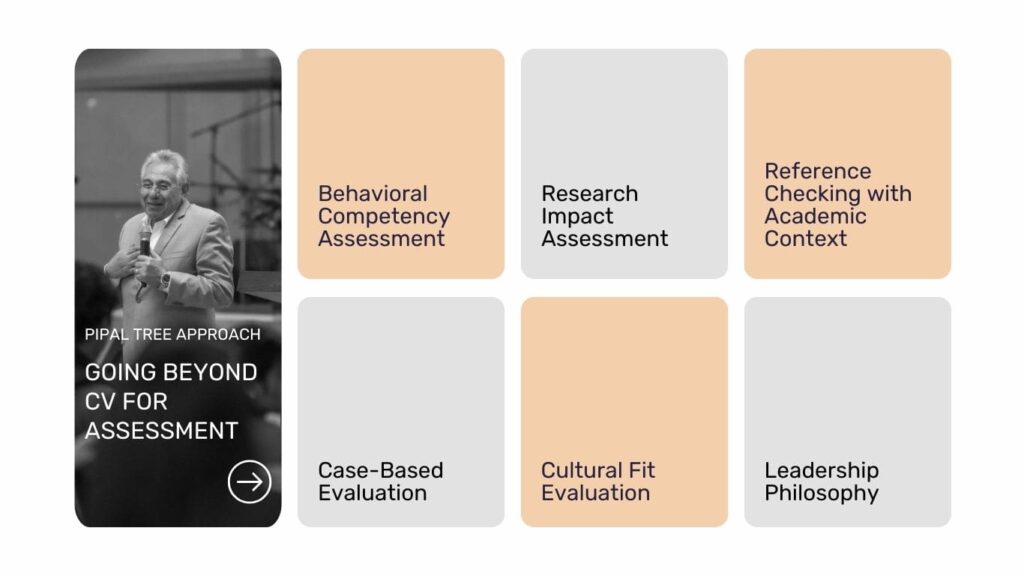
At Pipal Tree, we’ve developed assessment methodologies specifically for higher education leadership roles that go beyond evaluating CVs and publication lists.
Behavioral Competency Assessment
We conduct structured interviews exploring specific behavioral competencies critical for academic leadership:
- Collaborative capability: How do they build consensus across diverse stakeholders?
- Change leadership: How have they led institutions through significant transitions?
- Intellectual humility: Can they acknowledge limitations and learn from others?
- Stress resilience: How do they perform under pressure with competing priorities?
- Strategic thinking: Can they balance immediate operational needs with long-term vision?
Case-Based Evaluation
We present candidates with realistic scenarios they’d face in the role—budget cuts requiring difficult choices, faculty conflicts, strategic planning dilemmas, or technology implementation challenges. Their approach to these cases reveals thinking processes, values, and leadership style more effectively than traditional interviews.
Research Impact Assessment
For research-focused roles, we go beyond publication counts to assess genuine research impact:
- Influence on policy or practice
- Industry collaborations and real-world applications
- Success in securing competitive grants
- Development of research teams and mentoring of junior researchers
- Contribution to institutional research reputation
Cultural Fit Evaluation
Given the importance of institutional culture in academic settings, we invest significantly in assessing cultural alignment. This includes:
- Understanding candidates’ working style preferences
- Exploring their views on academic freedom and shared governance
- Assessing their approach to diversity and inclusion
- Evaluating their communication style and interpersonal approach
Reference Checking with Academic Context
Academic reference checking requires different approaches than corporate references. We speak with:
- Faculty who’ve reported to the candidate
- Peers who’ve collaborated on research or committees
- Administrative staff who’ve worked with them
- Students they’ve mentored or taught (where appropriate)
We ask specific questions about teaching effectiveness, research integrity, collegial behavior, administrative capability, and how they handle conflict and disagreement.
Strategic Hiring for Different Academic Roles
Different leadership roles in higher education require distinct assessment approaches.
Vice Chancellors and Presidents
For these apex roles, we assess:
- Vision and strategic thinking: Can they articulate a compelling future for the institution?
- External relationship building: Ability to engage with government, industry, alumni, and donors
- Academic credibility: Respect within the academic community
- Crisis management: How they navigate controversy and difficult decisions
- Fundraising capability: Increasingly critical for private institutions
Deans and Directors
These roles require balancing academic leadership with business management:
- Program development: Track record of building successful academic programs
- Faculty development: Ability to attract, develop, and retain excellent faculty
- Financial management: Experience managing budgets and developing revenue streams
- Stakeholder management: Balancing needs of faculty, students, and administration
- Change management: Leading academic units through organizational change
Department Heads and Program Chairs
These frontline academic leaders need:
- Pedagogical leadership: Driving teaching excellence and curriculum innovation
- Conflict resolution: Managing faculty dynamics and disputes
- Operational capability: Handling scheduling, resources, and day-to-day management
- Academic standards: Maintaining rigor while supporting student success
- Mentorship ability: Developing junior faculty
Chief Academic Officers and Provosts
These roles demand:
- Academic strategy: Ability to shape overall academic direction
- Faculty affairs expertise: Understanding promotion, tenure, and faculty governance
- Accreditation knowledge: Ensuring compliance and driving quality improvement
- Data-driven decision making: Using analytics to inform academic decisions
- Academic integrity: Championing standards while supporting innovation
Employer Branding in Higher Education
Attracting top academic talent requires more than competitive compensation. Through our work, we’ve observed what makes institutions attractive to academic leaders.
Culture as Differentiator
Institutions with clearly articulated, authentic cultures consistently out-recruit competitors, even when compensation is lower. This includes:
- Academic freedom and autonomy: Faculty want control over their research and teaching
- Collaborative environment: Preference for collegial over hierarchical cultures
- Innovation encouragement: Freedom to experiment with new approaches
- Purpose and impact: Connection to meaningful educational and societal outcomes
Research Ecosystem
For research-intensive roles, the strength of the research ecosystem matters enormously:
- Infrastructure: Quality of laboratories, libraries, computing resources
- Research support: Availability of grants, research assistants, administrative support
- Reduced teaching loads: Time allocation for research activities
- Collaboration opportunities: Both internal and with external institutions
- Publication support: Resources for conference attendance, open access fees, etc.
Career Development and Growth
Progressive institutions differentiate themselves through:
- Clear tenure tracks: Transparent criteria and supportive processes
- Leadership development: Formal programs to develop academic leaders
- Sabbatical programs: Opportunities for renewal and new learning
- International exposure: Teaching assignments, research collaborations, conferences abroad
- Internal mobility: Opportunities to take on new responsibilities and roles
Institutional Reputation and Trajectory
Brand power matters in academic hiring. Faculty want to be associated with institutions that are:
- Rising in national and international rankings
- Gaining recognition for specific strengths
- Attracting excellent students
- Making meaningful societal impact
- Financially stable with growth trajectory
Retention: The Other Half of the Equation
Hiring excellent leaders is only half the challenge. Retaining them in a competitive market requires deliberate strategies.
Autonomy and Empowerment
Academic leaders consistently cite autonomy as crucial for retention. This includes:
- Decision-making authority: Control over budget, hiring, and strategic direction
- Freedom to innovate: Encouragement to try new approaches
- Strategic input: Voice in institutional decision-making
- Academic independence: Freedom from excessive bureaucratic interference
Growth and Development
Leaders stay when they see continued growth opportunities:
- Project-based assignments: Opportunities to lead strategic initiatives
- Skill development: Support for leadership training and capability building
- Evolving responsibilities: Roles that grow with their capabilities
- Intellectual stimulation: Ongoing learning and challenge
Recognition and Support
Even accomplished academics need recognition and support:
- Acknowledgment of contributions: Formal and informal recognition
- Administrative support: Resources to execute their vision
- Peer community: Connection with other academic leaders
- Work-life balance: Understanding of academic work patterns and personal needs
Purpose and Impact
Leaders stay engaged when they see meaningful impact:
- Student success: Evidence that their work matters to student outcomes
- Institutional progress: Visible contribution to institutional advancement
- Societal contribution: Connection between their work and broader impact
- Legacy building: Opportunity to create something lasting
Common Hiring Mistakes to Avoid
-
Overweighting Research Credentials for Administrative Roles
While research credibility matters, administrative roles require management capabilities. Assuming that excellent researchers will automatically be excellent administrators is a costly error. We assess administrative capability independently from research achievement. -
Undervaluing Cultural Fit
Academic cultures are strong and distinctive. Hiring accomplished individuals who don't fit institutionally leads to frustration on both sides. We never recommend compromising on cultural alignment, regardless of credentials. -
Rushing the Process
Academic hiring timelines are naturally longer than corporate hiring. Faculty need time to consider opportunities, complete commitments, and make family decisions. Institutions that rush these processes often lose top candidates or make poor choices. -
Ignoring References
Academic reference checking is critical. Problematic behaviors - lack of collegiality, research integrity issues, abusive treatment of students. This often only emerge through careful reference checking. We invest heavily in this phase. -
Unclear Role Definition
Academic roles can be ambiguous. Hiring without clear agreement on expectations - teaching load, research requirements, administrative duties, decision-making authority. This can lead to conflict and disappointment.
Looking Ahead: The Future of Academic Talent
Several trends will shape leadership hiring in Indian higher education over the coming years:
Increased Professionalization
HR functions in educational institutions are becoming more sophisticated, adopting practices from the corporate world while respecting academic culture. This professionalization will improve hiring outcomes but requires HR professionals who understand both corporate best practices and academic culture.
Global Talent Flows
As Indian institutions improve their global standing, we expect increased movement of Indian-origin academics from Western universities back to India, as well as continued (though challenging) international hiring. Institutions that solve the practical barriers will gain competitive advantage.
Technology-Enabled Assessment
Advanced assessment tools—psychometric instruments, video-based interviews, data analytics—will become more common in academic hiring while requiring careful implementation to respect academic culture.
Focus on Diversity
Institutions are increasingly prioritizing diversity across multiple dimensions—gender, geography, international representation, and disciplinary backgrounds. This requires proactive sourcing strategies and careful attention to unconscious bias.
Interdisciplinary Leadership
As academic structures become more interdisciplinary, demand will grow for leaders comfortable operating across traditional boundaries. Assessment methods will need to evaluate these capabilities explicitly.
How Pipal Tree Serves Higher Education Leadership Hiring in India
As a specialized executive search firm for India’s higher education sector, Pipal Tree brings deep understanding of the unique challenges universities, colleges, and educational institutions face when hiring academic leaders.
Our approach to executive search in higher education is informed by deep understanding of this unique sector:
- Specialized Academic Networks: We’ve invested years building relationships with academic leaders across disciplines, institutions, and geographies. These networks give us access to passive candidates who could transform your institution.
- Academic-Specific Assessment: Our evaluation methodologies are designed specifically for academic contexts, going beyond traditional executive assessment to evaluate teaching, research, and academic leadership capabilities.
- Cultural Understanding: We understand academic culture and help ensure candidates align with your institution’s specific environment, values, and operating style.
- Discretion and Professionalism: We conduct searches with appropriate confidentiality, protecting both your strategic plans and candidates’ current positions.
- Long-Term Partnership: We view each search as the beginning of a relationship, supporting your leadership development and succession planning needs over time.
Whether you’re hiring your first Vice Chancellor, strengthening your faculty leadership, or building administrative capacity, we bring specialized expertise in academic leadership hiring that generic search firms cannot match.
Conclusion: Hiring for Transformation
Indian higher education stands at a pivotal moment. The sector’s ambitious growth targets, international aspirations, and evolving pedagogical approaches all require exceptional leadership.
The institutions that will thrive are those that approach leadership hiring strategically—understanding the unique competencies required, assessing candidates comprehensively, and creating environments that attract and retain transformational leaders.
At Pipal Tree, we’re committed to helping India’s educational institutions build the leadership teams that will define their future and contribute to India’s emergence as a global higher education destination.
The right academic leaders don’t just fill positions—they shape institutions, influence thousands of students, and contribute to India’s knowledge economy. Hiring them requires expertise, networks, and commitment to excellence.
If you’ve outgrown traditional recruitment approaches, or you’re struggling to find senior academic talent that resonates with your institutional values and vision, a purpose-driven search partner can help you unlock the passive talent market and build a leadership team rooted in shared purpose.
The competition for exceptional academic leaders intensifies every month.
Don’t let another semester pass with interim leadership or vacant critical roles. Let’s discuss how strategic executive search can help you secure the Vice Chancellors, Deans, and faculty who will transform your institution.
No pressure. Just talk.
Write to me at [email protected]
The leaders who will define your institution’s next decade are making career decisions right now. Let’s ensure they’re considering your opportunity.”

Rahul Bahuguna
“With over two decades of experience across executive search, digital strategy, and business consulting, Rahul brings a unique entrepreneurial perspective as Director of Pipal Tree Services. At Pipal Tree, Rahul leverages his background in strategy, market intelligence, and digital transformation to guide mission-aligned executive search and board mandates. He specializes in building long-term client partnerships, leading complex leadership searches, and shaping Pipal Tree’s distinct positioning at the intersection of talent and purpose. His ability to combine strategic insight with practical execution makes him a trusted advisor to organizations seeking leaders who can drive meaningful, sustainable change.”