

Table of Contents
What Is The Cost Of Executive Search in India
Executive search firms in India typically charge 20 – 33% of the candidate’s first-year total cost to company (CTC) for a retained mandate.
For a ₹1 crore CTC hire, this means a fee of ₹20–33 lakh.
Payment is structured in two-three stages: one-third on signing the engagement, one-third on shortlist delivery, and one-third on acceptance of offer. The fee covers market mapping, candidate identification and outreach, assessment, reference checks, and post-placement support, not simply candidate referral.
Most companies spend more time negotiating the executive search fee than they spend defining the mandate.
That is the wrong priority!
It signals a misunderstanding of what executive search actually costs and what it actually delivers.
There are three costs in every senior leadership hire.
The first is the most obvious: the search firm’s fee.
The second is rarely calculated: the internal cost of running the search – CHRO time, CEO time, board time in interviews and deliberation, and the administrative burden of coordinating a process that typically runs for four to six months.
The third is almost never quantified (also difficult to quantify): the cost of delay – the decisions not made, the products not shipped, the investor confidence not maintained because a critical role sat unfilled.
Most companies evaluate the first cost carefully and ignore the second and third entirely. This guide puts all three on the table.
For the foundational question of why executive search exists at all, our Executive Search or Recruitment guide is the starting point.
This article focuses specifically on cost: what to expect, how the fee is calculated, what it covers, and what the real financial stakes are when you get this decision wrong.
How Executive Search Fees Are Calculated in India
The standard formula is straightforward: fee = percentage × first-year total CTC.
In practice, the India-specific complexity of CTC structure makes this calculation more nuanced than it appears in markets where total compensation is simply base salary plus bonus.
India’s CTC framework includes multiple components:
– fixed base salary,
– house rent allowance (HRA),
– leave travel allowance (LTA),
– medical allowance,
– performance bonus (typically 15–30% of fixed), and
– sometimes ESOPs or stock options.
When a search firm quotes “25% of CTC“, the question of which CTC matters significantly.
Three approaches are used in practice:
Approach 1 : Total CTC including variable
Fee calculated on the full CTC including target bonus.
The most common approach with retained search firms operating at the CXO level. Results in a higher fee in absolute terms but most accurately reflects the total financial commitment the company is making to the hire.
If the candidate is expected to earn ₹80 lakh fixed and ₹20 lakh variable, the fee is calculated on ₹1 crore.
Approach 2 : Fixed CTC only
Fee calculated on the fixed component only.
More common with contingency firms and some boutique search firms. Lower headline fee but underrepresents the true cost of the hire.
If the same candidate earns ₹80 lakh fixed and ₹20 lakh variable, the fee is calculated on ₹80 lakh, producing a lower number that may not reflect the true economic value of the engagement.
Approach 3 : First-year total earnings
Fee calculated on actual first-year earnings including joining bonus, sign-on payments, and any accelerated variable payout.
Relevant when candidates receive significant buy-out compensation from their current employer as part of the offer. This approach is less common but worth clarifying explicitly in the engagement letter when joining bonuses are part of the offer structure.
The ESOP Question
For startup and PE-backed company CXO hires where equity is a meaningful component of the compensation package, most search firms exclude ESOP and stock option value from the fee calculation base. This is standard practice - but boards should verify it explicitly in the engagement letter before signing, since a substantial equity component can change the economics of the fee conversation considerably.
A practical example: A CFO hired at ₹80 lakh fixed + ₹20 lakh variable + ₹10 lakh ESOPs (excluded from fee base) = ₹1 crore CTC for fee calculation purposes. At 20–30% retained, the search fee is ₹20–30 lakh. This is the number to budget before the engagement starts.
Retained vs Contingency Search: What the Fees Difference Actually Means
Understanding the fee structure requires understanding why two fundamentally different models carry different price points.
This is not about one firm charging more for the same service. It is about two different services with different incentive structures, different candidate pools, and different risk profiles.
The Retained Executive Search Model
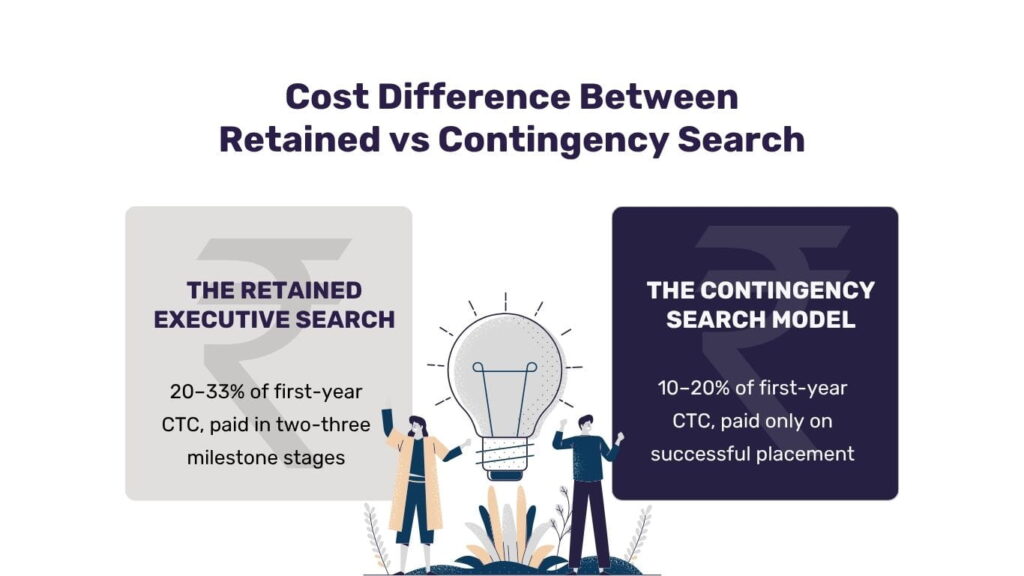
- Fee structure: 20–33% of first-year CTC, paid in two to three milestone stages
- Commitment: Search firm works exclusively on the mandate
- Process: Full market mapping, proactive passive candidate outreach, structured assessment, reference checks
- Guarantee: Typically 90 days - if the placed candidate leaves or is let go within 90 days, the search is re-run at no additional cost
- Appropriate for: Senior leadership roles where the right candidate is passive, where confidentiality is required, and where the cost of a wrong hire is significant
The Contingency Executive Search Model
- Fee structure: 15–30% of first-year CTC, paid only on successful placement
- Commitment: No exclusivity - multiple firms typically work the same role simultaneously
- Process: Speed-oriented - incentivised to submit candidates quickly rather than assess deeply
- Risk: Firm absorbs upfront cost; incentive is to place fast, not place well
- Appropriate for: Mid-management roles, active talent pools, time-critical hires where depth of assessment is secondary
Why the Best CXO Candidates Never Enter Contingency Processes
This is the part of the retained vs contingency search firms conversation that most search firms don’t explain clearly – because it requires acknowledging something uncomfortable about how contingency search actually works in practice.
The best CFOs, CTOs, and business unit leaders in India have a well-developed filter for which calls are worth taking. They are five or more years into stable, well-compensated roles. They have been approached dozens of times. They know, within the first thirty seconds of a call, whether the search is serious or speculative.
A contingency recruiter working against three other firms on the same role – under time pressure, without an exclusive relationship, incentivised to place fast rather than place well – does not pass that filter. The approach signals a company that hasn’t committed to the hire, a process with no clear timeline, and a recruiter who may be calling them about four other roles simultaneously. Strong candidates decline politely and move on. As we explore in our piece on why top executive search firms prioritise passive talent , the passive candidate is the defining advantage of retained search.
There is also a structural problem: contingency firms, because they are paid only on placement, submit candidates broadly and quickly. A senior executive who showed interest in one conversation sometimes finds their CV circulating across multiple companies without explicit consent. This is reputationally uncomfortable. It happens once. After that, they refuse to engage with contingency processes at all.
The result is a self-selecting talent pool.
Contingency processes consistently surface candidates who are actively looking for a reason – performance concerns, a difficult manager, a company in difficulty – or candidates comfortable being shopped around. Neither category represents the best available talent in India’s senior executive market. Retained search reaches a different pool entirely.
The India-Specific Reality
Contingency search is rarely the right model above VP level in India. According to Mercer’s 2024 India Leadership Pay Study, CXO hiring cycles in India stretched to 83 days on average - and that is for companies that eventually found the right candidate. The ones that went through contingency processes first, found inadequate shortlists, and then switched to retained search took considerably longer. The contingency detour is typically more expensive than going retained from the start.
“The best CEO or CFO we have ever placed was not looking for a job. They were not on any platform. They took our call because we had earned the right to make it over years of credibility in their market.
That is not a service you can buy on a contingency basis.”
The 2-Stage Payment Structure: What Each Milestone Covers
Stage 1: On Engagement (One-Fourth)
Paid when the search formally begins. Covers the market mapping phase: defining the candidate universe, building the list of target companies and individuals, developing the search brief, and beginning the initial outreach process. This work starts immediately on signing and continues regardless of how quickly the process moves. Stage 1 is non-refundable. It represents the committed investment of senior practitioner time in the first four to six weeks of the search.
Stage 2: On Offer Acceptance & Joining (Three-Fourth)
Paid when the candidate accepts the offer and joins. This milestone is when the search firm’s core work is complete.
The 3-Stage Payment Structure: What Each Milestone Covers
Stage 1: On Engagement (One-Third)
Paid when the search formally begins. Covers the market mapping phase: defining the candidate universe, building the list of target companies and individuals, developing the search brief, and beginning the initial outreach process. This work starts immediately on signing and continues regardless of how quickly the process moves. Stage 1 is non-refundable. It represents the committed investment of senior practitioner time in the first four to six weeks of the search.
Stage 2: On Shortlist Delivery (One-Third)
Stage 3: On Offer Acceptance (One-Third)
The Replacement Guarantee
Most reputable retained search firms offer a 90-day replacement guarantee: if the placed candidate leaves or is let go for performance reasons within 90 days of joining, the search is re-run at no additional fee.
This is the most important protection in the engagement structure - more relevant than a refund policy. Confirm the guarantee period, the conditions under which it applies, and any exclusions before signing. A firm that doesn’t offer a replacement guarantee is signalling a transactional rather than partnership approach to the engagement.
What Executive Search Fees Covers & What It Doesn’t
One of the most common sources of post-engagement friction is misalignment between what the client assumed was included in the fee and what was actually agreed. Clarify each of the following before signing.
Typically included in executive search fees
-
Market mapping and candidate universe definition
Identifying the pool of relevant candidates across target companies -
Candidate outreach and initial engagement
Approaching passive candidates and positioning the opportunity -
First-round candidate interviews
Structured conversations to assess fit against the brief -
Reference checks
Typically two to three references per finalist, conducted before offer stage -
Offer negotiation support
Structuring the offer, managing the candidate’s current employer conversation -
Post-placement check-ins
Typically at 30, 60, and 90 days; some firms extend to 180 days
Typically not included - clarify in the engagement letter
-
Background verification
Conducted by a specialist third-party firm; cost typically passed to the client at ₹25,000–40,000 per candidate -
Psychometric or formal leadership assessments
Tools like Hogan Assessment, Korn Ferry Asses, or Mercer-Mettl are additional; typically ₹50,000–1 lakh per assessment if used. -
Candidate relocation support
If the appointed candidate is relocating from another city or country -
Legal review of employment contracts
A separate cost if specialist employment law counsel is required
The hidden cost of Executive Search: Client's internal time
A typical CXO search involves six to eight client-side interviews across multiple stakeholders over twelve to sixteen weeks.
The CHRO, CEO, and often board members each invest four to eight hours per shortlisted candidate across multiple rounds. At the senior compensation levels of these participants, this internal time cost routinely represents ₹10–20 lakh for a single search and it never appears on the search firm’s invoice.
It is always part of the true cost of the hire, even when it’s invisible in the budget.
The Real Cost Comparison: Executive Search vs the Alternatives
The most important financial context for evaluating the cost of executive search firm is not the fee itself. It is what the fee is protecting against.
The cost of a wrong executive hire
At CXO level, the total cost of a failed hire – severance, team disruption, lost momentum, replacement search, and delayed strategy execution – is significant by any measure. Research from Gartner and Harvard Business Review suggests a failed executive hire can cost up to 10–15 times the executive’s annual salary, once severance, lost productivity, and re-hiring costs are factored in. India-specific analysis confirms the same order of magnitude: a wrong CXO hire in India can cost ₹15 crore for a mid-size form and set the company back 18 months of momentum.
Against that context, a retained search fee of ₹20–33 lakh is not a cost against the hire.
It is insurance against a ₹15 crore downside risk.
The cost of delay
Every month a senior role remains unfilled carries a cost that is rarely quantified.
A CFO absence means investor reporting slips and lenders grow impatient.
A CTO absence means product decisions wait or are made without technical authority.
An unfilled MD India means the PE investor’s 100-day governance plan stalls.
An unfilled critical leadership role in India can cost more than ₹20 lakh per month in lost productivity alone, before strategic delays and stakeholder friction are counted.
The cost of a DIY search
A company that runs a CXO search without a search partner spends more total time and money than the search firm’s fee would cost – but distributes that cost invisibly across internal salaries and leadership distraction rather than as a single invoice.
The CHRO spends six to eight weeks sourcing.
The CEO spends three to four weeks in interviews.
The finance function carries the role as an unfilled headcount for four to six months.
None of this appears on a fee invoice, but all of it is real cost.
| Approach | Direct cost | Hidden cost | Risk level |
| Retained executive search | ₹20–33 lakh fee | Low – structured process | Low |
| Contingency search | ₹15–20 lakh fee (if placed) | High – shallow assessment; wrong candidate pool | Medium–high |
| DIY (internal sourcing) | Near zero direct cost | Very high – leadership time, delay, passive talent not reached | High |
| Wrong hire cost (reference) | ₹15 crore+ total impact | – | Strategic |
Note: Wrong hire cost estimate based on Gartner/HBR research (10–15x annual salary) and India-specific analysis. Actual impact varies significantly by company stage, role, and strategic context.
5 Variables That Drive Fee Differences Between Search Firms
Two firms quoting on the same mandate can arrive at executive search fees that differ by five to eight percentage points. Understanding what drives that difference helps boards evaluate whether the premium is justified or arbitrary.
-
Variable 1: Role Seniority and Complexity
Board-level and group CXO searches command higher fees than functional head searches, even at similar compensation levels. The candidate pool is smaller, the assessment is more intensive, stakeholder management is more involved, and the mandates typically run longer.
A Group CFO search for a diversified conglomerate is a materially different engagement than a CFO search for a single-business mid-market company, even if the CTC is identical.
-
Variable 2: Market Geography and Candidate Dispersion
Searches that require candidates from specific or multiple geographies - India plus a global shortlist, or candidates spanning GCC and India contexts - involve larger market maps, more complex outreach, and often senior consultant travel for candidate meetings.
These mandates are typically priced at a slight premium over single-geography India searches. -
Variable 3: Confidentiality Requirements
Highly confidential searches - replacing an underperforming leader who is still in role, entering a new market without alerting competitors, evaluating a succession scenario - require more controlled processes, dedicated senior consultant time, and outreach that must be carefully managed to avoid market leaks.
Firms that handle these mandates with genuine discipline price this into the engagement.
-
Variable 4: Guarantee Period and Post-Placement Support
Firms that offer longer guarantee periods (180 days rather than 90), formal leadership onboarding support, or structured 12-month post-placement check-ins price these services into the fee.
Worth evaluating explicitly against what you actually need from the post-placement period. -
Variable 5: Firm Seniority and Specialisation
A senior partner at a specialised boutique firm costs more than a principal at a generalist firm. The question is whether the specialisation is worth it - usually yes for sector-specific or function-specific searches where market intelligence and passive candidate relationships are the primary deliverables.
Global Executive Search Firms vs Boutique Executive Search Firms: What the Fee Difference Actually Reflects
Global Executive Search Firms
The Korn Ferrys, Spencer Stuarts, Egon Zehnders, and Heidrick & Sullivans of the world – typically charge at the upper end of the retained range. The executive search firm fees are often 30–33% or higher for board and group CXO mandates. For certain mandates – a first-time India entry where the global HQ board needs to see a globally recognised firm name, or a cross-border mandate requiring genuine multi-geography candidate consideration – that premium is justifiable.
However, global firms carry a structural limitation in India-specific searches: off-limits lists.
A global search firm with 50 retained clients across India’s manufacturing, technology, and financial services sectors cannot recruit from those companies – meaning significant portions of the best candidate pool are structurally inaccessible.
There is also the execution reality: at global firms, the partner who presents credentials at the pitch frequently delegates day-to-day search execution to a principal or senior associate. The board signs based on the partner’s reputation; the search is run by someone more junior.
This is a structural feature of the global model, not a failure of individual commitment – but it matters when the mandate requires the most senior practitioner’s judgement to move a genuinely passive candidate.
Boutique Executive Search Firms
Executive search firms with specific sector or geography expertise typically charge 20–25% and run a materially different model. The senior practitioner who pitches the mandate runs it.
Smaller off-limits lists mean broader candidate access within the specific market.
Deep India market intelligence – knowing which candidates are in which roles, what their career motivations
The Right Question To Ask Any Firm, Global Or Boutique
Who specifically will run this search day-to-day, and what is their personal track record placing candidates in roles of this type and seniority in India?
The answer will tell you more about likely outcome than the name on the letterhead.
“The name on the letterhead does not tell you who will pick up the phone when the search stalls at week ten.
That is the question worth asking before you sign the engagement letter.”
Red Flags in Executive Search Pricing
Not all search firm proposals represent the same quality of engagement. These five pricing patterns are reliable signals that the service being offered is not what it appears.
1. Unusually Low Fees
A fee below 20% of CTC on a “retained” basis is almost always a signal that the firm is operating a contingency model under a retained label – collecting the upfront payment as a processing fee rather than committing to a true dedicated search. The economics of genuine retained search – senior practitioner time, market mapping, passive candidate outreach, structured assessment – cannot be sustained at fees below 20%.
2. No Milestone Structure
A firm that requests the full fee upfront rather than staging it against milestones has misaligned incentives. Once the full fee is received, the urgency of delivery diminishes. Milestone-based payment ties the search firm’s commercial interest directly to delivery quality.
3. No Replacement Guarantee
Any reputable retained search firm offers at least a 90-day replacement guarantee. Absence of a guarantee signals either a lack of confidence in the process or a transactional approach to the client relationship. This is non-negotiable at CXO level.
4. Vague Scope Definition
A proposal that doesn’t specify the assessment methodology, the reference check process, and the post-placement support period is almost certainly a contingency arrangement in retained clothing. Every quality retained search engagement begins with an explicit scope document.
5. Agreement to Work Alongside Other Firms
If the firm agrees to work on the role alongside other search firms, it is a contingency engagement regardless of what the contract says.
Retained search requires exclusivity.
Outreach to the same passive candidates from multiple firms simultaneously destroys candidate trust and signals a poorly governed search process to every senior executive who receives the approach.
How to Evaluate Whether the Executive Search Firm Fees Represents Value
Once the fee structure is understood, the more important question is whether the specific executive search firm being considered is worth the fee they are charging. Four questions clarify this before the engagement letter is signed.
- What does the shortlist actually include?
A shortlist of assessed candidates with interview notes, reference summaries, and fitment commentary against the brief is fundamentally different from a shortlist of CVs. Clarify what the firm is delivering before you agree to pay for it. - Who specifically is running this search?
The partner who presents credentials at the pitch is not always the person who runs the search day-to-day. Confirm which consultant owns the mandate, what their specific track record is in this function and sector in India, and how escalation works if the search stalls. - What happens if the shortlist isn’t delivered within the agreed timeline?
Fee milestone payment requires delivery milestone clarity. Confirm what constitutes shortlist delivery, what the agreed timeline is, and what recourse the client has if timelines slip beyond that. - How does the firm handle conflict of interest?
Confirm whether any of your target candidate companies are on the firm’s off-limits list before signing. A firm that cannot recruit from several of your most important candidate pools is structurally constrained to deliver an inferior shortlist.
How At Pipal Tree Structures We Structure Our Engagements
We practice what this guide describes. Our fee structure for retained CXO mandates reflects the principles above: milestone-based billing, explicit scope definition, and a 90-day replacement guarantee that we honour without qualification.
- Retained model for all CXO-level mandates – no contingency arrangements at this level
- Standard three-milestone payment structure: engagement, shortlist delivery, offer acceptance
- CTC definition clarified and agreed in the engagement letter before signing – no surprises on what the fee base includes
- Scope defined explicitly: number of shortlisted candidates, assessment approach, reference check process, post-placement check-in schedule
- 90-day replacement guarantee: clearly defined conditions, no qualification clauses that effectively nullify it
For the detailed view of how our search process works from market mapping to placement, our executive search service page covers the full methodology.
To discuss a specific mandate and what a realistic search timeline and budget looks like, reach out directly at [email protected]
Frequently Asked Questions
What is the typical executive search fee in India?
The standard retained executive search fees in India is 20–33% of the candidate’s first-year total CTC. For a ₹1 crore CTC hire, this represents a fee of ₹20–33 lakh.
Fees at the lower end of this range are more common with boutique firms and straightforward mandates. Fees at the upper end reflect board-level and group CXO searches, global search firms, and mandates with significant complexity or confidentiality requirements.
How is the executive search firm fees paid - all at once or in stages?
Retained executive search fees are paid in usually in 2-3 milestone stages: 1st on signing the engagement, 2nd on delivery of the shortlist, and 3rd on the candidate’s acceptance of the offer and joining. This structure aligns the search firm’s commercial incentive with delivery at each stage.
The full fee is never paid upfront in a quality retained engagement.
What is the difference in fee between retained and contingency search?
Retained executive search firm fees in India are typically 20–33% of first-year CTC.
Contingency search fees are typically 15–25%.
However, the lower contingency fee buys a fundamentally different and more limited service – candidate sourcing from an active talent pool, without exclusivity, structured assessment, or passive candidate access.
For CXO-level roles where the right candidate is passive and the cost of a wrong hire is significant, the contingency model is inappropriate regardless of the lower headline fee. See our Retained vs Contingent Search guide for the full comparison.
What happens if the search doesn’t result in a hire?
Stage 1 (the upfront retainer) is non-refundable – it covers work already completed.
Stage 2 is only payable on shortlist delivery; if the firm hasn’t delivered a qualifying shortlist, Stage 2 is not triggered.
Stage 3 is only payable on offer acceptance; if no candidate is placed, Stage 3 is not charged.
In the event of search termination by the client after a shortlist has been delivered, most engagement letters treat Stage 2 as payable regardless.
Why are executive search fees so high?
The fee feels high when compared to a recruitment agency commission for a mid-management hire.
It looks different when compared to what you are buying:
- structured access to passive senior talent who would not respond to any other approach,
- twelve to twenty weeks of dedicated senior practitioner time,
- a market map of the available candidate universe, structured assessment,
- reference checks, and
- post-placement continuity.
The more useful comparison is the cost of the alternative.
A wrong CXO hire at the ₹1 crore CTC level costs ₹15 crore or more in total impact. A retained search fee of ₹25–33 lakh is insurance against that downside.
The fee is also partly the cost of accessing the right candidate pool: the best senior executives in India are not on job boards.
Is retained search worth it?
For CXO and senior leadership roles in India where the right candidate is passive, the cost of a wrong hire is significant, or confidentiality is required – yes, retained search is almost always the right model.
The relevant question is not whether retained search is worth it in the abstract, but whether the specific firm you are retaining has the market relationships, sector knowledge, and assessment rigour to deliver the right outcome.
The model guarantees access and process. The firm’s capability determines the result. Both have to be right for the investment to pay off.
Do executive search firms refund fees?
Rarely, and the circumstances where refunds occur are narrowly defined.
Stage 1 is almost never refunded – the market mapping and initial outreach work it covers has already been done.
Stage 2 is only charged on delivery, so there is nothing to refund if delivery hasn’t occurred.
Stage 3 is only charged on placement, so if no candidate is placed, this fee is not triggered.
The more relevant protection than a refund is the replacement guarantee: if the placed candidate leaves or is let go for performance reasons within 90 days, the search is re-run at no additional fee.
This is the industry standard for quality retained search firms. Read the guarantee conditions carefully before signing – the scope of what triggers it, and any exclusions, vary between firms.
These FAQs cover the most common questions on cost of executive search.
For a more comprehensive breakdown, including questions on fees, timelines, guarantees, and how the process works step by step, visit our detailed Executive Search FAQ.
Before You Begin the Search: A Cost Conversation Worth Having
The most expensive mistake in executive search is not paying too much for a search. It is paying for the wrong search at the wrong moment, without clarity on scope, fee structure, or what success looks like.
At Pipal Tree Services, our initial conversations with boards, founders, and CHROs who are evaluating a CXO search are exploratory by design. We help you think through three questions before a fee is agreed: What is the realistic candidate pool, and what will it take to move the right person? What is the right fee structure for this specific mandate? And what does success look like at 90 days, six months, and 12 months?
If you are planning a CXO-level search and want a direct conversation about what it realistically involves and costs, let’s start with a conversation.
No pressure.
Just talk.
Write to me at [email protected]

Rahul Bahuguna
“With over two decades of experience across executive search, digital strategy, and business consulting, Rahul brings a unique entrepreneurial perspective as Director & Co-Founder of Pipal Tree Services. At Pipal Tree, Rahul leverages his background in strategy, market intelligence, and digital transformation to guide mission-aligned executive search and board mandates. He specializes in building long-term client partnerships, leading complex leadership searches, and shaping Pipal Tree’s distinct positioning at the intersection of talent and purpose. His ability to combine strategic insight with practical execution makes him a trusted advisor to organizations seeking leaders who can drive meaningful, sustainable change.”