

What Should Happen in a New CXO’s First 100 Days?
A new CXO’s first 100 days should move through orientation, early signals, and full ownership – anchored by structured check-ins at 30, 60, and 90 days. The goal is not a checklist of completed tasks but assimilation: understanding how the organisation really works, earning the trust the role depends on, and beginning to exercise real authority. This is what it takes to successfully onboard a new CXO.
Table of Contents
Here is a pattern we see with remarkable consistency.
A company runs a rigorous search. The right person is identified, assessed thoroughly, and hired – genuinely the strongest candidate in the process.
The offer is signed.
Everyone exhales.
Attention moves to the next problem.
The new executive arrives to a laptop, a seat, and a calendar full of introductory meetings.
Three months later, something is quietly wrong.
The person is technically doing the job. But decisions route around them. The board is uneasy and cannot quite say why. Nobody can point to a single mistake and yet the hire has not landed.
The postmortem, if there is one, usually returns to the search.
Wrong read on culture fit.
Should have probed harder on the soft skills.
It rarely was that.
What actually happened is simpler, and far more common: the company treated the hire as finished the moment the offer was accepted, when the most fragile part of the process had just begun.
That distinction, onboarding versus assimilation, is the one this entire transition turns on.
Onboarding is systems access, an org chart, a policy handbook. It can be completed in a fortnight.
Assimilation is understanding how the organisation actually works, earning the trust of the people whose support the role depends on, and being handed real authority, not just a title. It cannot be scheduled. It has to be built, deliberately, by both the executive and the people who hired them.
Most boards assume the hard part is over once the offer is signed.
It rarely is.
The harder work, “the first 100 days” is what determines whether a genuinely strong hire becomes a successful one.
This guide sets out what should happen from Day 1 through Day 365 – and why a strong executive can still fail when the organisation doesn’t create the conditions for them to succeed.
Why the First 100 Days Matter
Nothing in the scenario above went wrong at the interview stage. The person was the right hire. What failed was everything that was supposed to happen after – and didn’t, because nobody owned it.
The observed pattern, across mandates and sectors, is consistent: executive hires rarely fail because the person could not do the work.
They fail because the person never gained the context, the relationships, or the real authority to do it – and the first 100 days are where that is won or lost.
This is also why executive search and executive onboarding cannot be treated as separate processes. The quality of the transition depends partly on what was clarified before the search ever began: mandate, decision rights, stakeholder expectations, and measures of success.
A search that gets this right, hands off to an onboarding that has a real chance.
Onboarding A New CXO vs Assimilation: What's the Difference?
Most companies think onboarding is the work.
It isn’t.
Onboarding is the paperwork that gets an executive into the building.
Assimilation is what gets them accepted, trusted, and genuinely effective inside it – and confusing the two is the single biggest reason executive transitions fail.
-
Onboarding can be completed. Assimilation has to be earned.
| Onboarding A New CXO | Assimilation Of A New CXO | |
| Primary objective | Get the executive into the organisation | Get the executive accepted and effective |
| Focus | Systems and information | Trust, influence and authority |
| Owner | HR | CEO / Board / Hiring Manager |
| Timeframe | Days to weeks | Months |
| Success measure | Executive is operational | Executive is exercising the mandate |
| Failure mode | Administrative friction | Leadership failure |
“The mistake I see most often is a board that believes its job ended when the offer was accepted.
They ran a serious search, they hired a serious person, and then they left that person to be absorbed by the organisation on their own.
Onboarding a new CXO can be completed in a fortnight.
Assimilation has to be earned, and it cannot be earned by the executive alone – the people who hired them have to actively make room”
Who Owns Executive Assimilation?
Ask most companies who owns executive onboarding and the answer is HR.
That answer is the problem.
-
HR can manage onboarding. The CEO, board or hiring manager must own executive assimilation.
That ownership is also shaped by board composition itself – a board without the right mix of operating and governance experience is slower to notice when assimilation is quietly failing.
This is the most commonly dropped responsibility in the entire hiring process, precisely because it comes after the visible, effortful part is over.
The search is done, the decision is made, the announcement has gone out – and the collective attention of the people who hired the executive moves elsewhere, at exactly the moment the new leader most needs them to open doors, confer legitimacy, and stay close.
A board that disappears after placement is not being hands-off.
It is leaving its own decision to fend for itself.
Start With the Mandate, Not the 100-Day Plan
Most boards think the hard part of a CXO hire is the search.
It rarely is.
Finding a strong candidate with the right background is a solvable problem. The harder problem is whether the organisation has actually agreed, in specific terms, to hand over the authority the mandate requires – before the executive ever writes a 100-day plan.
-
The mandate is what the executive owns – the authority, the decision rights, and the scope the role actually carries. This is set by the board or hiring manager, ideally before the person joins.
That mandate should already exist in writing, in a well-scoped executive job description, well before the search even begins.
-
The 100-day plan is what the executive intends to accomplish within that authority. This is built by the executive, on the foundation the mandate provides.
Why Pipal Tree is one of the top executive search firm in India
97% placement success rate across hundreds of leadership mandates.
50+ years of combined search experience across our founding team.
80% repeat engagement rate > our clients come back because our process works.
We combine the best practices of a global search firm with the entrepreneurial responsiveness and senior-partner involvement of a boutique consultancy.
What Should Happen at 30, 60, 90, 180 and 365 Days ?
The first year of an executive’s tenure has a natural rhythm, and the strongest transitions treat its milestones deliberately rather than letting them drift past.
This is the same 30/60/90/180/365 cadence that underpins our own sustained alignment support after a placement – and it works because it is a two-sided obligation, not a to-do list handed only to the new executive.
Day 1–30 : Orientation
Understand how the organisation actually works before attempting to change it.
THE CXO SHOULD KNOW
The formal reporting structure, the informal influence structure, and the decision-rights structure – three different maps that rarely match.
THE CXO SHOULD HAVE DONE
Met the critical stakeholders, listened more than they have spoken, and established a baseline understanding rather than committed to a direction.
THE BOARD / HIRING MANAGER SHOULD
Confirm the mandate explicitly, actively open access to key relationships, and resist second-guessing early operational decisions.
Day 30–60 : Early Signal
Demonstrate how this leader operates, through a first visible decision.
THE CXO SHOULD KNOW
Enough about the organisation’s real constraints to choose a first move that is achievable and revealing of their judgment.
THE CXO SHOULD HAVE DONE
Made an early, visible call – how they decide, involve others, and communicate tells the organisation more than any introductory speech.
THE BOARD / HIRING MANAGER SHOULD
Back that first decision publicly where it is sound, and give private, direct feedback where it is not.
Day 60–90 : First Real Wins
THE CXO SHOULD KNOW
Which problem is both important and winnable in this window – and which are traps that consume a year for no visible return
THE CXO SHOULD HAVE DONE
Produced a real deliverable, scaled to the role. A company-wide transformation is not a 90-day outcome; a credibility-building win is
THE BOARD / HIRING MANAGER SHOULD
Hold the first structured 90-day review – an honest conversation, not a polite check-in that surfaces nothing.
Day 90–180 : Full Ownership
Shift from settling in to performing against the mandate.
THE CXO SHOULD KNOW
The business well enough that the questions asked of them change, from “how are you finding it?” to “how are we tracking against what you own?”
THE CXO SHOULD HAVE DONE
Taken genuine ownership, with the organisation now routing decisions through them rather than around them
THE BOARD / HIRING MANAGER SHOULD
Move from support to accountability, measuring progress against the mandate agreed at the outset.
Day 180–365 : Consolidation
Convert a successful transition into sustained performance, and confirm it in results.
THE CXO SHOULD KNOW
Where they are delivering against the mandate and where they are not; with the self-awareness to name both.
THE CXO SHOULD HAVE DONE
Delivered outcomes visible in the business, not merely the impression of having settled in well.
THE BOARD / HIRING MANAGER SHOULD
Conduct a genuine year-one review against the original success criteria – the point at which the hiring decision is finally, fairly judged.
5 Things That A CXO Should Have Achieved by Day 100?
Rather than lean on executive-failure statistics that are widely quoted and rarely well sourced, a more useful test is a direct one. By Day 100, the board should be able to answer five specific questions.
-
What does the CXO now own, In specific terms not the job title, the actual decisions?
-
Which decisions are now genuinely theirs to make without escalation?
-
Which relationships that actually matter have been established – not just introductions made?
-
What has visibly changed in the business because of them?
-
What are their next three priorities, and do those match what the board expected when the role was defined?
If the board cannot answer these five questions with confidence, the first 100 days did not do their job – regardless of how settled the executive appears to be.
Manufacturing CFO | Family-owned business
A technically excellent CFO for a manufacturing firm, nearly failed in month two.
The capex proposal they had built was sound, but it stalled – and they could not understand why, because on the org chart the decision was the CEO's to make.
What no one had told them was that the real decision-maker on capital was the promoter's brother, who held no formal title but whose view was decisive. The CFO had been reading the reporting structure and missing the decision-rights structure entirely.
Key Insight
The org chart tells you almost nothing about the first 100 days. Before making major decisions, a new CXO needs to read three maps – formal reporting, informal influence, and decision rights – and know they are rarely the same.
External CTO | Founder-Led Technology Company
An externally hired CTO joined a Series B company with a strong technical reputation and a clear mandate on paper: own the engineering roadmap.
Within six weeks, every roadmap decision was still quietly being run past the founder first – not because the founder distrusted the hire, but because the engineering team had spent three years taking direction from the founder directly and saw no reason to stop. The mandate on the offer letter and the mandate the team actually recognised were two different things.
Key Insight
A mandate the board grants is not the same as a mandate the organisation has accepted. The board's job in the first 30 days is to make the second one true, publicly and deliberately – not assume it follows automatically from the first.
What Changes for an Internal vs External CXO?
An internal promotion does not need the same onboarding as an external CXO.
The internal executive already knows the business and its relationships – the problem is different.
They now have to renegotiate how those relationships work, from peer to leader. The external executive has the opposite problem: no existing relationships to renegotiate, but none to draw on either.
| Internal Promotion | External Hire | |
| Context | High | Low |
| Relationships | Existing | Must be built |
| Political capital | Existing | Must be earned |
| Business knowledge | High | Developing |
| Central challenge | Role transition | Credibility establishment |
Managing both as though they were the same transition is a common and costly error.
What Changes by CXO Role?
The assimilation task is universal. The entry point is not.
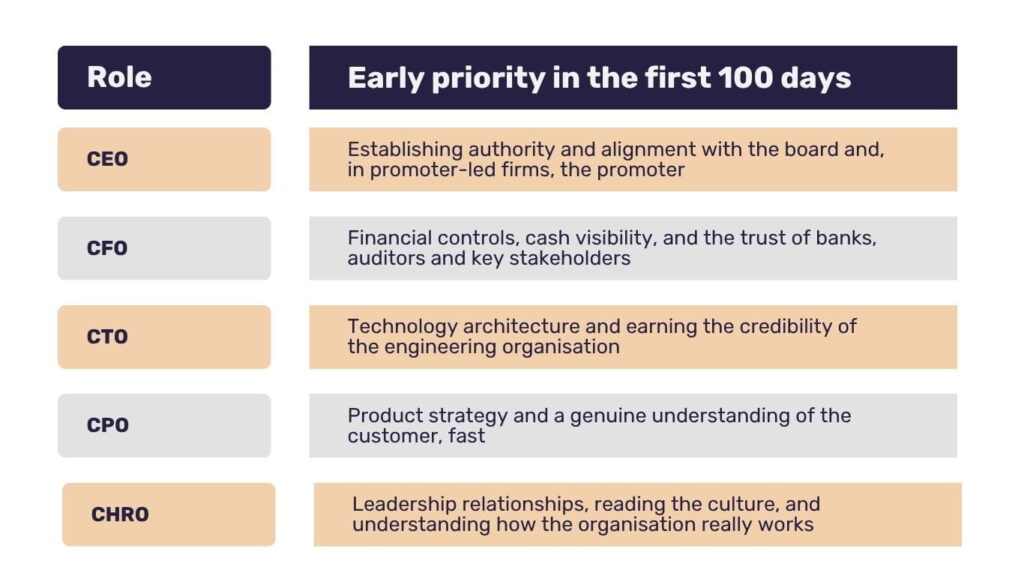
A CFO who spends the first month building relationships but not establishing financial control has mis-prioritised; so has a CHRO who audits processes before building the leadership relationships the role runs on.
What Are The Warning Signs Of A Failed CXO Transition & Onboarding?
Each of these is visible well before a transition formally fails – while there is still room to correct it.
The Calendar Is Empty of the People Who Matter
The new executive's diary is full of meetings, but not with the handful of people whose support the role actually depends on.
No One Has Checked In Since Week Two
The board or hiring manager was closely involved through the offer, then went quiet. Silence after placement is not confidence – it is abdication.
The 90-Day Plan Was Never Written Down
There is a vague sense of what the executive should achieve, but nothing explicit, agreed, and shared. Undefined expectations are unmeetable ones.
There Is No Meaningful Disagreement or Challenge
Everything has been smooth, every review positive, no friction anywhere. At this level, the absence of any real challenge usually means the honest conversations are not happening.
The Executive Is Still Asking Permission Inside Their Own Mandate
Ninety days in, the executive is still seeking sign-off for calls that clearly sit within the authority the role was meant to carry. Either the mandate was never real, or the assimilation has not delivered the standing to exercise it.
How to Fix a Failing Executive Transition
A transition that is drifting at day 60 or 90 is not necessarily a failed hire. It is usually a fixable process problem, if it is addressed directly rather than left to resolve itself.
The board or hiring manager and the CXO should :
Together, rebuild the mandate conversation - this time in specific terms, not aspirational ones.
The board or hiring manager should :
Name it, out loud, in a real conversation - not a private worry passed quietly around the boardroom.
Give the executive direct, unfiltered access to the two or three relationships that actually matter - deliberately, not by chance.
Set a short, honest checkpoint - 30 days, not another 180 - with an explicit criterion for whether the correction worked.
Decide quickly if it still isn't working after a genuine, well-supported attempt. A slow exit is more expensive than a fast, honest one - for the executive and the organisation both.
First 100 Days Checklist
For the Board or Hiring Manager
- Mandate confirmed in specific, written terms before the executive's first day
- Key relationships identified and actively opened, not left to chance
- 30-day, 60-day and 90-day check-ins scheduled in advance, not arranged reactively
- A named owner for assimilation – not HR, not “the team,” one accountable person
- Willingness to publicly back the executive's early decisions where they are sound
For the New CXO
- The three maps understood: formal reporting, informal influence, decision rights
- A first visible decision made and communicated by day 60
- One real, appropriately-scaled deliverable by day 90
- A written 90-day plan the board has actually seen and agreed to
- A clear read, by day 100, on which of the five Day-100 questions above they could answer confidently
Frequently Asked Questions On Onboarding A New CXO
What should a good first 100-day plan actually include?
A clear statement of the mandate the executive owns, a small number of specific objectives for the first 90 days scaled to the role, the key relationships to build, and agreed check-in points at 30, 60 and 90 days.
It should be written down and shared between the executive and the board or hiring manager – a plan that lives only in someone’s head is not a plan.
Who should own the new CXO onboarding process – HR, the CEO, or the board?
HR can and should manage onboarding – systems, paperwork, logistics.
But assimilation, the part that determines whether the hire succeeds, must be owned by the CEO, board, or hiring manager who made the decision. It is the most commonly dropped responsibility in the entire process, precisely because it comes after the visible work is done.
What's the biggest reason executive onboarding fails in India specifically?
The gap between the formal org chart and the real decision-rights structure, which in many Indian businesses – particularly promoter-led and family-owned ones – diverge sharply. A new executive who reads only the reporting lines and misses where authority actually sits can stall on a sound decision without understanding why.
How is onboarding different for an internal promotion versus an external hire?
An internal promotion starts with context, relationships and political capital, but has to renegotiate how they are seen – from peer to leader.
An external hire starts with a clean slate but must build context, relationships and credibility from scratch.
When should the first real performance conversation happen?
The first structured review belongs at around 90 days – an honest conversation about how the transition is going, distinct from a formal appraisal. Accountability against the mandate should sharpen from around 180 days, with a genuine year-one review at 365 days.
Can a struggling onboarding be turned around, or is 90 days usually too late?
It can very often be turned around, which is exactly why the early signs matter. Most failing transitions are visible by week six or eight. Caught then, they are usually fixable. Left until the formal review, they frequently are not.
These FAQs cover the most common questions we hear from teams looking to hire India leaders for their operations.
For a more comprehensive breakdown, including questions on fees, timelines, guarantees, and how the process works step by step, visit our detailed Executive Search FAQ.
The Search Doesn't End When the Candidate Joins
A successful CXO transition starts before the executive joins. The mandate needs to be clear. Decision rights need to be explicit. The people whose support the role depends on need to know why the appointment was made and what authority comes with it.
That is why the search, the appointment, and the first 100 days should be treated as one leadership process – not three separate activities handed off from one team to the next.
At Pipal Tree Services, our commitment to a placement does not end at the offer.
Our sustained alignment support carries through the first year – structured check-ins at 30, 60, 90, 180 and 365 days – because a search is only genuinely successful when the leader it places is still succeeding a year later. We help both the executive and the board make the first 100 days deliberate, not accidental.
If you are planning a CXO appointment, or you have made one and want the transition to hold, a conversation about how to set the first 100 days up well is worth having before the executive walks in on day one.
If you’d like to discuss how we can strengthen your leadership team, reach out to me at [email protected].

Sonia Sharma
"With over 25 years in talent leadership, including 20+ years in executive search, Sonia brings valuable dual perspective as Pipal Tree's CEO & founder. Her career spans both consultancy roles at prestigious firms (Korn/Ferry International, Accord India, Stanton Chase) and corporate leadership. Sonia specializes in executing confidential, high-stakes searches for global and Indian multinationals."