

CEO or a COO: Which Should a Founder-Led Business Hire First
Should you hire a professional CEO or a COO?
The answer depends less on company size than on the founder’s role. If the founder is ready to step back from executive leadership, a CEO may be right. If the founder wants to remain CEO but needs to delegate execution, a COO may be the better fit.
The decision comes down to three questions: Role, Capability and Authority.
Table of Contents
A promoter of a fast-growing manufacturing business called us last year with what he thought was a clear brief: he wanted to hire a professional CEO.
The company had scaled past the point where he could stay across everything, growth was straining the organisation, and he had decided it was time to bring in someone to run the company so he could step up and out.
We spent the first meeting not on the search, but on the question underneath it.
What, exactly, did he want to stop doing?
As we worked through it, something became clear that he had not quite said out loud. He did not, in fact, want to stop leading the business.
He was proud of it, he still had a strong sense of where it should go, and – pressed honestly – he was not ready to hand the direction of the company to someone else.
What he wanted was to stop personally running it:
– the daily operations,
– the firefighting,
– the coordination that had swallowed his calendar.
He had come in asking for a CEO. What the business actually needed was a COO.
The distinction was not academic – it changed the profile, the mandate, the compensation and, most of all, what he would have to give up.
And it turned on a question he had never explicitly asked himself: what role did he want to play next?
That answer to the question “CEO or a COO” seems to be an org-chart.
It is not.
For a founder-led or promoter-led business, it is a question about the founder’s own role – and getting the org chart right depends on answering that first.
This is a guide for the founder, promoter or board director weighing that first top-level leadership hire.
Should You Hire a CEO or a COO?
A founder holds three things at once: ownership, executive leadership, and operational execution. The CEO or COO decision is really about which of them you are ready to hand over.
In most founder-led and promoter-led businesses, one person quietly holds three distinct things at the same time:
#1. Ownership
The equity, and the ultimate authority that comes with it.
#2. Executive Leadership
Setting the direction of the company and being accountable for it: the CEO’s job.
#3. Operational Execution
Actually running the business day to day: the work a COO owns.
Because one person has always held all three, the instinct is to treat “bringing in senior help” as a single decision.
It is not.
Hiring a professional CEO means handing over executive leadership – while, usually, keeping ownership.
Hiring a COO means keeping executive leadership and handing over operational execution.
The title you should hire follows directly from which of these you are actually ready to let go of. Get that wrong, and no candidate, however good, can rescue the appointment.
CEO vs COO: What Each Decision Really Means
The two roles solve different problems – and leave the founder in very different positions.
| Hiring a Professional CEO | Hiring a COO | |
| What the business needs | A new leader of the company | A leader for how the company runs |
| The gap it closes | A leadership requirement | A capacity constraint |
| Founder / promoter’s role after | Steps back from day-to-day executive leadership; may remain Chairman / promoter | Remains CEO and delegates operational execution |
| Authority transferred | Strategic and operational | Operational |
| The real risk if mismatched | The founder won’t let go, and the CEO is CEO in name only | The COO is given the title but not the operating authority |
When a Professional CEO Is the Right Call
When the founder no longer wants or is no longer the right person, to lead the company, not just to run it.
A professional CEO is the right hire when the constraint is leadership itself, not bandwidth. That situation takes a few recognisable forms:
The founder wants to step back.
They are ready to move into a Chairman or promoter role focused on ownership, governance and strategic direction, and to let someone else lead the company.
The business needs a kind of leadership the founder cannot provide.
A new phase - a category shift, a professionalisation drive, an eventual sale or public listing - may call for leadership experience the founder does not have and does not want to acquire on the job.
Succession is the real agenda.
Where the goal is an eventual generational or ownership transition, the CEO hire is a succession decision as much as a leadership one.
For promoter-led and family businesses in particular, this is the promoter-to-professional transition, and it succeeds or fails on the promoter’s genuine readiness to cede leadership.
We look at that transition in depth in our guide to succession planning for family businesses.
When a COO Is the Right Call
When the founder is still the right leader of the company, but has become the bottleneck in running it.
A COO is the right hire when the founder is still the right person to lead the company – the direction is theirs, and it is sound – but the business can no longer execute at the pace of one person’s personal capacity. The founder is in every operational meeting, decisions of every size wait on them, and the limit on growth has become the founder’s calendar rather than the strategy.
In that situation the founder does not need to be replaced as leader; they need to be freed to lead, by handing operational execution to someone whose job is to run th business day to day.
That is a COO decision.
We set out the signals, the types and the timing in detail in When Does a Company Need Its First COO?.
The Half-Measure Trap
The most common failure is hiring one title to avoid confronting the founder’s-role question at all.
The costliest mistakes we see are not a founder choosing the wrong title. They are a founder choosing a title precisely so they do not have to answer the harder question underneath it. It shows up two ways:
A COO hired to do a CEO’s job.
The founder knows, privately, that they have checked out of leading the company - but is not ready to say so, or to give up the CEO title.
So they hire a “strong COO” and quietly expect them to set direction, carry the company and make the calls a CEO makes, all without the mandate or the authority to do it.
The role is impossible as designed.
A CEO hired while the founder keeps every real decision.
The reverse, and more common: the founder hires a professional CEO to signal that the business has professionalised, then continues to make every decision that matters.
The CEO is CEO on the letterhead and a highly paid executor in practice, and usually leaves inside two years.
In practice : The CEO Search That Became a COO Search
The promoter in the opening had been ready to run a full CEO search - external, high-profile, expensive. Had we simply executed the brief as given, we would have found him a capable CEO who would have spent a frustrated year discovering that the promoter had no intention of ceding direction, and then left. The brief was right about the symptom (the promoter was overloaded) and wrong about the cure (a new leader). Reframed as a COO search, the mandate became coherent: the promoter stayed CEO and kept the direction of the company, and we searched for an operator to take execution off his plate - with an explicit, written line on which decisions were now theirs to make. The hire held because the authority question had been answered before the search began, not discovered after it.
“Almost every founder who calls asking whether they need a CEO or a COO is really asking a question about themselves that they haven’t phrased yet: what do I actually want to be doing in this business in three years?
Answer that honestly and the title is obvious.
Skip it, and you hire a title to avoid the decision – which is the one hire that reliably fails.”
How to Decide Between CEO Or a COO: Three Questions for the Founder
Role, then Capability, then Authority – answered honestly and in that order.
Before deciding on a title, we take founders through three questions, in sequence. Each one narrows the answer, and the order matters.
#1. The Role Question: Do you still want to be the CEO in three years?
This is the first fork, and the one founders most often skip. If the honest answer is no – you want to step back, move into a Chairman or promoter role, or begin a genuine transition out of leadership – you are heading toward a professional CEO.
If the answer is yes, you still want to lead the company, then you are looking for a COO, and the next two questions confirm what kind.
#2. The Capability Question: Is the constraint your capacity, or your capability?
These are not the same problem, and they point to different hires:
- Capacity: “I can lead this business, but I cannot personally run everything anymore.”
That is a capacity constraint – and it points to a COO, someone to take operational execution off your plate so you can keep leading. - Leadership requirement: “The business now needs a different type or level of leadership than I want, or am able, to provide.”
That is not about your bandwidth; it is about the kind of leadership the company requires next – and it points to a professional CEO.
#3. The Authority Question: Can you genuinely give up decisions you would have made differently?
This is the test that decides whether either hire will actually work. Whichever role you bring in, they will make calls you would have made differently.
A COO will run operations in ways you would not have. A CEO will set directions you might not have chosen. If you cannot let a decision you disagree with stand – within sensible guardrails – then you are not yet ready to hand over the authority the role requires, and the hire will fail regardless of the title on it.
The candidate is rarely the problem. The founder’s readiness to answer this question is.
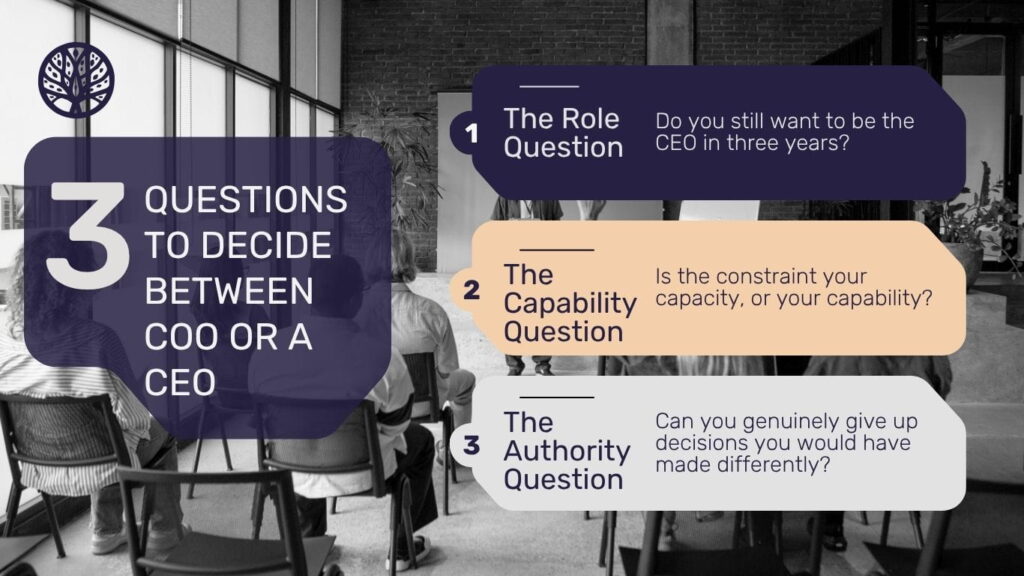
Role, then Capability, then Authority.
It is a simple sequence, but a demanding one, because it forces the founder – not the org chart – to make the decision.
“Founders think the hard part is finding the person.
It almost never is – the market has capable CEOs and capable COOs. The hard part is the authority question: can you genuinely let someone make a decision you would have made differently, and live with it?
Until a founder can answer that honestly, no title fixes anything. It just relocates the bottleneck.”
What If the Answer Is Both COO and CEO or Neither?
Sometimes the right answer is a sequence, not a single hire – and sometimes it is no hire at all, yet.
Both - COO and CEO , but in sequence.
For many businesses the honest answer is that they will eventually need both - but not at once, and not in either order. The most reliable path we see separates the three things the founder holds, over time: ownership, executive leadership and operational execution, handed over one at a time.
The common sequence is Founder → COO → Professional CEO.
The founder first brings in a COO to take operational execution, while staying CEO and continuing to lead.
That does two things: it relieves the immediate constraint, and it professionalises the operating layer of the business.
Then, when the founder is genuinely ready to step back from leadership - often years later - the business is far readier to absorb a professional CEO, sometimes with the COO themselves as the internal successor.
Trying to skip the middle step - hiring a CEO before the operating layer has been professionalised and before the founder is ready to cede leadership - is what produces the half-measure failures above.
Neither a CEO Or a COO, yet.
Sometimes the three questions reveal that the founder is not ready to give up authority to either role.
That is a legitimate answer - but then the right first move is not a senior hire at all.
It may be a Chief of Staff to create leverage, a strong functional head to close a specific gap, or simply the founder learning to delegate within the current structure. Hiring a CEO or a COO into a founder who will not let go does not solve the problem; it adds a very expensive person to it.
Frequently Asked Questions on Hiring a CEO or COO
Should a startup hire a CEO or a COO first?
Almost always a COO, if either. In a founder-led startup the founder is usually still the right leader of the company and the constraint is capacity, not leadership – which points to a COO to take operational execution.
A professional CEO becomes the right first hire only when the founder is genuinely ready to step back from leading the company, which is uncommon at the startup stage.
Can a founder hire a CEO and stay involved in the business?
Yes – but the involvement has to be defined, or the hire fails. A founder can move to a Chairman or promoter role focused on ownership, governance and strategic direction while a professional CEO leads the company. What does not work is hiring a CEO and continuing to make every executive decision; that leaves the CEO accountable without authority, and they typically leave.
What is the difference between a COO and a professional CEO?
A CEO leads the company – sets direction and is accountable for it. A COO runs the company day to day – owns operational execution under the CEO. Hiring a CEO means the founder hands over executive leadership; hiring a COO means the founder keeps executive leadership and hands over operational execution.
When is it too early to hire either a CEO or a COO?
When the founder is not yet willing to transfer real authority to anyone. If the founder cannot let a decision they disagree with stand, both roles will fail regardless of the candidate. In that situation a lighter appointment – a Chief of Staff or a strong functional head – usually solves the real problem better than a senior leadership hire.
Should a family business or promoter-led firm hire a CEO from outside?
It depends on whether the promoter is ready to cede leadership. Where the promoter wants to step back and the next generation is not ready or not willing, an external professional CEO can be the right bridge. But it is fundamentally a promoter-to-professional and succession decision, and it works only if the promoter genuinely transfers leadership rather than retaining it informally.
Can you hire a CEO and a COO at the same time?
Rarely a good idea as a first move. Bringing in both leadership and operational execution at once, into a business that has been run by one person, usually creates authority confusion at the top. The more reliable path is a sequence – typically a COO first to professionalise operations, and a professional CEO later, when the founder is ready to step back.
These FAQs covers the most common questions we hear when it choosing between a CEO or COO in India.
For a more comprehensive breakdown, including questions on fees, timelines, guarantees, and how the process works step by step, visit our detailed Executive Search FAQ.
Why Pipal Tree is one of the top executive search firm in India
97% placement success rate across hundreds of leadership mandates.
50+ years of combined search experience across our founding team.
80% repeat engagement rate > our clients come back because our process works.
We combine the best practices of a global search firm with the entrepreneurial responsiveness and senior-partner involvement of a boutique consultancy.
The Question Isn't Which Role - It's What Role You're Ready to Play
The CEO or COO decision looks like a question about the business.
It is really a question about the founder.
The org chart is downstream of one honest answer: what role are you, the founder or promoter, actually ready to play next?
Decide that – through the Role, Capability and Authority questions – and the title you need becomes clear, and the hire has a real chance of holding.
Skip it, and you end up hiring a title to avoid a decision, which is the one appointment that reliably fails.
At Pipal Tree Services, we help founders and boards answer that question before the search begins – separating what the business needs from what the founder is ready to hand over, and defining the mandate and authority the role will genuinely carry. Whether the answer is a professional CEO, a COO, or a different first move altogether, the discipline is the same: get the founder’s-role decision right first, then search for the person.
If you are weighing a CEO or a COO for your business, it is a conversation worth having before you write the brief.
Write to me at [email protected].
Also read:
When Does a Company Need Its First COO?

Rahul Bahuguna
“With over two decades of experience across executive search, digital strategy, and business consulting, Rahul brings a unique entrepreneurial perspective as Director & Co-Founder of Pipal Tree Services. At Pipal Tree, Rahul leverages his background in strategy, market intelligence, and digital transformation to guide mission-aligned executive search and board mandates. He specializes in building long-term client partnerships, leading complex leadership searches, and shaping Pipal Tree’s distinct positioning at the intersection of talent and purpose. His ability to combine strategic insight with practical execution makes him a trusted advisor to organizations seeking leaders who can drive meaningful, sustainable change.”