

What is the difference between a CTO, CPO and CPTO?
The decision between a CTO, CPO, and CPTO comes down to who should own product strategy, technology execution, and overall organisational leadership.
A CTO owns technology strategy and engineering execution.
A CPO owns product strategy and go-to-market decisions.
A CPTO combines both under a single leader — most common at early-to-growth-stage companies, where unified accountability and speed outweigh the benefits of separate, specialised leadership.
Table of Contents
A CPTO – Chief Product and Technology Officer, is a combined executive role that integrates product strategy and technology leadership under a single leader. As companies decide whether to hire separate CTO and CPO roles, combine them into a CPTO, or create a reporting hierarchy between the two, this decision profoundly shapes their ability to innovate, execute, and scale.
Drawing from our extensive executive search experience in the technology sectors and insights from product and technology leaders across industries, we’ve developed this comprehensive guide to help you make the right choice for your organization.
CPTO stands for Chief Product and Technology Officer - a senior executive role that combines the responsibilities of the Chief Technology Officer (CTO) and Chief Product Officer (CPO) into a single position. The CPTO owns both product strategy and technology execution, providing unified leadership across engineering and product management teams. The role is most commonly adopted at early-to-growth-stage technology companies and startups where consolidating product and engineering leadership reduces friction and accelerates delivery.
Understanding the Technology & Product Structure Landscape
The traditional model positions the CTO as “head of technology,” sometimes with product functions reporting to them.
However, modern organizational structures increasingly favor treating the CPO and CTO as peer roles, both reporting directly to the CEO or Managing Director.
A third option – the combined CPTO role – has also gained traction, particularly in specific contexts.
The optimal structure isn’t universal. It depends on your company’s stage, product complexity, technical requirements, and existing team dynamics.
Defining the Roles - CTO vs CPO vs CPTO
What is a Chief Technology Officer (CTO)?
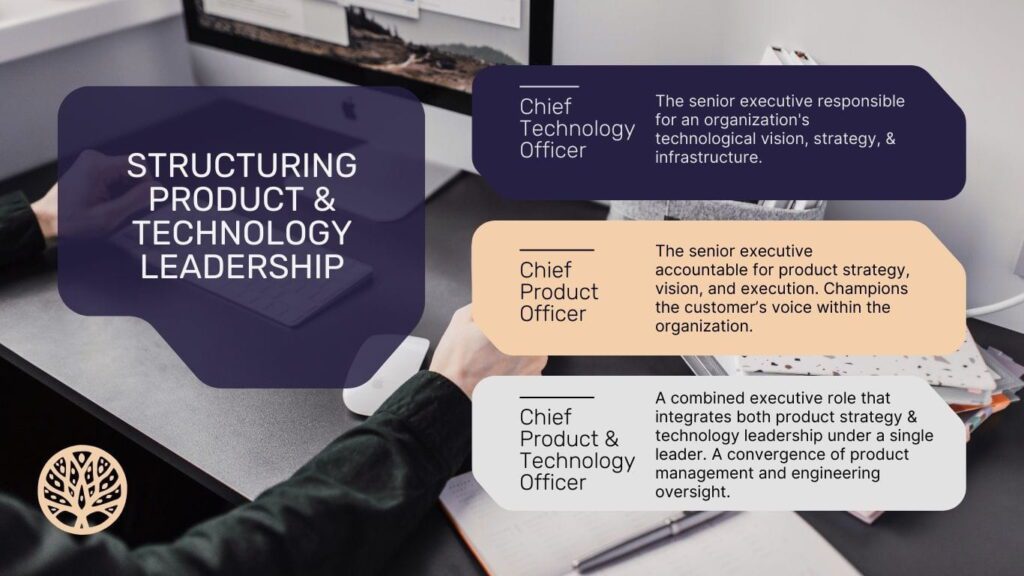
The Chief Technology Officer is the senior executive responsible for an organization’s technological vision, strategy, and infrastructure. The CTO team structure consists of the engineering team and ownership of the technology stack, system architecture, and technical operations that power the company’s products and services.
Core Responsibilities:
- Defining and executing the company’s technology strategy and roadmap.
- Building and leading the engineering team, including hiring top technical talent.
- Ensuring technical infrastructure is scalable, secure, and reliable.
- Making critical technology decisions on architecture, platforms, and tools.
- Managing technical debt and balancing innovation with system stability.
- Overseeing development processes, methodologies, and engineering culture.
- Staying current with emerging technologies and assessing their relevance to the business.
- Partnering with product leadership to ensure technical feasibility of product vision
The CTO typically comes from a strong engineering background, often with years of hands-on development experience and progressively senior technical leadership roles. They excel at translating business objectives into technical solutions and building high-performing engineering organizations.
What is a Chief Product Officer (CPO)?
The Chief Product Officer is the senior executive accountable for product strategy, vision, and execution. The CPO champions the customer’s voice within the organization and ensures the company builds products that deliver meaningful value to users while achieving business objectives.
Core Responsibilities:
- Defining product vision, strategy, and roadmap aligned with company goals.
- Leading product management teams and establishing product development processes.
- Conducting market research and competitive analysis to inform product decisions.
- Prioritizing features and capabilities based on customer needs and business value.
- Owning product-market fit and go-to-market strategy for new offerings.
- Collaborating with engineering, design, marketing, and sales to deliver successful products.
- Defining and tracking product success metrics and KPIs.
- Managing the product lifecycle from ideation through launch and optimization.
- Representing customer needs and market opportunities in executive discussions.
The CPO typically has extensive product management experience, deep customer empathy, strong analytical skills, and the ability to balance user needs with business viability and technical feasibility. They excel at identifying market opportunities and translating them into compelling product experiences.
What is a Chief Product and Technology Officer (CPTO)?
The Chief Product and Technology Officer is a combined executive role that integrates both product strategy and technology leadership under a single leader. This role represents the convergence of product management and engineering oversight into one cohesive function.
Core Responsibilities:
- Unifying product vision and technical strategy into an integrated roadmap.
- Leading both product management and engineering teams.
- Ensuring seamless collaboration between product and technology functions.
- Making holistic decisions that balance user needs, business goals, and technical constraints.
- Accelerating innovation by eliminating handoffs between product and engineering leadership.
- Providing single-point accountability for product delivery and technical execution.
- Managing the complete product development lifecycle from strategy through deployment.
- Allocating resources across product and engineering priorities.
- Building organizational culture that values both customer focus and technical excellence.
The CPTO is a rare breed who possesses deep expertise in both product management and engineering, with proven ability to lead effectively in both domains. This role demands exceptional breadth of knowledge, strategic thinking, and the stamina to manage the combined demands of two traditionally separate executive functions.
Role Comparison: CTO vs CPO vs CPTO
| Aspect | Chief Technology Officer (CTO) | Chief Product Officer (CPO) | Chief Product & Technology Officer (CPTO) |
|---|---|---|---|
| Primary Focus | Technology strategy, engineering execution, and infrastructure | Product strategy, customer needs, and market fit | Integrated product-technology strategy and execution |
| Key Question | “How do we build it?” | “What should we build?” | “What should we build and how do we build it together?” |
| Typical Background | Engineering, software development, technical architecture | Product management, business strategy, UX/customer research | Hybrid: Strong in both product and engineering domains |
| Core Expertise | System architecture, engineering management, technical innovation | Market analysis, product strategy, user experience | Product vision + technical feasibility + organizational integration |
| Team Leadership | Engineering, DevOps, IT, Technical Operations | Product Management, Product Design, Product Analytics | Combined product and engineering organizations |
| Success Metrics | System uptime, development velocity, technical debt reduction, engineering productivity | Product adoption, customer satisfaction, revenue growth, feature usage | Holistic: Speed to market, product-market fit, technical excellence, team alignment |
| Decision Authority | Technology stack, architecture, development processes | Product roadmap, feature prioritization, go-to-market strategy | End-to-end authority from product concept to technical delivery |
| Strategic Orientation | Technology as competitive advantage and operational enabler | Customer value creation and market opportunity | Unified strategy balancing innovation, feasibility, and execution |
| Collaboration Requirements | Must partner closely with CPO and business leaders | Must partner closely with CTO and commercial teams | Internal collaboration within combined org; external with CEO and commercial leaders |
| Ideal Company Stage | All stages, especially where tech is differentiator | All stages, especially customer-centric or market-driven companies | Early-to-growth stage, or during rapid innovation phases |
| Reporting Structure | Typically reports to CEO | Typically reports to CEO | Reports to CEO with broader organizational scope |
| Risk Factor | Technical tunnel vision; over-engineering | Building features customers don’t want; ignoring technical constraints | Role overload; burnout; possible bias toward area of strength |
| Talent Pool | Large pool of experienced engineering leaders | Growing pool of experienced product leaders | Very limited pool of dual-expertise executives |
Tech Org Structure 1: The CPTO Model (Combined Leadership)
What It Is
A single leadership role of Chief Product and Technology Officer which integrates product management and engineering oversight into a single executive function, creating unified accountability for both product vision and technical execution.
When to have a CPTO
-
Your Product Is Inherently Technical
If you operate in AI software, hardware manufacturing, or other deeply technical domains where technology serves as a core differentiator, a CPTO can effectively bridge the gap between product vision and technical feasibility. The combined perspective ensures product decisions are grounded in technical reality from the outset. -
You're in a Rapid Growth or Innovation Phase
During periods of intense innovation, seamless collaboration between product and engineering becomes critical. A CPTO can dismantle communication barriers between these departments and accelerate decision-making. -
You Need Speed and Unified Accountability
This structure particularly benefits Private Equity-backed companies or startups racing against tight timelines. A single point of accountability expedites decision-making and ensures integrated strategies that align development capabilities with customer needs. -
Your CEO Lacks Product or Engineering Background
When the CEO doesn't have deep expertise in product or engineering, consolidating these functions under a CPTO provides unified leadership without requiring the CEO to navigate the nuances of both domains daily.
The Challenges With CPTO Model
-
The Burden of Dual Responsibilities
The combined role is extraordinarily demanding. Managing both product strategy and technical infrastructure simultaneously can lead to burnout, particularly as the company scales. -
Limited Talent Pool
Finding candidates with exceptional expertise in both product management and engineering is challenging. You'll often face a trade-off between a product executive with technical acumen or a technology leader with product sensibilities. True dual-expertise at the executive level is rare and commands premium compensation. -
Resource Intensity
When you do identify the right candidate, securing their recruitment may require substantial resources, both financial and in terms of equity allocation.
Tech Org Structure 2: Separate CPO and CTO Roles
What It Is
This structure maintains distinct leadership for product strategy (CPO) and technology infrastructure (CTO), with both executives reporting directly to the CEO as organizational peers.
When to have a separate CTO & CPO
-
Your Product Isn't Highly Technical
If technology serves primarily as a tool for business operations rather than a core differentiator, you benefit from distinct expertise in product strategy and technical infrastructure. The separation allows each leader to focus on their specialized domain. -
You Have Strong, Established Teams
When you've already built well-functioning product and engineering teams, introducing a combined role could disrupt effective dynamics. Maintaining dedicated leadership preserves team morale and allows specialized guidance to flourish. -
Your Product and Tech Requirements Are Complex
Complex products demand deep, specialized oversight. Separation allows each leader to dive deeply into their respective domains for greater strategic effectiveness. -
You Value Diverse Executive Perspectives
Companies with larger executive teams that prioritize diverse viewpoints in strategic decision-making benefit from the healthy tension and balanced advocacy that separate CPO and CTO roles provide. -
You Want to Build Strong Product-Engineering Partnerships
Separate but equal roles foster collaboration built on mutual respect rather than hierarchy. Strong products emerge when product and engineering work as equals toward common goals, with neither function subordinate to the other. -
Making the Partnership Work
When pursuing separate roles, success depends on establishing clear collaboration frameworks. Both leaders must share accountability for outcomes while maintaining distinct areas of ownership. Regular joint planning sessions, shared OKRs, and executive sponsorship of the partnership are essential
A Decision Framework To Choose Between CPTO vs CPO & CTO
Your Company Stage and Size
- Early-stage startups (pre-Series A)
Often benefit from a technical co-founder serving as CTO, with product leadership emerging later. - Growth stage (Series A-C)
May thrive with CPTO during rapid scaling, then split roles as complexity increases. - Mature companies
Typically require specialized, separate leadership.
Your Product Complexity
- Highly technical products (AI, infrastructure, developer tools)
lean toward CPTO or technical-first leadership - User-focused products with complex business logic
Benefit from balanced, separate leadership - Simple technical implementation with sophisticated go-to-market
May prioritize product leadership
Organizational Culture
- Engineering-driven cultures
ensures product voice isn’t diluted - Product-driven cultures
Protect engineering quality and architectural integrity - Balanced cultures
Maintain equilibrium through structure
Questions to Guide Your Choice
- Does our product’s competitive advantage come primarily from technical innovation or market/customer insight?
- Do we currently have leaders in place who could grow into these roles, or are we hiring externally?
- What is our CEO’s background and comfort level with product and technology decisions?
- Are we optimizing for speed and decisiveness, or for depth of expertise and specialization?
- What stage of company maturity are we at, and where will we be in 18-24 months?
- Can we attract and afford the caliber of CPTO candidate who truly excels at both domains?
"The best search firms don't just fill your current opening. They provide market intelligence, assist with succession planning, and become trusted advisors in building your leadership team."
Sonia Sharma, CEO Founder Tweet
Common Mistakes to Avoid
-
Creating Hierarchies Without Strategic Rationale
Making product report to the CTO (or vice versa) simply because it's "traditional" or convenient often backfires. These decisions should be driven by your specific product, market, and organizational needs. -
Underestimating the CPTO Role's Demands
Don't assume a strong product leader can easily add technology oversight (or vice versa). The combined role requires genuine expertise and passion for both domains. -
Neglecting the Relationship Dynamic
When hiring separate CPO and CTO roles, evaluate candidates not just on individual merit but on their ability to partner effectively. Cultural fit between these two leaders is as critical as their functional expertise. -
Failing to Evolve the Structure
What works at 50 employees may not work at 500. Build in regular evaluation points to assess whether your structure still serves your strategic objectives.

The Pipal Tree Services Recommendation
Based on our experience placing product and technology executives across diverse organizations, we generally recommend the following approach:
For most non-tech companies building technology teams
Start with separate CPO and CTO roles reporting to the CEO as peers. This structure provides balanced expertise, reduces key-person risk, and builds organizational muscle in both domains.
For deeply technical products or rapid-growth phases
Consider the CPTO model, but plan for eventual separation as the company matures and complexity increases.
For early-stage startups
Prioritize technical leadership first (CTO or technical co-founder), then add dedicated product leadership as you achieve product-market fit and begin scaling.
Final Thoughts
There is no universally “correct” answer to structuring your product and technology leadership. The right choice depends on your company’s unique context, strategic priorities, and available talent.
What matters most is making a deliberate choice based on clear strategic rationale, then committing to making that structure work through aligned incentives, clear accountability, and executive support of the collaborative dynamic you want to create.
At Pipal Tree Services, we partner with companies to not only identify exceptional product and technology leaders but to ensure those leaders are set up for success within a structure that serves your company’s goals.
We’d welcome the opportunity to discuss your specific situation and help you navigate this critical decision.
Let’s start with a conversation about your leadership needs and the transformation you’re navigating.
No pressure. Just talk.
Write to me at [email protected]

Rahul Bahuguna
“With over two decades of experience across executive search, digital strategy, and business consulting, Rahul brings a unique entrepreneurial perspective as Director of Pipal Tree Services. At Pipal Tree, Rahul leverages his background in strategy, market intelligence, and digital transformation to guide mission-aligned executive search and board mandates. He specializes in building long-term client partnerships, leading complex leadership searches, and shaping Pipal Tree’s distinct positioning at the intersection of talent and purpose. His ability to combine strategic insight with practical execution makes him a trusted advisor to organizations seeking leaders who can drive meaningful, sustainable change.”