

Table of Contents
Which Job Description Keywords Indicate Global Scope in Executive Roles?
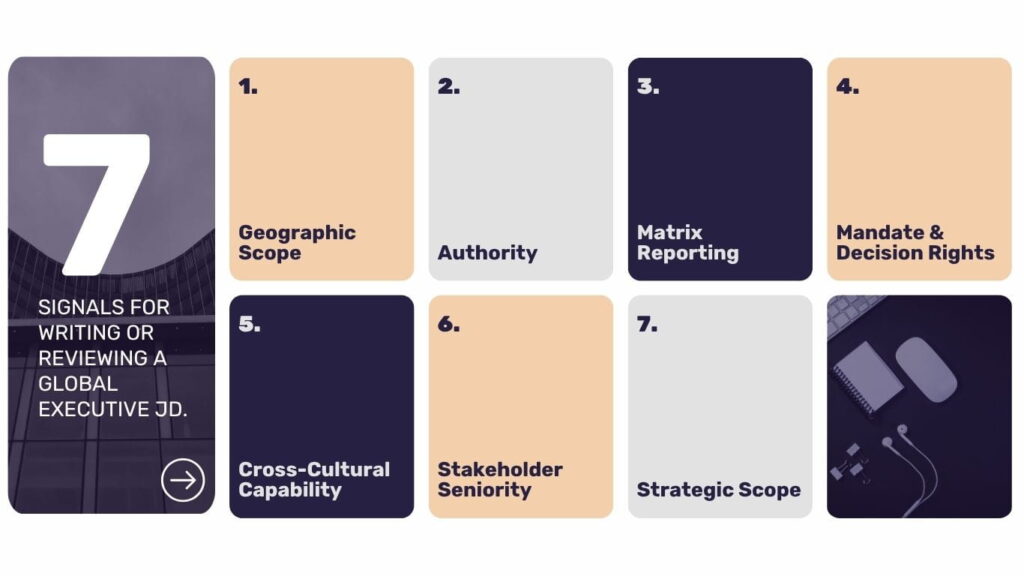
- Geographic scope: “multi-country,” “cross-border,” “regional,” “global,” “APAC,” “EMEA,” “India + APAC,” “Global P&L”
- Authority and mandate: “end-to-end ownership,” “MD with statutory board authority,” “dotted-line to global CTO,” “direct report to global CEO”
- Matrix complexity: “matrix reporting,” “regional cluster,” “dual reporting,” “global functional partner”
- Cross-cultural capability: “HQ-country bridge,” “cross-cultural leadership,” “global stakeholder management,” “multi-jurisdiction governance”
- Strategic scope: “Global Capability Centre,” “India-for-global delivery,” “regional strategic mandate,” “country leadership reporting to global P&L”
Writing an executive job description for a role with global or international scope is fundamentally different from writing one for a domestic position.
The keywords you use don’t just describe the role they signal authority, mandate, reporting structure, and the cultural complexity the leader will need to navigate.
Get the language wrong, and the best candidates self-select out before the first conversation. Get it right, and the JD becomes a precise filter that attracts exactly the calibre of leader the role requires.
This guide is for CHROs, founders, board members, and global HR teams who are writing or reviewing job descriptions for executive roles with cross-border, regional, or global scope.
The keywords and phrases below are drawn from years of executive search work across international mandates – the language that consistently appears in successful searches and the language that consistently fails.
For the broader framework on writing a strong executive JD, our complete guide to executive job descriptions is the foundation; this article goes deeper specifically on global and international roles.
Why Global Scope Language Matters in Executive Job Descriptions
Senior leaders evaluating a role spend, on average, less than 3 minutes reading the job description before deciding whether to engage further. For international or global roles, that decision is being made on signal density, not detail.
The candidate is asking themselves 4 questions and the language in the JD must answer all four:
How much authority does this role actually carry?
Is this a leadership role with genuine decision-making power, or a coordination role with a senior title?
How clear is the reporting line?
Will I report to someone who can advocate for my mandate, or will I be buried in a matrix that dilutes accountability?
What is the real geographic scope?
Is “regional” code for “you’ll spend 80% of your time managing India”?
Is “global” actually two markets?
Does the company understand cross-cultural complexity?
Does the JD demonstrate that the company has thought carefully about how the role operates between cultures or does it read like a domestic JD with “international” appended?
The job description keywords below answer these questions explicitly.
When a senior leader sees them, they signal seriousness, clarity, and a company that has thought deeply about what the role actually requires.
The Global Executive Scope Signal Matrix
Before getting into role-specific language, here is the single most useful reference for anyone writing or reviewing a global executive JD.
Each row shows a category of signal a senior international candidate looks for : the weak language that fails to deliver that signal, and the strong language that does.
Use this matrix as a final check.
If your JD is dominated by the middle column, you are likely losing senior international candidates before they reach the third paragraph.
| Signal Type | Weak Language (Avoid) | Strong Language (Use) |
| Geographic Scope | “International exposure” “Overseas operations” “Global footprint” |
“Multi-country P&L ownership across India + APAC” “Cross-border authority for 6 markets” “India-for-global delivery mandate” |
| Authority | “Collaborate with senior leadership” “Support the strategy” “Drive alignment” |
“Direct report to Global CEO” “Full P&L ownership for India operations” “Signing authority on contracts up to [value]” |
| Matrix Reporting | “Work in matrix environment” “Liaise with global teams” “Cross-functional coordination” |
“Solid line to Global CFO; dotted line to Regional President” “Functional partnership with global CTO” “Defined decision rights with regional cluster head” |
| Mandate & Decision Rights | “Recommend strategic initiatives” “Contribute to decision-making” “Influence stakeholders” |
“End-to-end ownership of India strategy” “Capital allocation authority up to [value]” “Hiring authority across the function” |
| Cross-Cultural Capability | “Global mindset required” “Culturally sensitive” “Comfortable across cultures” |
“HQ-country bridge leadership” “Multi-jurisdiction governance experience” “Board-level cross-border communication” |
| Stakeholder Seniority | “Manage stakeholders” “Work with senior leaders” “Represent the company” |
“Direct engagement with regional board and audit committee” “Principal company spokesperson to PSU procurement” “Global CEO leadership council member” |
| Strategic Scope | “Strategic thinking required” “Contribute to growth” “Help shape direction” |
“Define India strategy for the next five years” “Build GCC from setup to 1,500-person scale” “Own regional growth from ₹X to ₹Y in three years” |
How to Use This Matrix
Print your draft JD.
Highlight every phrase that maps to the middle column in red, and every phrase that maps to the right column in green.
If the document is dominated by red, the JD is signalling a coordination role even if you intend a leadership one. Senior candidates will read it that way.
“The hardest part of an international leadership search isn’t finding the candidate. It’s defining the role precisely enough that the right candidate recognises themselves in the description and the wrong ones rule themselves out.
Most companies underinvest in the first conversation and pay for it in the fourth month of a stalled search.”
Geographic Scope: Job Description Keywords That Define Where the Role Operates
The first signal a senior candidate looks for is the actual geographic footprint of the role. Vague language here is the single most common mistake in international JDs. The matrix above showed the contrast; the table below gives you the working vocabulary.
Use these keywords with precision
| Job Description Keywords | What It Signals |
| Global | True worldwide scope, typically covering 3+ continents. Use only when accurate. Candidates assume “global” means authority over multiple regions, not just visibility into them. |
| Multi-country | Authority across two or more specific countries, often within a region. Use when the role spans 3–7 countries, typically in a single geographic cluster. |
| Regional (APAC, EMEA, LATAM) | Coverage of a defined region. Always specify which region. “Regional” without naming the region is a red flag for senior candidates. |
| Cross-border | Implies meaningful operational presence in more than one country, often with regulatory or cultural complexity. Strong signal for senior international roles. |
| India + APAC | Specific scope where India is the primary base but the role extends across APAC. Common for senior commercial or operational roles based out of India. |
| India-for-global | India-based role contributing to global delivery, product development, or service. Very common for GCC leadership and engineering centre heads. |
| Hub-and-spoke model | Signals a central operational base with satellite presence in other markets. Useful for describing the actual operating model rather than just listing geographies. |
Reporting Structure: Job Description Keywords That Define Matrix Complexity
For roles operating across geographies, the reporting structure is often more complex than a simple solid-line relationship.
The JD must describe this complexity precisely, because senior candidates use it to assess how the role will actually function day-to-day.
| Job Description Keywords/Phrases | What It Signals |
| Solid line to [X], dotted line to [Y] | The clearest way to describe dual reporting.Be specific about who holds what authority. For example: “Solid line to global CEO for strategic and performance accountability; dotted line to regional COO for operational coordination.“ |
| Functional reporting to global [function head] | Signals expertise oversight from the global function while operational reporting sits elsewhere. Common for CFO roles in MNC subsidiaries. |
| Regional cluster head | Signals authority over a defined geographic cluster (e.g., India, Middle East, Africa) with consolidated reporting |
| Global functional partner | A peer-level relationship with a global function head, not a subordinate reporting line. Strong for senior subsidiary roles |
| Signing authority on contracts up to [value] | Specific financial authority. Vague references to “authority to make decisions” are weak; specific value thresholds are strong. |
| Direct access to [CEO/CFO/CHRO] | Useful when the formal reporting line is through a regional structure but the role has informal direct access to global C-suite. A strong differentiator for ambitious senior candidates |
A Critical Distinction
There is a significant difference between “matrix reporting” written in a JD as a fact and “matrix complexity” experienced by the leader in practice.
Senior candidates know that matrix reporting can be functional and energising, or paralysing and frustrating.
The JD should signal which version this is.
Phrases like “clear accountability framework,” “defined decision rights,” and “regular alignment cadence with [specific roles]” indicate that the company has thought through how the matrix actually works.
Generic references to “working in a matrix structure” signal the opposite.
“In every JD that fails, the company tells me they wrote what they wanted the role to be. In every JD that succeeds, they wrote what the role would actually require.
The first is wishful thinking. The second is leadership.“
Role-Specific Examples: Global Scope Language for Different CXO Mandates
The right job description keywords vary by role.
Below are examples of strong global scope language tailored to specific CXO mandates.
-
For a CEO India role at an MNC subsidiary
Managing Director and CEO of [Company] India, reporting directly to the Global CEO with full P&L ownership for India operations spanning manufacturing, commercial, and engineering functions.
End-to-end authority for India strategy, with signing authority for contracts up to [value], statutory MD responsibilities under the Companies Act, and direct board reporting. Functional partnership with global CTO, CFO, and CHRO. Member of the global CEO’s leadership council. -
For a CFO role at a multi-country regional cluster
Regional CFO for India + APAC, reporting solid line to the Global CFO and dotted line to the Regional President. Full financial accountability for India, Singapore, Malaysia, and Vietnam operations, with consolidated P&L responsibility of [revenue range].
Direct interaction with audit committee and regional board. Functional leadership over country finance heads across four markets. Authority for capital allocation across the regional cluster within agreed thresholds. -
For a CTO role at a GCC or India-for-global engineering centre
Head of Engineering and Product, [Company] India - leading an India-based engineering centre delivering for global product lines.
Solid line to Global CTO; dotted line to India MD for entity governance.
Full accountability for technical roadmap, engineering hiring across four product groups, and partnership with global product leadership in [HQ location].
Authority for technology architecture decisions for India-developed products. Board-level visibility within the global technology function. -
For a CHRO role with regional scope
Regional CHRO for South Asia and Middle East, reporting solid line to the Global CHRO with dotted line to the Regional President. End-to-end ownership of talent strategy, organisational design, and culture for a 4,000-person workforce across six markets. Authority for senior leadership hiring across the region. Direct engagement with regional board on talent risk and succession. Functional partnership with country HR heads and global Centres of Excellence.
For more on writing role-specific executive job descriptions, our broader guide to executive JDs provides templates and structural frameworks across CXO roles.
5 Common Mistakes in Global Executive Job Descriptions
-
Mistake 1: Treating “Global” as a Modifier Instead of a Mandate
Adding “global” in front of a role title without changing the underlying responsibilities is the most common mistake.
A “Global Marketing Director” who reports to a regional VP and has no authority outside one country is not a global role and senior candidates will see through this immediately. If the role doesn’t carry actual cross-border authority, don’t use the global modifier. -
Mistake 2: Hiding the Geographic Scope
Some JDs deliberately keep geographic scope vague to maintain flexibility.
This consistently backfires.
Senior candidates assume the worst when scope is unclear, they assume the role is smaller than implied, the authority is weaker than stated, or the company hasn’t thought through the mandate. Specificity, even when it narrows the candidate pool, attracts higher-quality interest. -
Mistake 3: Vague Reporting Lines
Some JDs deliberately keep geographic scope vague to maintain flexibility. This consistently backfires. Senior candidates assume the worst when scope is unclear - they assume the role is smaller than implied, the authority is weaker than stated, or the company hasn’t thought through the mandate. Specificity, even when it narrows the candidate pool, attracts higher-quality interest.
-
Mistake 4: Underweighting Authority Language
JDs frequently spend three paragraphs on responsibilities and one sentence on authority. For senior international roles, this ratio should be inverted. Responsibilities tell candidates what they’ll do; authority tells them whether they can actually do it. Strong global JDs allocate significant space to defining decision rights, signing authority, and hiring autonomy.
-
Mistake 5: Generic Cultural Language
“Global mindset,” “cultural sensitivity,” and “international exposure” appear in 90% of global executive JDs and signal nothing.
Replace generic terms with specific descriptions of the cultural complexity the role will navigate. “Will bridge the strategic priorities of a US-based parent company with the operational realities of an India manufacturing operation” is infinitely more compelling than “strong cross-cultural capability required.”
A Quick Checklist: Does Your JD Signal Global Scope?
- Does the JD specify exact geographic scope (countries, regions, or business units), not just “global” or “international”?
- Is the reporting line described with solid-line and dotted-line specificity, including role titles?
- Is the P&L scope quantified - either by revenue range, geography, or function?
- Are signing authority, capital allocation rights, and hiring authority described with specific thresholds or scope?
- Does the JD describe the matrix complexity precisely, or does it use generic “matrix structure” language?
- Is the cross-cultural complexity described in specific terms (HQ-country bridge, multi-jurisdiction governance), not generic ones?
- Does the JD signal stakeholder seniority — board interaction, audit committee engagement, regulator-facing responsibilities?
- Has the company thought through and articulated the failure modes of the role — what makes this role hard, and what kind of leader will succeed?
How Pipal Tree Approaches Job Description Drafting for Global Roles
At Pipal Tree Services, we view executive job descriptions not as administrative documents but as strategic leadership briefs. For roles with global or international scope, the JD becomes the single most important signalling tool the company has to attract senior passive talent.
Our process for clients with cross-border or global mandates starts with three structured conversations: one with the role’s sponsor or hiring manager, one with the regional or global stakeholders the role will interact with, and one with the board or investor representatives where relevant.
From these conversations, we extract the actual operating reality of the role – not just what the company wants the role to be, but what the role will functionally require. We then draft the JD using language calibrated to attract the specific candidate pool the mandate demands.
For most clients, this process surfaces clarifying questions the company hadn’t yet answered:
– How much autonomy does this role actually have?
– What is the real geographic footprint?
– Where does the role sit in the matrix?
Resolving these questions before the search begins is often more valuable than the search itself. We run dedicated practices across CEO , CFO, CTO, CHRO, and COO mandates, with deep experience in international and cross-border search.
Why Pipal Tree is one of the top executive search firm in India
97% placement success rate across hundreds of leadership mandates.
50+ years of combined search experience across our founding team.
80% repeat engagement rate > our clients come back because our process works.
We combine the best practices of a global search firm with the entrepreneurial responsiveness and senior-partner involvement of a boutique consultancy.
Frequently Asked Questions On Job Description Keywords
What is the single most important keyword in a global executive JD?
There isn’t one – but if forced to pick, it would be the phrase that describes the reporting line. “Direct report to the Global CEO” signals a fundamentally different role than “Reports to the Regional President for APAC.”
Senior candidates read the reporting line first and use it as a proxy for the role’s strategic importance.
Should we use job description language tailored to specific countries?
For roles based in a specific country, yes.
India-based roles benefit from language that acknowledges Indian regulatory complexity (Companies Act references, statutory MD designation, GST/transfer pricing exposure).
US-based roles benefit from language on equity structures and at-will employment frameworks.
European roles benefit from language on works council interaction and data privacy authority.
Generic global JDs that ignore country-specific signals lose credibility with regionally experienced candidates.
How long should a global executive job description be?
For C-level international roles, 600–900 words is typical. Shorter than that and the JD lacks signal density. Longer than that and senior candidates stop reading. The length should be driven by content, not target word counts – every sentence should add either authority signal, scope clarity, or candidate qualification.
Can search firms help draft the JD before the search begins?
This is something that we at Pipal Tree Services, have done with lots of our clients. This is one of the most valuable services we provide as one of the top search firms in India. As a search firm, our view of the market, candidate landscape, and competitive positioning often shifts how the role should be defined before the search begins.
JDs drafted in collaboration with the search partner consistently outperform JDs drafted internally and handed over for execution.
Does global scope language work the same way for non-Indian companies?
The principles are universal: specificity beats vagueness, authority signals matter more than responsibility lists, and reporting line clarity is critical. The specific vocabulary varies by region – US companies use different language norms than European or Asian companies – but the underlying logic of signalling authority and scope precisely is consistent across all geographies.
From Job Description to Successful Search
The JD is the first leadership signal your company sends to the market.
For international and global roles, getting the language right is not a stylistic choice – it is a strategic decision that determines whether senior passive talent engages with the opportunity at all.
If you are drafting or reviewing a job description for an executive role with global, regional, or cross-border scope, we can help. At Pipal Tree Services, we work with founders, boards, and CHROs to translate complex international mandates into job descriptions that attract the calibre of leader the role actually requires.
So let’s start with a conversation.
No pressure.
Just talk.
Write to me at [email protected]
Because the right keywords don’t just describe the role – they decide who applies.

Rahul Bahuguna
“With over two decades of experience across executive search, digital strategy, and business consulting, Rahul brings a unique entrepreneurial perspective as Director & Co-Founder of Pipal Tree Services. At Pipal Tree, Rahul leverages his background in strategy, market intelligence, and digital transformation to guide mission-aligned executive search and board mandates. He specializes in building long-term client partnerships, leading complex leadership searches, and shaping Pipal Tree’s distinct positioning at the intersection of talent and purpose. His ability to combine strategic insight with practical execution makes him a trusted advisor to organizations seeking leaders who can drive meaningful, sustainable change.”

[…] dismantle these roadblocks. One global firm, for instance, used AI to anonymize résumés and scan job descriptions for biased language, resulting in fairer and more diverse shortlists. A leading tech giant deployed […]