

How do you assess AI capability when hiring a CTO?
Assess AI capability in a CTO candidate by probing for consequential decisions, not knowledge. Ask which AI projects they killed and why; how they made build-versus-buy decisions on AI components; what data infrastructure they built before deploying models; and how they attracted and retained AI talent.
AI-capable CTOs answer with specific decisions, trade-offs, and outcomes.
AI-informed CTOs answer with concepts, trends, and vocabulary.
The difference is whether they have built with AI or only talked about it.
This guide provides a practical framework for boards, CEOs, founders, and CHROs to assess an AI CTO and determine whether a candidate is genuinely AI-capable or simply AI-informed.
Table of Contents
A fintech company recently engaged us to find a CTO.
The mandate was specific: they needed a technology leader who could drive AI adoption across the organisation – not just generative AI, but agentic AI that could act, decide, and execute within their systems.
It was exactly the kind of forward-looking brief that signals a company taking AI seriously.
What we found during the assessment calls was instructive.
Candidate after candidate spoke fluently about large language models, agentic architectures, retrieval-augmented generation, and precisely how AI should reshape the company’s product roadmap. They were articulate, current, and convincing.
On paper and in the first conversation, several looked ideal.
But as the assessments went deeper, a pattern emerged. Many of these candidates could describe AI strategy beautifully – yet had never made a consequential AI decision.
They had
- Never chosen a model architecture under cost pressure.
- Never killed an AI project that wasn’t working.
- Never built the unglamorous data infrastructure that AI actually depends on.
They were AI-literate. They were not AI-capable. And in our experience, that difference – invisible in a polished interview – becomes expensive in production.
This is now the central difficulty in hiring a CTO with AI capability.
It is not finding someone who understands AI; In todays time, every serious candidate sounds AI-fluent.
It is distinguishing genuine capability from fluent familiarity – a distinction that standard interviews are poorly designed to surface.
The stakes are not theoretical. RAND Corporation’s analysis of more than 2,400 enterprise AI initiatives found that 80.3% fail to deliver their intended business value, and MIT’s Project NANDA found only 5% of integrated enterprise AI pilots produce measurable P&L impact. The single largest differentiator between the projects that succeed and the vast majority that don’t is leadership judgment – the CTO’s judgment. This guide gives boards and CHROs a framework to assess it.
AI-Informed vs AI-Capable CTO: The Distinction That Matters
AI vocabulary is the minimum expected capability of any serious CTO candidate.
Every credible CTO candidate can discuss transformers, fine-tuning, RAG, agentic workflows, and the model landscape. Fluency in the language of AI tells you almost nothing about whether a candidate can lead an AI-era technology organisation. The assessment must move past vocabulary to decisions.
| Dimension | AI-Informed CTO | AI-Capable CTO |
| AI vocabulary | Fluent, current | Fluent, current (same) |
| Decisions made | Oversaw pilots and demos | Architected systems, killed failures |
| Data infrastructure | “We need better data” | Built the data foundation AI requires |
| Build vs buy | Defers to vendors or team | Owns the trade-off with clear logic |
| Talent | Hired AI people | Attracted, retained, grew AI teams |
| Failure experience | Few AI projects failed under them | Has killed AI projects, learned from it |
| Business connection | AI as capability | AI as commercial outcome |
The core insight: the only row where the two columns are identical is the first one.
Vocabulary is where every CTO assessment starts and where most assessments wrongly stop. Everything that actually predicts performance lives in the rows below it.
AI-Native CTO vs Traditional CTO
Before assessing how AI-capable a candidate is, it helps to understand a more fundamental distinction – one of formation, not just skill.
The traditional CTO built their judgment in a pre-AI paradigm: deterministic systems, requirements defined upfront, software that is either working or broken.
The AI-native CTO’s instincts were formed in a world of probabilistic systems, model behaviour, data dependency, and continuous evaluation.
Very important to note : this is not a value judgment.
A traditional CTO is not obsolete and an AI-native CTO is not automatically superior. They are formed differently, and the difference shows up in how they think before it shows up in what they know.
| Dimension | Traditional CTO | AI-Native CTO |
| Core mental model | Deterministic systems | Probabilistic systems |
| Requirements | Defined upfront | Discovered through iteration |
| Quality assurance | Test against specification | Evaluate against benchmarks, monitor drift |
| Data relationship | Data serves the application | Data is the product |
| Failure mode | System breaks visibly | Model degrades silently |
| Talent they attract | Strong engineers | Engineers, researchers, ML-ops |
The most important cell in this table is “failure mode.”
A traditional CTO’s systems fail loudly – something breaks, an alert fires, someone fixes it.
An AI-native CTO’s systems fail quietly – a model’s accuracy drifts over weeks, recommendations subtly degrade, and nobody notices until a business metric moves.
A leader who has only operated in the deterministic world often does not have the instinct to monitor for silent failure. That instinct is the heart of AI-native judgment.
The Six Dimensions of AI Capability to Assess for a CTO
These six dimensions to assess an AI CTO, form the basis of the downloadable scorecard at the end of this guide. Each can be assessed in interview through specific, decision-focused questions.
AI Systems Architecture Judgment
Can the candidate make sound architectural decisions about AI-native systems, or only describe them?
The distinction is whether they have owned the consequences of architecture choices – latency versus cost, model size versus accuracy, real-time versus batch inference. Listen for a specific system they architected and the trade-offs they personally navigated, not a textbook description of how such systems work.
Data Infrastructure Maturity
AI capability is downstream of data capability. Gartner found that only 12% of organisations have data of sufficient quality to support AI applications, and predicts 60% of AI projects lacking AI-ready data will be abandoned through 2026.
An AI-capable CTO understands this in their bones – they build the data foundation before the application.
Probe for what data infrastructure they built before deploying models.
The AI-informed candidate says “we needed better data.”
The AI-capable candidate describes the pipelines, quality gates, and governance they put in place.
Build vs Buy Decision-Making
This is the most consequential AI decision a CTO makes, and they make it repeatedly: build a custom model, fine-tune an open one, or call a frontier model’s API.
The right answer depends on cost, data sensitivity, latency, differentiation, and team capability – and it changes as the model landscape shifts.
Assess the reasoning, not the conclusion.
A candidate who always builds or always buys is signalling the absence of judgment, not the presence of conviction.
AI Talent Strategy
Can the CTO candidate attract, retain, and grow AI engineers in one of the most competitive talent markets on earth?
AI talent does not move for compensation alone – it moves for interesting problems, strong technical leadership, and the freedom to build.
Probe for how they attracted a specific key hire and why that person stayed. Our guide to building engineering organisations in India covers the structural side of this; in assessment, what matters is whether the candidate is someone strong AI talent chooses to work for.
Commercial Thinking
Does the candidate connect AI capability to business outcomes, or treat AI as an end in itself?
The AI-capable CTO ties their AI work to a number – revenue gained, cost reduced, churn lowered, a competitive position defended.
The AI-informed CTO describes AI capability in technical terms and never closes the loop to commercial impact.
Given that the overwhelming majority of enterprise AI initiatives fail to deliver measurable financial return, commercial discipline is not a soft skill here – it is the differentiator.
AI Restraint - Knowing When Not to Use AI
The most underrated signal of all – AI-capable leaders kill AI projects that aren’t working and resist applying AI for its own sake.
AI-informed leaders, particularly those hired into a board’s AI enthusiasm, often want to apply AI to everything – and ship expensive solutions to problems that didn’t need them.
Ask where the candidate has decided against using AI, against pressure to use it.
A candidate who cannot recall ever arguing for restraint is telling you something important.
Can a Traditional CTO Become AI-Capable?
This is the question every board with a strong incumbent CTO, or a compelling traditional candidate, eventually asks.
The honest answer: sometimes and it depends on one trait more than any other.
What Can Be Learned
AI vocabulary, architecture patterns, the tooling landscape, the model ecosystem. These are knowledge gaps, and knowledge gaps close with focused effort.
A capable traditional CTO can absorb the technical landscape of AI within months.
What Is Harder To Develop
The instinct for probabilistic thinking - genuine comfort operating systems that are right 94% of the time rather than systems that are either correct or broken.
A leader whose entire career rewarded deterministic correctness sometimes struggles to lead where “good enough, monitored, and improving” is the operating standard.
The Single Trait That Predicts Whether The Transition Works
Intellectual humility about the limits of their existing mental model. A traditional CTO who treats AI as “just another technology to add to the stack” rarely makes the leap.
One who recognises it as a genuinely different paradigm - one that requires them to relearn parts of how they judge systems - usually can.
Pipal Tree Insight : The Assessment Implication
If you are considering an internal or traditional candidate, assess for trajectory and humility, not current state. A candidate two years into a genuine AI learning curve with the right mindset will often outperform a candidate with surface AI fluency and a fixed model of how systems should work.
Ask: “What have you changed your mind about regarding AI in the last year?”
The candidate who has changed their mind about something specific is learning.
The one who hasn’t, isn’t.
“The traditional CTOs who make the leap to AI are not the ones who learned the vocabulary fastest.
They are the ones who were willing to say ‘I need to relearn how I judge systems.’
That sentence… that humility… predicts the transition better than any technical credential on the CV”
The 4 India-Specific CTO Assessment Distortions
India’s AI talent market has world-class depth at the engineering and research level. But the way AI capability has developed in the Indian enterprise market creates four specific distortions that make CTO assessment harder – and that international companies hiring in India most frequently misread.
Title Inflation in AI Roles
“Head of AI” ,“VP AI,” and “AI Lead” titles have proliferated in India faster than the underlying capability.
A title containing “AI” tells you almost nothing about whether the person made AI-consequential decisions. Probe the mandate behind the title with the same rigour you would apply to any India leadership designation.
Outsourced AI Ownership
Many Indian enterprises ran their AI initiatives through systems integrators or consulting partners.
A CTO candidate may have “led” an AI programme that was actually architected, built, and operated by an external vendor.
Assess carefully what the candidate personally owned versus what they oversaw being delivered by someone else.
Programme management of a vendor-built AI system is a real skill – it is just not the same skill as building AI capability.
Vendor-led AI Programmes
Related but distinct: CTO candidates who deployed a vendor’s AI product – a Salesforce Einstein rollout, a Microsoft Copilot implementation – and present it as having built AI capability.
Deploying a vendor’s AI is a procurement and change-management achievement.
It is valuable, but it does not demonstrate the architecture, data, and build-versus-buy judgment the CTO role requires.
Pilot-Heavy Enterprises
Many Indian companies ran AI pilots for board optics – demonstrations that impressed leadership and never reached production.
A candidate who oversaw six AI pilots, none of which shipped, has demonstration experience, not deployment experience.
Ask specifically what reached production and stayed there. Given the industry-wide failure rates, a candidate with even one or two genuinely deployed, sustained AI systems has done something rarer than a candidate with a portfolio of impressive pilots.
The Six Questions That Reveal AI Capability For CTO Assessment
Each question maps to a scorecard dimension to assess an AI CTO. In every case, the value is in the specificity of the answer – decisions, trade-offs, and outcomes rather than concepts and intentions.
“Tell me about an AI project you killed. Why, and how did you decide?”
The single most revealing question. AI-capable leaders have killed projects and can explain the judgment.
AI-informed leaders have never killed one - because they were overseeing pilots that quietly faded rather than making active decisions to stop.
“Walk me through a build-versus-buy decision you made on an AI component.”
Listen for the reasoning: cost, data sensitivity, latency, differentiation, team capability.
A strong answer reveals a structured way of thinking that transfers to future decisions. A weak answer reveals deference - “the team recommended” or “the vendor suggested.”
“What data infrastructure did you build before your team deployed models?”
The answer separates those who understand that AI is downstream of data from those who treat data as someone else’s problem.
The strong answer describes pipelines, quality gates, and governance. The weak answer is a restatement of the problem without the work.
“How did you attract your best AI engineer, and why did they stay?”
Reveals whether the candidate is a leader strong AI talent chooses to work for.
Listen for a specific person and specific reasons - the problem they offered, the autonomy they granted, the technical credibility they had. “We hired good people” is not an answer.
“Which of your AI initiatives changed a business metric - and by how much?”
Forces the commercial connection.
The strong answer has a number attached.
The weak answer describes capability, adoption, or activity without ever reaching outcome.
“Where have you decided NOT to use AI, against pressure to use it?”
Tests for restraint and judgment.
A CTO candidate who can describe a specific instance of arguing against AI is demonstrating the maturity that the failure statistics reward.
A CTO candidate who cannot imagine doing so is a risk in a board environment that is enthusiastic about AI.
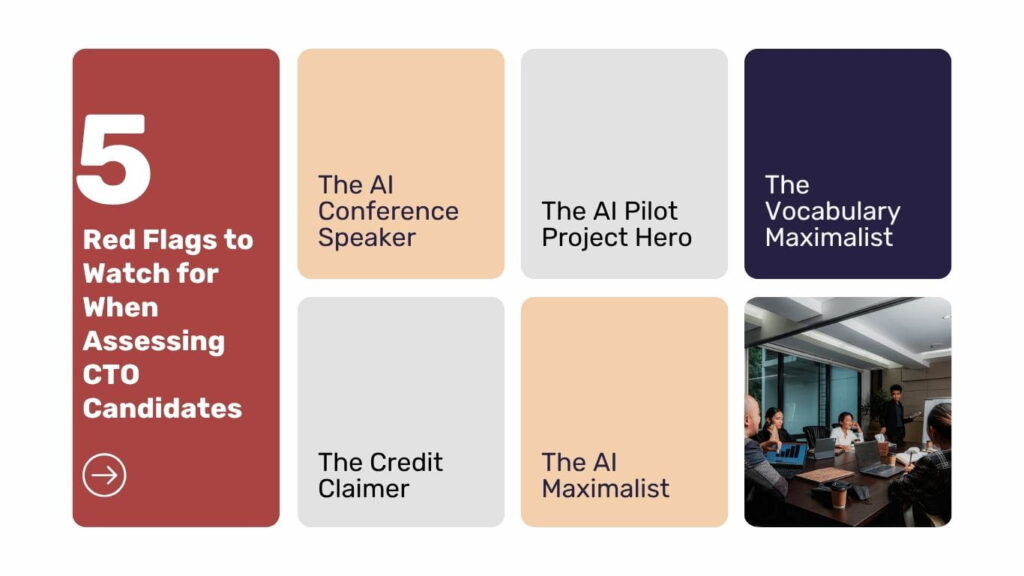
Red Flags to Watch for When Assessing CTO Candidates
These five archetypes appear repeatedly in CTO assessment. Naming them makes them easier to spot in the room.
The AI Conference Speaker
A CTO candidate who is fluent on every panel, every trend, every model release. Ask what they actually built and the specifics evaporate into generalities. Their AI knowledge is a performance, not an applied capability. The tell: they are more current on the newest announcements than on the systems they themselves shipped.
The AI Pilot Project Hero
Oversaw impressive demonstrations that wowed the board and never reached a single production user. Confuses the pilot with the product.
Their portfolio is a series of proofs-of-concept, none of which became a sustained, value-generating system.
The Vocabulary Maximalist
Over-indexes on the newest models and tools as a substitute for architectural judgment.
The tell: they can name every technology but cannot explain a single trade-off they made between two of them.
Breadth of vocabulary masking absence of decisions.
The Credit Claimer
Every AI success belongs to them; every AI failure belongs to the team, the data, or the timeline.
Has never killed a project they personally championed, and cannot describe a time their own judgment was wrong. The absence of owned failure is itself the red flag.
The AI Maximalist
Wants to apply AI to everything, has never argued against using AI, and treats restraint as a lack of ambition.
The most expensive archetype, because they ship AI nobody needed - and given the industry failure rates, they ship a great deal of it.
The AI Capability Assessment Scorecard
To make this framework usable in an actual hiring process, we have built a one-page scorecard that scores CTO candidates across the six dimensions covered above – architecture, data infrastructure, build versus buy, AI talent, commercial thinking, and AI restraint.
Each dimension is scored 1 to 5, with a total out of 30 that maps to three bands: AI-Capable, Developing, and AI-Informed.
The second page pairs each dimension with the interview question that surfaces it, and what to listen for in the answer.
It is designed to be taken directly into interviews and used across a hiring committee so that multiple interviewers assess against the same standard.
How Pipal Tree Approaches AI-Era CTO Search
We assess technology leadership candidates for the AI-informed versus AI-capable distinction as a core part of every CTO and CPTO mandate.
Our process probes for consequential decisions, owned outcomes, and the specific judgment dimensions this guide describes – not vocabulary fluency, which every serious candidate now has.
For global companies hiring technology leadership in India, we bring the additional market intelligence to read past the four India-specific distortions – title inflation, outsourced ownership, vendor-led programmes, and pilot theatre – that most frequently cause AI capability to be misjudged.
To hire a CTO, reach out at [email protected] or visit our executive search practice page
“In that fintech search, the gap was not knowledge. Every candidate knew more about the latest models than I did.
The gap was decisions.
The ones who had actually built something could tell you about the project they killed and what it taught them. The ones who hadn’t changed the subject. That is the entire assessment, in one tell.”
Why Pipal Tree is one of the top executive search firms in India
→ 97% placement success rate across hundreds of leadership mandates.
→ 50+ years of combined search experience across our founding team.
→ 80% repeat engagement rate > our clients come back because our process works.
→ We combine the best practices of a global executive search firm with the entrepreneurial responsiveness and senior-partner involvement of a boutique consultancy.
Frequently Asked Questions On How to Assess a AI CTO
Should an AI-era CTO have a machine learning background?
Not necessarily. A formal ML or research background is valuable but neither sufficient nor strictly required. Some of the most effective AI-era CTOs come from strong systems or product-engineering backgrounds and developed AI capability through building. What matters is demonstrated judgment across the six dimensions – architecture, data, build-versus-buy, talent, commercial thinking, and restraint – not the specific academic path that produced it. A research background with no production deployment experience can be as limiting as deep engineering experience with no AI exposure.
How important is hands-on coding ability for an AI-capable CTO?
For most CTO roles above a certain company scale, the CTO is not writing production code. What matters is technical depth sufficient to make and defend architectural decisions, evaluate trade-offs credibly, and earn the respect of strong AI engineers. A CTO who cannot engage substantively with their best engineers on technical decisions will struggle to retain them – which is why technical credibility, even without daily coding, remains essential.
Can a strong traditional CTO become AI-capable, or must we hire externally?
Sometimes yes. The determining factor is intellectual humility about the limits of their existing mental model, combined with genuine investment in the AI learning curve. A traditional CTO who treats AI as a different paradigm requiring them to relearn parts of their judgment can often make the transition. One who treats it as another technology to bolt onto the stack usually cannot. Assess the trajectory and the mindset, not just the current state.
How do we assess AI capability when our own team cannot evaluate it?
This is a common and legitimate concern, particularly for boards and CHROs without deep technical backgrounds. Three approaches help: use the decision-focused questions in this guide, which surface capability without requiring you to evaluate technical correctness; involve a trusted technical advisor or board member in one interview round; or work with a search partner whose assessment methodology is calibrated for this distinction. The scorecard is designed precisely so that non-technical assessors can evaluate the quality of decisions and outcomes rather than the technical content.
Is an AI-capable CTO significantly more expensive in India?
Genuinely AI-capable technology leaders command a premium in India’s current market, driven by intense competition from GCCs, well-funded startups, and global companies hiring into India. The premium over a strong traditional CTO is real but variable. For current compensation context and the full economics of a technology leadership search, see our guide on the cost of executive search in India [LINK: /insights/cost-of-executive-search-india/].
These FAQs cover the most common questions we talk about when looking to assess an AI CTO
For a more broader questions on fees, timelines, and how the executive search process works, visit our Executive Search FAQ section.
Before the Search: Know Which Capability You Actually Need
Not every company needs an AI-native CTO.
Some need a strong traditional CTO with the humility and trajectory to grow into AI capability. Some need a genuinely AI-native leader from day one because AI is the core of the product. The most expensive hiring mistake is not hiring an AI-informed candidate by accident – it is hiring for a capability profile the business does not actually need.
If you are planning a CTO or CPTO search, the conversation worth having before the search begins is about which capability profile your specific business, product, and stage actually require – and what the realistic market looks like for that profile in India. We have that conversation with boards and CHROs regularly, with no obligation attached.
If you are a promoter, board member, or family business leader navigating this question, we would welcome the conversation. Reach out to me at [email protected].

Sonia Sharma
"With over 25 years in talent leadership, including 20+ years in executive search. Sonia brings valuable dual perspective as Pipal Tree's CEO & founder. Her career spans both consultancy roles at prestigious firms (Korn/Ferry International, Accord India, Stanton Chase) and corporate leadership. Sonia specializes in executing confidential, high-stakes searches for global and Indian multinationals."