

Chief Growth Officer (CGO) vs Chief Revenue Officer (CRO) vs Chief Marketing Officer (CMO)
Hire a CMO when the challenge is demand – awareness, positioning and pipeline creation.
Hire a CRO when the challenge is conversion and predictable revenue across the customer lifecycle.
Consider a CGO when the existing business is performing well but the next source of growth is unclear, provided the role has the authority and resources to pursue it.
Table of Contents
A founder-led B2B business, growth flat for two years, and a board pushing to appoint a Chief Growth Officer.
An hour into the conversation the picture looked different.
Marketing was two people running trade events. Sales was eleven people working from four different definitions of a qualified lead. Every deal above a threshold still went to the promoter for approval.
There was no growth function to lead. There were two functions that had never been built, and a decision right that had never been delegated.
The question was never which of the three titles. It was which of the three questions the business had not answered.
- Hire a Chief Marketing Officer (CMO) when the unanswered question is demand — whether enough of the right people know you exist and understand why you are worth considering.
- Hire a Chief Revenue Officer (CRO) when the unanswered question is conversion — whether the pipeline you already generate turns into revenue predictably and stays.
- A Chief Growth Officer (CGO) belongs to a third question entirely: where the next source of growth comes from when the existing engine works and the market is maturing.
These are three roles answering three different questions, not three answers to one.
Most companies weighing these titles have only one of those questions genuinely open. The mis-hire happens when the title is chosen before anyone has established which.
This guide covers what each mandate centres on, how to identify which question is open in your business, when a senior functional head is the better answer than a C-suite appointment, and where these appointments fail even when the title and the candidate are both right.
The 3 Questions Behind The Three Titles - CGO, CRO and CMO
The quickest way to separate the three is to ask what question each one exists to answer.
| Role | The question it answers | What the mandate centres on |
| CMO | How do we get known and considered? | Brand, positioning, customer insight, demand creation and product marketing – and in many businesses, parts of the customer experience |
| CRO | How do we convert and retain predictably? | The revenue engine end to end: sales, customer success, revenue operations, forecasting, and in many models demand generation too |
| CGO | Where does the next S-curve come from? | New markets, new business models, pricing, partnerships and corporate development – possible areas of focus rather than a standard job description |
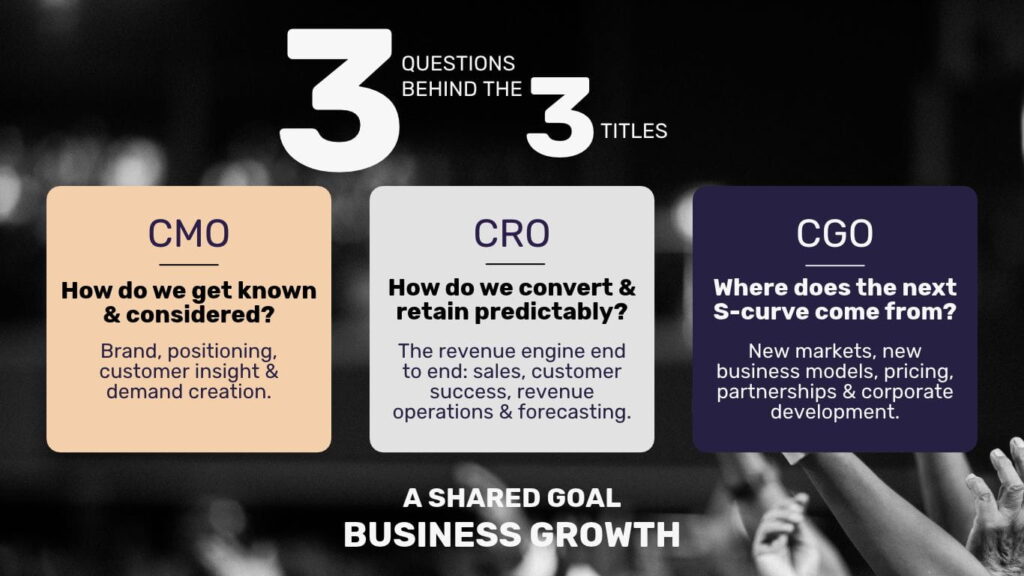
They are measured accordingly: a CMO on pipeline created, market position and the cost of demand; a CRO on forecast accuracy, conversion, retention and revenue per head; a CGO on revenue from sources that did not exist before.
The boundaries follow your operating model
These are mandates, not org charts. Which functions sit underneath each one moves depending on how the business runs, and demand generation is the clearest case.
In product-led and SaaS businesses it frequently reports to the CRO, because pipeline and conversion are managed as a single system. In brand-led consumer businesses it sits firmly under the CMO. In enterprise B2B it is often split – brand and product marketing under the CMO, demand generation under the CRO. All three are coherent. None of them is the standard.
What separates the three roles is the primary mandate each carries, not a fixed allocation of functions.
In Practice
When a brief arrives already labelled CRO, CMO or CGO, the first thing we test is whether the company can name the number the role will be accountable for.
If they cannot, the title is not the problem. The mandate has not been written yet.
3 questions that settle The Choice Between A CGO, CRO or CMO
The decision becomes a diagnostic the moment you stop comparing job descriptions and start naming the gap.
Is The Problem Demand, Conversion, Or Direction?
Not enough of the right people know you exist, or understand what you actually do - that is demand, and it points to a CMO.
Enough pipeline arriving, too little of it closing or staying closed - that is conversion, and it points to a CRO.
Both engines running adequately, but the core market maturing and no clear answer to where the next phase comes from - that is direction, and the only one of the three that genuinely points to a CGO.
Most companies have one of these open. Very few have all three.Will This Leader Own A Number, Or Own A Plan?
This is the authority question, and it decides more than the title does. A role that owns a number has a quota, a P&L line or a retention target, and the budget and headcount to move it. A role that owns a plan coordinates people who own numbers.
Both are legitimate appointments. They are not the same appointment. Briefing for one while expecting the other is the most reliable way to lose a capable executive inside eighteen months.
Are There Already Leaders Strong Enough To Be Coordinated?
A cross-functional growth mandate assumes functional leaders exist to be aligned. Where marketing and sales leadership are themselves the gap, appointing someone above them does not close it - it adds a layer between the CEO or promoter and the problem.
This is the same structural question that decides whether a business needs a CEO or a COO, applied to the commercial side of the organisation.
“In most of these conversations the title has already been chosen, and it usually reflects which function currently has the strongest leader rather than where the business is actually stuck.
A company with a strong sales head arrives asking for a CRO. A company with a strong marketer arrives asking for a CGO, because it is the only title that gives that person more room. Neither is a diagnosis. Both are a description of the org chart as it stands”
5 Signs That You Need a CMO
-
You are entering a category where you have no permission to play.
The product may be ready; the market has no reason yet to believe you belong in that conversation. Nothing in the sales process fixes this, because the problem occurs before the sales process begins.
-
The product is genuinely differentiated and almost nobody knows it.
The people who do find you convert well. There are simply not enough of them, and the shortfall is not explained by effort from the sales team.
-
Pricing power is eroding because you compete on being known rather than on being chosen.
Discounting creeps in. Deals come down to price more often, because nothing else in the buyer's mind separates you from the alternatives..
-
The business has outgrown the founder's voice.
Brand has been carried personally - on a founder's network, reputation and presence - and that no longer stretches to the number of markets, segments and buyers the company now needs to reach.
-
Marketing sits downstream of decisions it should be shaping.
Pricing, packaging, which segments to pursue and which products to build get settled before marketing is consulted, and marketing's job becomes producing collateral for decisions already made. That is a structural problem, and a more senior marketing manager rarely solves it.
The common thread: the constraint sits in demand, not in conversion.
If that is the problem you are solving, the appointment is a Chief Marketing Officer, assessed against demand creation and market position rather than campaign execution. This is the mandate our CMO search practice is built around.
When A Senior Marketing Head Is Enough
A single campaign, a rebrand or a website rebuild is not a CMO mandate – that is work for an agency with a strong marketing manager running it.
A senior marketing head reporting to the CEO is usually sufficient where marketing’s job is execution against a strategy the leadership team has already set, where the budget does not yet justify a board-level appointment, and where the company competes primarily on product or price rather than on position. The CMO appointment becomes necessary when demand creation turns into a sustained capability the business depends on, and somebody has to own what the company stands for.
5 Signs That You Need a CRO
-
Multiple revenue motions that do not talk to each other.
Direct sales, channel, inside sales and renewals each running on their own definitions, their own pipeline and their own view of the customer. Each may work in isolation. Together they produce a number nobody can assemble with confidence.
-
A forecast nobody fully trusts.
The figure gets revised late in the quarter, consistently in the same direction. The problem is usually not CRM discipline - it is that no single person owns the whole path from first touch to renewal.
-
Marketing and sales can each explain, convincingly, why the number was missed.
Both accounts are internally coherent.
Both exonerate the function giving them. When the two explanations never have to meet, nobody above them is accountable for the result rather than the contribution.
-
Retention and expansion now matter more to the economics than new logos.
The business was built on winning customers and is increasingly valued on keeping and growing them. Sales leadership optimised for acquisition rarely rebalances toward that on its own.
-
Investors want revenue predictability ahead of a raise or an exit.
The question shifts from how fast you grew to how reliably you can forecast what comes next. That is a different capability, and it takes longer to build than a diligence timetable allows.
The Common Thread: The Demand Exists; The System That Converts And Keeps It Does Not Hold Together.
Where that is the gap, the appointment is a Chief Revenue Officer, assessed on whether they can run a connected revenue system rather than on sales pedigree alone. This is the mandate our CRO search practice is built around.
When a VP Sales is enough
A strong VP Sales or Head of Sales is the right answer more often than the market admits. Where the business runs one revenue motion, where marketing is small enough to coordinate informally, and where the CEO is still close enough to commercial decisions to arbitrate between functions, a CRO adds a layer rather than a capability.
Promoting a strong sales leader into the CRO title without giving them marketing, customer success and revenue operations is title inflation with extra steps – and it usually costs you the sales leadership you already had.
When a Chief Growth Officer makes sense - and when it doesn't
The CGO title is not new, but it became fashionable quickly. In 2017 Coca-Cola replaced its Chief Marketing Officer with a Chief Growth Officer, and the move was widely read as a signal about where the C-suite was heading. Hershey’s and others made comparable appointments soon after.
What gets quoted less often is what happened next. Coca-Cola reinstated the global CMO role in December 2019, appointing Manolo Arroyo after its Chief Growth Officer retired. In March 2026 it went further in the same direction: Arroyo’s remit was expanded into a Chief Marketing and Customer Commercial Officer role, taking on customer and commercial leadership that had previously sat with the CFO.
That arc is worth more than the original headline. Confronted with the problem the CGO title was invented to solve, growth decisions scattered across functions, the company that popularised it answered by widening a functional leader’s mandate rather than installing a coordinator above the functions.
A CGO is the hardest of the three to scope, and the one most often appointed for the wrong reason.
It works where the existing engine is healthy and the constraint is genuinely where to grow next rather than how to grow here: a diversified group entering a new category, a business whose core market is maturing, an organisation with capable functional leaders and a real coordination problem between them.
It tends NOT to work in three situations:
As a promotion vehicle for a strong CMO the company does not want to lose
As a coordinating layer above functions that do not yet have leaders of their own
As a title applied to what is really a strategy or corporate development role
The CGO appointments we see struggle are the ones where the leader had neither strong functional leaders to work through nor decision rights of their own. A coordinating mandate with nothing to coordinate and no authority to compel is not a growth role – it is an advisory one with a C-suite title.
The CGO question in promoter-led businesses
In many of the promoter-led and founder-led businesses we work with, the question a CGO is meant to answer – where the next source of growth comes from – is still closely held by the promoter. That is not a criticism of how those businesses run; the promoter’s market judgment is frequently the firm’s single greatest asset.
But it changes what the conversation is actually about. It is rarely a question of organisation design. It is a question of whether the promoter is prepared to transfer growth decision rights to someone else, and to live with calls they would have made differently. Where the answer is no, the appointment creates a senior executive holding a mandate they cannot exercise.
It is also worth saying plainly that the title is less common here than the trend coverage suggests. Indian businesses more often reach for Chief Business Officer in startups, Head of Growth in D2C and consumer internet, and simply CRO in B2B and SaaS.
“Give someone a growth mandate and no authority and you have not created a growth leader.
You have created a very expensive internal consultant who will spend eighteen months building consensus they have no power to enforce, and then leave.
The organisation usually concludes it hired the wrong person. It did not. It designed the wrong role”
How the decision resolves across Indian business models
While the underlying questions stay the same, the appointment they point to varies with the company’s business model, its scale, and the management structure already in place.
These are patterns we see rather than rules – the unanswered question always decides the appointment – but they show how it tends to resolve in this market.
| Business context | Where it usually lands |
| Promoter-led B2B manufacturer | Often none of the three yet. The gap is usually a sales leader with real authority and a marketing function that properly exists. Growth direction sits with the promoter. |
| B2B SaaS scaling past early traction | CRO. Multiple motions, retention economics, and a forecast the board needs to be able to trust. |
| D2C and consumer internet | CMO where brand is the moat; a dedicated growth leader where performance marketing is the engine. The two are not interchangeable. |
| MNC India subsidiary | Usually a CMO with regional reporting. Revenue authority tends to sit at regional or global level, which makes a genuine CRO mandate rare. |
| Diversified promoter group entering a new category | The closest thing to a true CGO mandate – conditional on the promoter ceding decision rights. |
| PE-backed business approaching exit | Usually a CRO, where the value-creation plan rests on revenue visibility, sales discipline and retention. Where the thesis is category position or brand, a CMO can be the higher-value appointment. |
Industry labels do not decide this.
The question the business has not answered does.
Where growth leadership appointments fail and what it costs
This is where the choice stops being a matter of preference.
A CMO hired against a conversion problem will improve brand, positioning and pipeline volume, and the close rate will not move. The business gets visibility where it needed a working funnel.
A CRO hired against a demand problem will install forecasting rigour, pipeline hygiene and sales discipline against a pipeline that was never large enough to begin with. The business gets predictability where it needed reach.
A CGO appointed over functions that do not yet have leaders produces the most expensive version of the three: a senior hire whose entire job is coordination, with nothing underneath to coordinate and no number of their own to be judged on.
Wrong: Choosing the title that fits the leader you have, or the one you do not want to lose.
Right: Naming the question the business has not answered, then appointing against it.
Key Insight
The three above are selection failures.
The fourth is not.
A CRO given a revenue number without control of marketing, sales operations or customer success, or a CMO held to pipeline targets with no influence over how sales works that pipeline, will fail against a correct brief with the right person in the seat.
The appointment was never the problem.
The design was.
How Pipal Tree scopes growth leadership mandates
Growth appointments differ from other C-suite searches in one practical respect: the scope has to come from somewhere.
A CRO mandate takes territory from an existing sales leader. A CMO mandate takes it from whoever has been making positioning calls by default, which in many businesses is the founder. Before a search starts, someone has to decide what moves and tell the people it moves away from.
That is where we begin.
Working with CEOs, promoters and boards, we establish which of the three questions is actually open, what the new role will be accountable for in numbers, what authority and budget comes with it, and what is being carved out of whose remit to create it.
Two things usually surface in that conversation.
The first is whether an internal candidate should be in the running, in growth roles there is almost always a credible one, and the honest answer is sometimes yes.
The second is compensation structure: growth roles carry variable pay tied to a number, and that cannot be designed before the number has been agreed.
If you are at that stage, or still working out which of the three questions is open, our CRO search practice and CMO search practice set out how we run these mandates.
Frequently asked questions on CRO, CMO and CGO roles
What is the difference between a Chief Revenue Officer (CRO) and a Chief Marketing Officer (CMO)?
A Chief Marketing Officer (CMO) owns demand – brand, positioning and the creation of pipeline.
A Chief Revenue Officer (CRO) owns conversion and retention across the revenue system, including sales, customer success and revenue operations.
In many businesses demand generation sits with the CRO and brand with the CMO, but the split follows the operating model rather than a standard template.
Can one person be both Chief Revenue Officer (CRO) and Chief Marketing Officer (CMO)?
In smaller or earlier-stage businesses, yes.
One commercial leader can hold both mandates where the revenue motion is simple and the brand requirement is modest. As demand creation and revenue conversion each become full-time, board-level responsibilities, combining them tends to under-serve one of the two – usually brand, because the revenue number is louder.
Is a Chief Growth Officer (CGO) the same as a Chief Revenue Officer (CRO)?
No.
A Chief Revenue Officer (CRO) is accountable for the existing revenue engine performing predictably.
A Chief Growth Officer (CGO) is accountable for finding growth the existing engine does not produce – new markets, new models, partnerships, pricing.
Where a company uses CGO as a label for the revenue leader, it is usually describing a CRO mandate.
Should a B2B company hire a Chief Revenue Officer (CRO) or a VP Sales?
A VP Sales is sufficient where the business runs one revenue motion and the CEO remains close enough to arbitrate between sales and marketing.
A Chief Revenue Officer (CRO) becomes necessary when several motions need to be run as one system, when retention and expansion drive the economics, or when the forecast has to withstand board or investor scrutiny.
When does a company need a Chief Growth Officer (CGO)?
When the existing growth engine is working, functional leaders are already in place, and the open question is where the next phase of growth comes from rather than how to improve the current one. Without capable functional leaders to work through, or without explicit decision rights, the role becomes advisory.
These cover the questions we hear most often on growth leadership appointments.
For a more comprehensive breakdown, including questions on fees, timelines, guarantees, and how the process works step by step, visit our detailed Executive Search FAQ.
97% placement success rate across hundreds of leadership mandates.
50+ years of combined search experience across our founding team.
80% repeat engagement rate > our clients come back because our process works.
We combine the best practices of a global search firm with the entrepreneurial responsiveness and senior-partner involvement of a boutique consultancy.
Start With the Mandate, Not the Title
CRO, CMO and CGO look like three versions of the same appointment. They are not. They are three answers to three different questions, and most businesses weighing them have only one of those questions genuinely open.
Before you write the brief, name the gap. Is it demand, conversion, or direction? Will this person own a number or own a plan? And are there leaders already in place for them to work through?
Answer those three and the title stops being a decision. It becomes a consequence.
At Pipal Tree Services we help founders, promoters and boards work through that before the search begins – because a strong shortlist against the wrong question still ends in the wrong appointment.
Let’s Talk!
Write to me at [email protected]

Rahul Bahuguna
“With over two decades of experience across executive search, digital strategy, and business consulting, Rahul brings a unique entrepreneurial perspective as Director & Co-Founder of Pipal Tree Services. At Pipal Tree, Rahul leverages his background in strategy, market intelligence, and digital transformation to guide mission-aligned executive search and board mandates. He specializes in building long-term client partnerships, leading complex leadership searches, and shaping Pipal Tree’s distinct positioning at the intersection of talent and purpose. His ability to combine strategic insight with practical execution makes him a trusted advisor to organizations seeking leaders who can drive meaningful, sustainable change.”