

When To Hire A CMO?
A company needs a CMO when marketing has become a strategic, board-level function – owning brand, demand, and go-to-market across the business – not a set of campaigns a founder or a marketing manager can run. If marketing is still mostly execution, a senior marketing head is usually enough.
Table of Contents
A promoter-owned building-materials manufacturer we worked with came to us with a marketing problem it had never had to solve before.
For most of its thirty years it had sold through dealers and distributors – a trade business, with a marketing function built entirely around channel schemes, trade shows, and dealer relationships. Brand, in the consumer sense, had never really been the job.
Now the promoter wanted to do something the company had never done: build a consumer-facing brand and sell directly to homeowners, alongside the dealer business that still paid the bills.
His instinct was to “hire a CMO.”
The harder questions – whether the business was ready for one, and which kind of marketing leader it actually needed – were the ones we had to work through first.
When is a CMO the right hire?
A company needs a CMO when marketing has become a strategic, board-level function – owning brand, demand, and go-to-market across the business – not a set of campaigns a founder or a marketing manager can run.
If marketing is still mostly execution, a senior marketing head is usually enough. And once the seat is justified, the harder question is which type of CMO you actually need.
What This Guide Covers
- The clear signs you need a CMO – and when you don’t need one yet
- The three types of CMO, and what each actually owns
- How to match the CMO type to your stage and business model
- Why CMOs churn – and how to avoid it
- CMO or a growth / revenue leader – where the line sits
6 Signs You Need a CMO (Not Just a Bigger Marketing Team)
Part of what has changed is scale.
Marketing in India is now one of the largest and most measurable lines in the business — digital advertising spend alone has crossed ₹71,000 crore and is on track to approach ₹98,000 crore by 2027 ( As per dentsu Digital Advertising Report 2026) — which means marketing increasingly commands the budgets, data, and board-level accountability that justify a C-suite owner. But scale is context, not a trigger.
A stalled number is a symptom, not a signal – it does not tell you whether the business needs marketing leadership at the top table or simply better execution below it. These are the signs it is genuinely the former, and it is the same discipline we apply to whether a company needs a CEO or a COO: define the mandate before the title.
Marketing now has to own a number, not just activities.
The board expects marketing to be accountable for growth, pipeline, or revenue contribution – not just campaigns and brand-health metrics. Owning a number needs leadership, not execution.
The business is entering a new model, segment, or category.
A B2B maker adding a consumer line, a regional brand going national, a national brand going global, a move upmarket – a step-change in what marketing must do, not more of the same.
Brand has become a board-level asset.
When pricing power, reputation, talent pull, or the investor narrative now hinge on brand, those decisions carry consequences a founder/promoter can no longer make on instinct.
Go-to-market has turned multi-channel and cross-functional.
Marketing now has to orchestrate across sales, product, digital, trade or retail, and partnerships – and someone has to own the whole system, not run one channel of it.
The founder is the de facto CMO, and that has become the bottleneck.
Marketing strategy still runs through the promoter’s instinct, and growth is waiting on their bandwidth. The constraint is leadership capacity, not effort.
Acquisition economics have become the growth constraint.
When CAC, funnel efficiency, and demand generation are what gate the next stage, you need senior ownership of the growth engine – not more agencies.
What is not a sign: a single bad quarter, one underperforming campaign, or a stalled number on its own.
Those are execution problems a marketing head or an agency can fix.
A CMO is justified when marketing leadership – the strategy, the integration, the ownership – is what is missing.
When You Don’t Need a CMO - Yet
Some companies hire a CMO because growth has stalled.
Others because a competitor just did.
Neither is a reason.
In the promoter-led and B2B businesses we work with, a CMO is often the wrong first move – not forever, but for now. The clearest cases:
Marketing Is Still Sales-Support.
In many promoter-led B2B businesses, marketing means brochures, trade shows, lead lists, and the collateral the sales team asks for. That is a real function - but it is a marketing manager’s job, not a CMO mandate. Hiring a CMO to run sales-support over-levels the role and all but guarantees the disappointment.
The Need Is One Capability, Not A Leader.
Sometimes the gap is performance marketing, a rebrand, or a single product launch - a specific capability you can hire a specialist or an agency for, not a board-level leader who owns the whole function.
The Founder Still Owns The Marketing Instinct - And It Is Working.
In early-stage and many promoter businesses, the founder is the brand and the go-to-market instinct, and that is still an edge, not a bottleneck. A CMO brought in over a founder who hasn’t let go creates friction, not leverage.
There Is No Number For Marketing To Own Yet.
If you can’t hand marketing a real mandate - a growth, demand, or revenue number the business will hold it to - a CMO has nothing to be accountable for. Build the function to the point where the mandate exists first.
You’re Hiring To Signal, Not To Solve.
A CMO appointed because the board or investors expect the title, rather than because the work demands it, is an expensive signal. The market sees through it, and the hire rarely lasts.
Until the business crosses into a genuine CMO mandate, the smarter moves are cheaper: a senior marketing head, a growth lead, a fractional or interim CMO to stand up a new line, a specialist agency – or the founder continuing to own it. In the building-materials business, the first question was never which CMO to hire; it was whether the consumer line was far enough along to give one a real mandate, or whether it needed a focused growth hire first.
A CMO becomes the right hire when the mandate is real and the business is ready for it. And several of the signs already point to a type – acquisition economics to a growth leader, brand-as-asset to a brand builder. The sign tells you whether; the mandate tells you which.
“The mistake is treating this as a seniority question – as though a CHRO is just an HR Head with a bigger title.
They solve different problems. One owns whether the people function runs well.
The other owns whether the organisation is built to deliver the strategy.
A company that needs both and hires only one will feel the gap inside a year, and will usually blame the person rather than the design.”
The Three Types Of CMO
“CMO” is a single title covering three very different leaders.
Hiring well starts with knowing which one the business needs – because few leaders are equally strong across all three, and insisting on all three is how a search stalls.
These are practical hiring archetypes, not fixed industry definitions.
Many CMO roles combine elements of more than one type, but identifying the dominant mandate is what defines the right candidate profile.
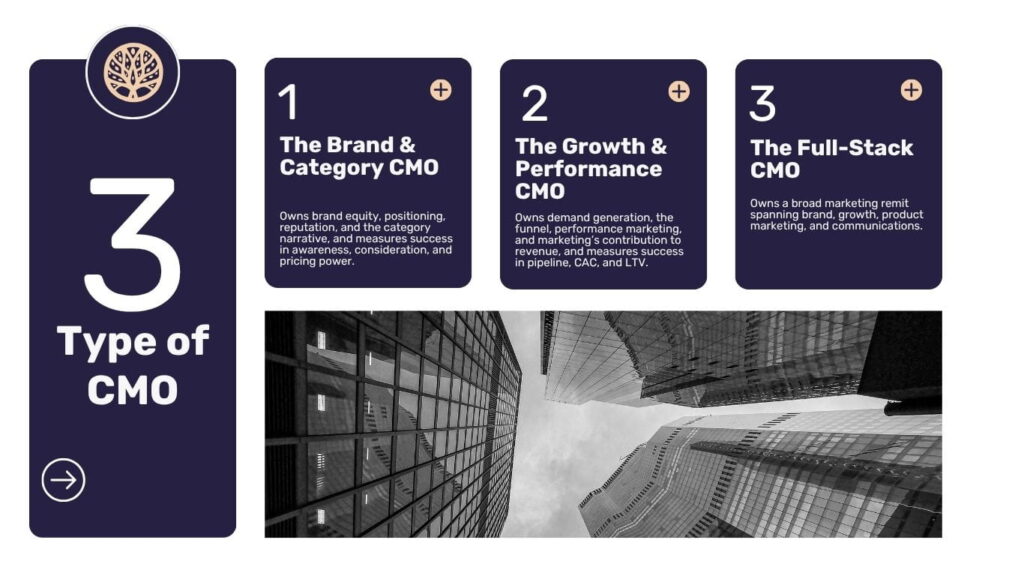
The Brand & Category CMO
Owns brand equity, positioning, reputation, and the category narrative, and measures success in awareness, consideration, and pricing power. This is the profile for consumer and FMCG businesses, and for any company whose moat is its brand or whose game is creating a category - the same instincts that shape CXO hiring across consumer goods businesses in India.
The Growth & Performance CMO
Owns demand generation, the funnel, performance marketing, and marketing’s contribution to revenue, and measures success in pipeline, CAC, and LTV. This is the profile for D2C, consumer-internet, and B2B SaaS businesses where the mandate is efficient, measurable growth rather than brand-building for its own sake.
The Full-Stack CMO
Owns a broad marketing remit spanning brand, growth, product marketing, and communications. This profile suits businesses that need integrated leadership across these areas and can support the scope of the role. The real challenge is finding a leader with genuine depth across the remit - rather than assuming one candidate will be equally strong in every discipline.
Which Type Your Stage & Model Need
The same three types resolve differently depending on what kind of business is hiring, and at what stage. These are illustrative patterns, not rules.
| Business context | Likely CMO type |
| Early-stage D2C / consumer-internet | Growth & Performance CMO – demand and unit economics are the job |
| FMCG / established consumer brand | Brand & Category CMO – the brand is the moat |
| B2B SaaS / tech scale-up | Growth-led CMO, usually with product-marketing depth |
| Manufacturing / industrial | Often a senior marketing head, not a CMO, until brand and GTM become strategic |
| Large / diversified enterprise | A Full-Stack CMO may fit when brand, demand, product marketing and communications need integrated leadership across the business |
These are starting points, not rules by industry label. The right type depends on the mandate the business needs owned, the stage it is at, and where marketing actually creates value – a manufacturer building a consumer brand needs a very different CMO from one selling to procurement teams.
It also varies by market: brand and consumer-marketing talent concentrates in hubs like Mumbai, while growth and performance talent clusters around the consumer-internet and SaaS ecosystems.
The fuller sector view sits on our consumer & retail executive search practice.
In Practice
The most common CMO brief we are handed asks for a strong brand-builder who is also exceptional at performance marketing.
That person exists - but rarely at the stage, or the budget, the company is hiring at, and holding out for both is the single most common reason a CMO search stalls.
Deciding which capability the business genuinely needs now is the real work, and it is usually done before the first candidate is approached.
Why CMOs Churn - And How To Hire One Who Lasts
The CMO is widely regarded as one of the shortest-tenured roles in the C-suite. The cause is rarely capability. It is mismatch.
A brand CMO measured from month one on quarterly pipeline will be judged a failure at something they were never hired to do. A performance CMO asked to build a brand they were never equipped to build will spend a budget and move no perception. In both cases the person may be excellent; the brief was wrong.
The cost compounds. A mis-typed CMO means wasted spend, a marketing team whipsawed by a change in direction every few quarters, and a founder or board that eventually concludes “marketing doesn’t work here” – when the real failure was the brief, not the hire.
Wrong: hiring the most impressive marketing leader available.
Right: hiring the type whose mandate matches what the business needs now – and measuring them against that mandate, not a different one.
CMO Or A Growth / Revenue Leader?
A CMO owns marketing – brand, demand, positioning. A
growth or revenue leader, often a CRO, owns the revenue number end to end and aligns sales and marketing behind it.
If the real gap is pipeline-to-revenue and sales-and-marketing alignment rather than marketing leadership itself, you may need a revenue leader – not, or as well as, a CMO.
That decision deserves its own treatment, and it is the mandate our CRO search practice is built around.
How Pipal Tree Approaches CMO Search
We start a CMO search by deciding which CMO the business actually needs. Before we approach a candidate, we help founders and boards define the mandate – brand, growth, or the full remit – the stage it has to fit, and the number the role will own.
That definition, and the market mapping that goes with it, is what keeps a CMO in the seat past the average tenure.
If you are weighing a CMO appointment – or trying to work out whether you need a CMO, a marketing head, or a revenue leader – that is exactly the conversation we have with leadership teams, with no obligation attached.
Explore our CMO search practice or CRO search practice, or write to me directly at [email protected].
“The most expensive CMO hire is the one made against the wrong type.
We spend the first part of every marketing-leadership mandate deciding whether the business needs a brand builder, a growth operator, or the full remit – because that single call determines the shortlist, the compensation, and whether the person is still there in three years.”
Frequently Asked Questions on When To Hire a CMO in India
When does a company need a CMO?
When marketing has become a strategic, board-level function – owning brand, demand, and go-to-market across the business – rather than a set of campaigns a founder or marketing manager can run. If marketing is still mostly execution, a senior marketing head is usually the better hire.
What is the difference between a CMO and a marketing head?
A marketing head runs marketing execution – campaigns, channels, and the team delivering them.
A CMO owns marketing strategy at board level: brand, demand, positioning, and marketing’s contribution to the business.
The CMO seat is justified when marketing is a strategic mandate, not when the team simply needs a manager.
Should a startup hire a brand CMO or a growth CMO first?
Many early-stage startups need growth expertise before a full CMO appointment, particularly when demand generation and unit economics are the immediate priorities. However, a business entering a new category or struggling to establish its positioning may need brand and product-marketing leadership earlier. First determine whether the company needs a CMO at all; then identify the capability most critical to its next stage.
Why do CMO tenures tend to be short?
Almost always because of a mismatch between the type of CMO hired and the mandate they are measured against – a brand leader judged on quarterly pipeline, or a performance leader asked to build a brand. Defining the right type before the hire, and measuring them against that mandate, is what extends tenure.
CMO or CRO - which does my business need?
A CMO owns marketing; a CRO owns the full revenue number and aligns sales and marketing behind it. If the gap is marketing leadership, hire a CMO. If the gap is revenue ownership and sales-marketing alignment, you may need a CRO – or both, with clear ownership between them.
These FAQs covers the most common questions we hear when it comes to hiring a CMO in India.
For a more comprehensive breakdown, including questions on fees, timelines, guarantees, and how the process works step by step, visit our detailed Executive Search FAQ.
97% placement success rate across hundreds of leadership mandates.
50+ years of combined search experience across our founding team.
80% repeat engagement rate > our clients come back because our process works.
We combine the best practices of a global search firm with the entrepreneurial responsiveness and senior-partner involvement of a boutique consultancy.
Hire the Type, Not the Title
The question is almost never whether to hire a marketing leader. It is which kind – and whether marketing is strategic enough to need one at the top table yet.
So before you open a CMO search, decide which of the three you are actually hiring: the brand builder, the growth operator, or the full-stack leader. Name the mandate first, and the rest of the decision tends to follow.
At Pipal Tree Services, we help founders, promoters and boards settle that question before the search begins – defining the altitude the role has to operate at, the mandate it will genuinely carry, and whether the business needs a CMO.
Let’s Talk!
Write to me at [email protected]

Rahul Bahuguna
“With over two decades of experience across executive search, digital strategy, and business consulting, Rahul brings a unique entrepreneurial perspective as Director & Co-Founder of Pipal Tree Services. At Pipal Tree, Rahul leverages his background in strategy, market intelligence, and digital transformation to guide mission-aligned executive search and board mandates. He specializes in building long-term client partnerships, leading complex leadership searches, and shaping Pipal Tree’s distinct positioning at the intersection of talent and purpose. His ability to combine strategic insight with practical execution makes him a trusted advisor to organizations seeking leaders who can drive meaningful, sustainable change.”

[…] dismantle these roadblocks. One global firm, for instance, used AI to anonymize résumés and scan job descriptions for biased language, resulting in fairer and more diverse shortlists. A leading tech giant deployed […]