

When should a startup hire a CFO?
A startup should hire a CFO when its finance function becomes a strategic requirement rather than primarily a reporting and compliance function. Common triggers include :
– increasing investor demands,
– a major fundraise,
– complex unit economics,
– significant capital-allocation decisions,
– expanding regulatory complexity, or
– a founder spending substantial time managing finance.
The right time depends on the mandate, not simply the funding stage.
Table of Contents
There is a moment in every Indian startup’s life when the Head of Finance, the CA who has been managing compliance since day one, or the VP Finance who joined to build the accounting function, hits a ceiling.
Not a competence ceiling – a mandate ceiling.
The company has outgrown what a finance head can do, and now needs what only a CFO can deliver.
Recognising that moment – and more importantly acting on it correctly – is one of the most consequential decisions a founder and board will make.
Getting startup CFO hiring in India right is not about finding a better accountant.
It is about finding a fundamentally different kind of leader.
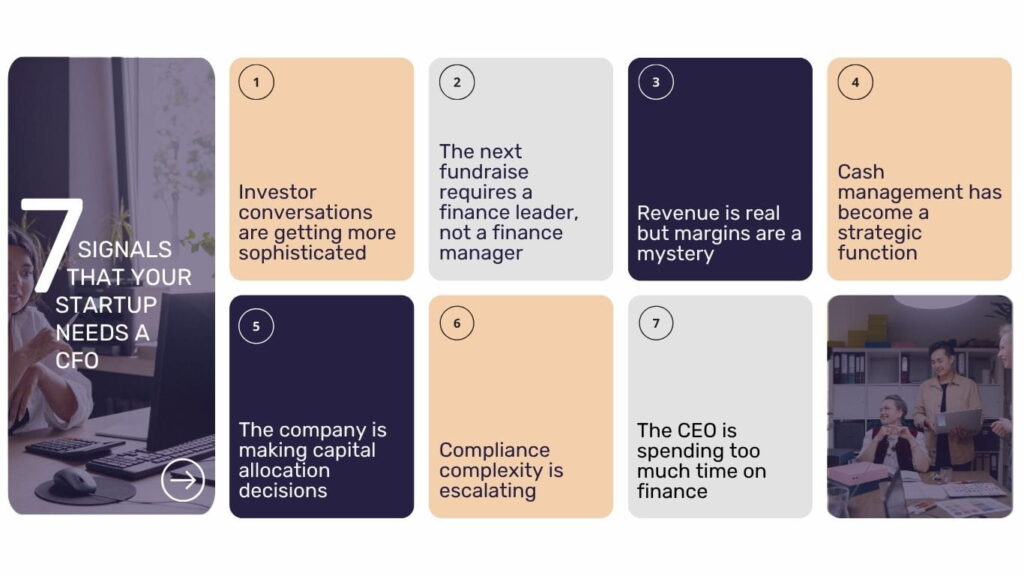
7 Signals That Your Startup Has Outgrown Its Head of Finance
The transition from Head of Finance to CFO is not about job titles. It is about a qualitative shift in what the company needs from its finance function. Here are the seven signals that indicate the shift has arrived.
Signal 1 : Investor conversations are getting more sophisticated
In the early stages, investor reporting is relatively straightforward: burn rate, runway, high-level revenue metrics.
By Series B, investors expect
– cohort-level unit economics,
– LTV/CAC analysis by channel,
– contribution margin by product line, and
– forward-looking financial models that tie operating metrics to capital requirements.
If your Head of Finance is scrambling to build these reports manually for every board meeting, you need a CFO who can design the reporting architecture once and let it run.
Signal 2 : The next fundraise requires a finance leader, not a finance manager
There is a material difference between preparing financial data for a fundraise and being a credible participant in investor conversations.
A CFO can sit across from a growth equity fund and defend the company’s unit economics, explain the path to profitability, and negotiate valuation with financial sophistication.
A Head of Finance typically cannot.
If a Series C or growth round is on the horizon, the CFO should be in place six to nine months before the process begins – not hired in the middle of it.
Signal 3 : Revenue is real but margins are a mystery
Many Indian startups reach ₹50–200 crore in revenue without truly understanding their margin structure at a granular level.
Revenue is growing, but nobody can precisely articulate which customers, products, channels, or geographies are profitable and which are subsidised.
A Head of Finance can tell you total margins.
A CFO can tell you why those margins exist, where they are deteriorating, and what operational changes would improve them.
Signal 4 : Cash management has become a strategic function
In the early stages, cash management means tracking the bank balance and flagging when runway drops below a threshold.
At scale, cash management means optimising working capital cycles, managing receivables from enterprise customers with 60–90-day payment terms, structuring vendor payment schedules, evaluating debt versus equity for specific growth initiatives, and potentially managing multiple currencies if the company has international operations.
This is CFO territory, not finance manager territory.
Signal 5 : The company is making capital allocation decisions
Should we invest ₹10 crore in expanding the sales team or ₹10 crore in product engineering?
Should we enter a new geography or double down on the existing one?
Should we build or buy a specific capability?
These are capital allocation questions that require a strategic finance partner at the leadership table – someone who can model the options, quantify the trade-offs, and provide a financial perspective that complements the founder’s product and market intuition.
Signal 6 : Compliance complexity is escalating
GST across multiple states, transfer pricing for international subsidiaries, ESOP taxation, regulatory requirements for specific sectors (fintech licensing, FSSAI for food, CDSCO for health-tech), and increasing scrutiny from statutory auditors as the company scales.
All of this demands a finance leader with the seniority and judgement to manage regulatory risk proactively, not reactively.
Signal 7 : The CEO is spending too much time on finance
This is the signal founders often miss because they have normalised it. If the CEO is personally involved in every investor update, every pricing decision, every cash flow conversation, and every compliance escalation, it means the finance function lacks a leader who can own these responsibilities independently.
The CEO’s time is the company’s most expensive resource. As we explored in The Evolving Role of the CEO in the Age of AI. the CEO’s bandwidth should be focused on product, market, and team – not on defending transfer pricing positions.
How the Startup CFO Mandate Changes by Funding Stage
| Dimension | Series A-B | Series C-D | Pre-IPO / Late Stage |
|---|---|---|---|
| Primary mandate | Build finance infrastructure from scratch. Establish accounting systems, MIS, compliance. | Drive unit economics clarity. Fundraise credibility. Strategic finance partnership with CEO. | IPO readiness. Governance maturity. Public market investor relations preparation. |
| Investor relationship | Prepare data for founder-led investor conversations. | Co-lead investor conversations. Defend economics independently. | Lead investor relations. Manage analyst expectations. Build IR function. |
| Team | May be the only senior finance hire. Builds a small team of 3–5. | Builds finance team of 8-15. Hires specialists (FP&A, tax, treasury). | Leads a 20+ person finance function. Hires Controller, Head of IR, internal audit. |
| Key competency | Systems builder. Comfortable with ambiguity and incomplete data. | Strategic thinker. Cohort analysis. Capital allocation. Burn management. | Governance leader. SEBI/listing readiness. Board and audit committee fluency. |
| Typical profile | CA + 8-12 years. May come from Big 4 audit/advisory or another startup. | CA/MBA + 15-20 years. Prior startup CFO or PE/VC fund experience. | CA/MBA + 20+ years. Prior IPO experience. May have listed company CFO background. |
| Compensation range | ₹30-60 lakh CTC + meaningful ESOP | ₹60 lakh-₹1.5 crore CTC + significant equity | ₹1.5-3 crore CTC + equity with liquidity path |
The Dangerous Gap: Why Series B to Series C Matters
The most dangerous moment is the transition from Series B to Series C.
The company has proven product-market fit, revenue is scaling, and investor expectations have shifted from growth-at-all-costs to demonstrating a credible path to profitability.
This is precisely when many Indian startups are still operating with a Head of Finance who was the right hire at Series A but lacks the strategic finance capability the company now needs.
The gap between what the business requires and what the finance function can deliver widens every month and the cost of closing it late is measured in fundraising delays, valuation compression, and founder distraction.
What Is the Difference Between a Head of Finance and a CFO?
The distinction between a Head of Finance and a CFO is not about seniority or title inflation. It is about a qualitative difference in what the role delivers to the company.
| Head of Finance / Controller | CFO |
| Prepares financial statements | Interprets financial data to drive business decisions |
| Manages compliance and statutory filings | Anticipates regulatory risk and structures the business proactively |
| Reports cash position and burn rate | Manages cash as a strategic asset — working capital, debt, treasury |
| Provides data for investor updates | Co-leads investor conversations and defends unit economics |
| Builds accounting systems and MIS | Designs the financial architecture that scales with the business |
| Answers “what happened?” | Answers “what should we do?” |
| Reports to the CEO | Partners with the CEO as a strategic equal |
The last 2 rows are the most important one.
A Head of Finance is a functional leader who runs the finance department.
A CFO is a strategic leader who uses financial intelligence to shape the company’s direction.
The founder who confuses these two roles or who promotes the Head of Finance to CFO without evaluating whether they can make this shift, often creates a problem that takes eighteen months to surface and another six months to fix.
“A great Head of Finance tells you where the money went. A great CFO tells you where the money should go. That shift, from reporting the past to shaping the future, is what separates a finance function from a finance leader. And most startups make the transition far later than they should“
How to Evaluate Startup CFO Candidates in India
Startup CFO hiring in India carries a unique challenge: the best candidates are often unconventional.
They may come from Big 4 advisory practices, PE or VC funds, corporate finance roles in larger companies, or other startups. The evaluation must be calibrated for what matters in a startup context, not what matters in a traditional CFO search.
The VC-Backed CFO archetype demands a specific combination of financial rigour and founder-friendly communication that differs sharply from other CFO types.
-
Test 1: Can they tell your financial story?
Give the candidate your last investor update or board deck and ask them to identify the three most important financial insights the board should focus on.
A Head of Finance will summarise the numbers.
A CFO will identify the strategic implications - where the economics are improving, where they are deteriorating, and what decisions the board should be considering in response.The quality of the narrative matters as much as the accuracy of the numbers.
-
Test 2: Do they understand unit economics at the cohort level?
Ask the candidate to walk through how they would build a unit economics model for your business.
Probe for specifics:- Which cohorts would they segment by?
- How would they calculate fully loaded customer acquisition cost versus marketing-only CAC?
- How would they define contribution margin for a business with your cost structure?
-
Test 3: Can they manage a fundraise?
If a fundraise is on the horizon, ask the candidate to describe a fundraise process they have been involved in.
Probe beyond "I prepared the data room."- Did they participate in investor meetings?
- Did they field financial due diligence questions independently?
- Did they negotiate valuation or deal terms?
-
Test 4: How do they think about cash?
Present a scenario: the company has 14 months of runway, revenue is growing 60% year-on-year, but gross margins have declined from 55% to 48% over the past two quarters.
What would they do?A Head of Finance will flag the margin decline and recommend cost cuts.
A CFO will model the impact on runway, identify the root cause of margin erosion, evaluate whether it is structural or transitional, and present the founder with options that balance growth investment with cash preservation. -
Test 5: Are they founder-compatible?
This is the most underweighted criterion in startup CFO hiring.The CFO must be able to push back on the founder with data and conviction, without creating a political dynamic that paralyses decision-making. They must be comfortable with ambiguity, speed, and the reality that startup financial data is inherently messier than corporate data. And they must be capable of communicating financial complexity in language that a product-oriented founder can act on. As we explored in Why Top Executives Decline Job Offers the founder-CFO dynamic is often the deciding factor in whether a strong candidate accepts or declines the role.
“The most common mistake founders make is waiting until the investor asks ‘where is your CFO?’ before starting the search. By that point, you’ve already lost six months of financial clarity that could have shaped your fundraise, your pricing, and your growth decisions.”
5 Mistakes That Derail Startup CFO Hiring in India
-
Mistake 1: Promoting the Head of Finance by default
The Head of Finance has been loyal, hardworking, and knows the business intimately. Promoting them to CFO feels like the obvious and respectful choice.
But the competency shift from finance manager to strategic finance leader is not a natural progression - it is a role change.
Some Heads of Finance can make this transition.
Many cannot.
The decision should be based on a honest assessment of capability against the CFO mandate, not on loyalty or convenience. -
Mistake 2: Hiring a corporate CFO and expecting startup speed
A CFO from a large listed company or an established MNC subsidiary brings impressive credentials but is often fundamentally mismatched with startup reality. They are accustomed to large teams, established processes, quarterly rhythms, and board-level formality.
A startup needs a CFO who can build systems from scratch, operate with incomplete data, and make decisions at a pace that would be considered reckless in a corporate environment.
As mentioned in our Types of CFO Playbook for India , this as one of the most common mismatch patterns. -
Mistake 3: Delaying the hire until the fundraise is imminent
A CFO needs six to nine months to understand the business, build the financial infrastructure, and establish credibility with existing investors before they can effectively co-lead a new fundraise. Hiring a CFO three months before a Series C process begins creates a leader who is simultaneously learning the business and performing in high-stakes investor conversations - a combination that rarely ends well.
-
Mistake 4: Underpricing the role
Indian startups often benchmark CFO compensation against their existing finance team’s salary structure.
This produces offers that are 30-50% below what a strong startup CFO candidate expects. The relevant benchmark is not internal parity - it is what PE-backed companies, other funded startups, and Big 4 partnerships are paying for the same profile.
Equity is a powerful lever, but it must be meaningful (0.5 - 1.5% at growth stage) and accompanied by a credible liquidity path. -
Mistake 5: Using a recruitment agency instead of a search firm
The best startup CFO candidates are not on job boards. They are running finance at other funded companies, advising PE funds, or building practices at Big 4 firms. Reaching them requires targeted outreach, a compelling articulation of the opportunity, and a search partner who understands both the startup ecosystem and the CFO talent landscape.
As we discussed in Executive Search or Recruitment: What CXOs & Boards Often Get Wrong, the distinction matters especially for roles where the candidate pool is small and entirely passive.
What We See in Practice

The Logistics-Tech Company
A Series C digital freight logistics company had scaled revenue past ₹300 crore but lacked granular visibility into unit economics by route, client, and service type.
The Head of Finance was excellent at compliance and reporting but could not model the profitability of individual client contracts or evaluate the economics of geographic expansion. The CFO hire, a candidate with experience in both B2B SaaS unit economics and logistics, restructured the financial architecture to provide route-level margin visibility within four months, enabling the commercial team to reprice unprofitable contracts and prioritise high-margin corridors.

The e-Commerce Platform
A US based funded e-commerce company operating at significant scale had a strong finance team but no single leader who could integrate FP&A, treasury, investor relations, and strategic finance into a cohesive function at the same time, keep the modalities of the US and India compliance into action. The founder who was also the CEO, was personally managing investor communication, cash flow planning, and pricing decisions - consuming 30–40% of their time. The CFO hire freed the founder to focus on product and market expansion, took ownership of the investor relationship, and implemented real-time margin dashboards that replaced a monthly Excel-based reporting process.
How Pipal Tree Approaches Startup CFO Hiring in India
At Pipal Tree Services, we recognize that hiring a CFO for startups in India requires a very different approach compared to traditional CFO search. For a startup CFO, the candidate profile is unconventional, the assessment criteria are non-standard, the compensation structure involves equity as a core component, and the founder-CFO dynamic is as important as functional competence.
Our approach starts where every effective search should start: with mandate clarity.
Before identifying a single candidate, we work with the founder and board to answer the questions.
- What stage is the company at?
- What is the 12-24-month mandate for the CFO?
- Is the immediate priority fundraising, unit economics clarity, operational finance infrastructure, or governance readiness?
The answers to these questions determine whether you need a systems-building CFO, a strategic finance partner, or a governance-ready leader preparing for an IPO.
We then map the relevant talent landscape – identifying candidates from other funded startups, PE and VC fund teams, Big 4 advisory practices, and select corporate finance leaders who have the temperament and capability to operate in a startup environment.
We assess candidates not just on financial competence but on founder compatibility, speed of decision-making, comfort with ambiguity, and the ability to communicate financial complexity in actionable terms.
We run dedicated search practices across CEO, CTO, and other CXO mandates for growth-stage and funded companies – combining deep understanding of the startup ecosystem with the structured search methodology that ensures you find the right CFO, not just the fastest available one.
Why Pipal Tree is one of the top executive search firm in India
97% placement success rate across hundreds of leadership mandates.
50+ years of combined search experience across our founding team.
80% repeat engagement rate > our clients come back because our process works.
We combine the best practices of a global search firm with the entrepreneurial responsiveness and senior-partner involvement of a boutique consultancy.
Frequently Asked Questions About Startup CFO Hiring
These FAQs cover the most common questions we hear from startup founders and HR heads when it comes to hiring a CFO.
For a more comprehensive breakdown, including questions on fees, timelines, guarantees, and how the process works step by step, visit our detailed Executive Search FAQ.
When should a startup hire its first CFO?
The trigger is not a specific funding round – it is the complexity of the finance mandate.
Most startups hit the inflection point between Series B and Series C, when investor expectations shift from growth metrics to unit economics and profitability path.
If the founder is spending more than 20% of their time on finance-related decisions, the company probably needs a CFO already.
Can we promote our Head of Finance to CFO?
Possibly, but the decision should be based on capability assessment, not loyalty.
The competency shift from finance manager to strategic finance leader is significant. Some Heads of Finance can make the transition with the right support and mandate clarity.
Many cannot!
Promoting someone who is not ready creates a problem that is harder to solve than hiring externally would have been.
What should a startup CFO’s equity package look like?
At growth stage (Series B -C), a strong CFO candidate typically expects 0.5 – 1.5% equity with a standard four-year vesting schedule and one-year cliff.
The equity must be accompanied by a credible liquidity path – either through a planned IPO, secondary sale, or acquisition timeline. Cash-heavy, equity-light offers will not attract the best candidates, and equity-heavy, cash-light offers only work when the company’s trajectory is genuinely compelling.
Should we hire a CFO with startup experience or corporate experience?
Startup experience is strongly preferred for Series A – C hires. The operational reality of a startup – incomplete data, small teams, rapid decision-making, founder dynamics, is qualitatively different from corporate finance.
Corporate CFOs can transition to startups, but the success rate is lower than startup-to-startup hires.
For pre-IPO and late-stage companies, a hybrid profile (startup experience plus listed company or PE experience) is often ideal.
We have tried a recruitment firm to hire a CFO and that didn’t work out. Why?
Contingency recruiters are paid only upon placement, which creates an economic incentive to prioritise speed and volume over fit and quality.
To hire the right CFO, it requires deep market mapping, passive candidate engagement, multi-dimensional assessment, and cultural alignment evaluation, the contingency model simply does not provide the search firm with enough incentive to invest the time required.
Exclusive or retained executive search partnerships align the firm’s incentives with your outcome: finding the right leader, not just filling the role.
Your startup’s next CFO hire will shape whether the company’s financial story is told with clarity and conviction or lost in spreadsheets and confusion.
If you are a founder or board member evaluating when and how to make this hire, we can help. At Pipal Tree Services, we work with funded Indian startups to define the CFO mandate, identify the right candidate profile for the company’s stage, and conduct a search that finds the leader who can partner with the founder to build a fundable, scalable, and ultimately valuable business.
So as a founder, if you’ve outgrown DIY hiring, or you’re struggling to find senior leadership talent for your startup, Pipal Tree as one of the top executive search firm in India can help you unlock the passive talent market and build a leadership team rooted in your shared vision.
So let’s start with a conversation.
No pressure.
Just talk.
Write to me at [email protected]
Because the best time to find your next leader is before you need one.

Rahul Bahuguna
“With over two decades of experience across executive search, digital strategy, and business consulting, Rahul brings a unique entrepreneurial perspective as Director & Co-Founder of Pipal Tree Services. At Pipal Tree, Rahul leverages his background in strategy, market intelligence, and digital transformation to guide mission-aligned executive search and board mandates. He specializes in building long-term client partnerships, leading complex leadership searches, and shaping Pipal Tree’s distinct positioning at the intersection of talent and purpose. His ability to combine strategic insight with practical execution makes him a trusted advisor to organizations seeking leaders who can drive meaningful, sustainable change.”