
Why Do MNC Manufacturers Struggle to Hire India Leaders?
Global manufacturers struggle to hire India leaders not because talent is scarce, but because the search is mis-defined – the role is set from the global org chart, the title is underpowered for the Indian market, compensation is benchmarked too low, and the search is run like a recruitment exercise. This guide covers the seven most common mistakes and a five-phase framework for fixing them.
Table of Contents
Here is a pattern we see with remarkable consistency.
A European or American manufacturer with operations in India – a factory, an engineering centre, a growing commercial function, sometimes all three – spends six to nine months trying to hire their India leader.
The search stalls.
Strong candidates decline.
The ones who accept leave within a short time.
The role reopens.
The cycle restarts.
The companies experiencing this are not small or unsophisticated.
They are well-run global businesses making valves, industrial components, auto components, medical devices, industrial chemicals, wiring systems, water treatment equipment – companies with strong brands, solid technology, and genuine growth ambitions in India.
And yet, when it comes to hiring the one person who will determine whether their India operation succeeds or drifts, they keep getting it wrong.
After working with international manufacturers across these sectors on India leadership mandates, we have identified seven recurring mistakes that explain why these searches fail.
Not one of them is about a shortage of talent.
India has an exceptionally deep pool of manufacturing and industrial leadership. The problem is almost always in how the search is defined, conducted, and concluded.
This guide dissects each mistake and provides a practical framework for fixing it.
If you are a global CEO, CHRO, or board member at an international manufacturing company with India operations, this is written for you.
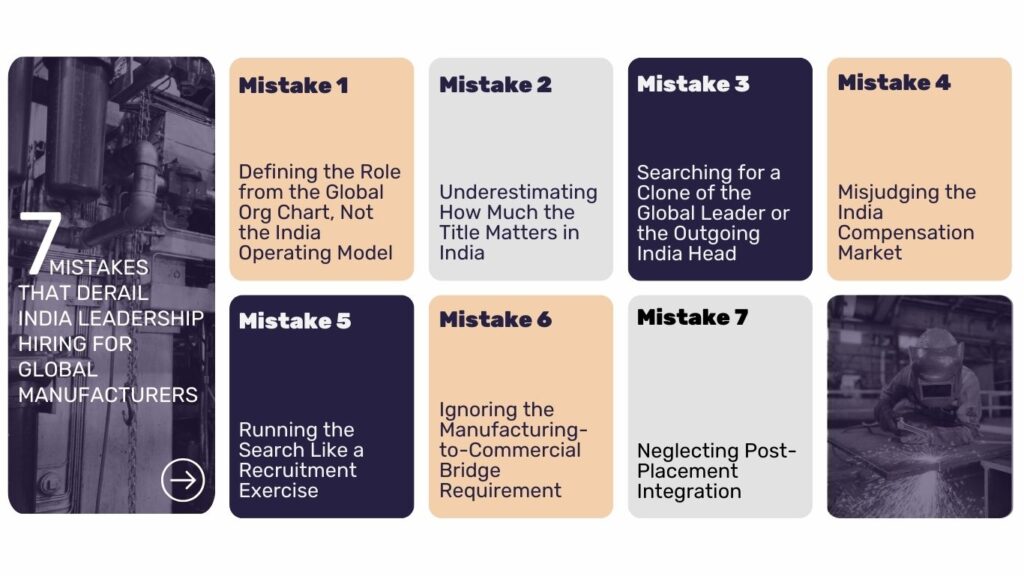
7 Mistakes That Derail India Leadership Hiring for MNC Manufacturers
Mistake 1: Defining the Role from the Global Org Chart, Not the India Operating Model
The fix
Start with the India operating model, not the org chart. What is the India entity today? What does it need to become in three to five years? As we detailed in our CEO vs Managing Director vs Country Head guide for global manufacturing firms, the title and mandate should be a function of the business model.
For a promoter-led or first-CEO appointment specifically, our board’s guide to hiring a manufacturing CEO works through the authority-transfer question in detail.
This approach is irrespective of India business being a pure export hub, an emerging commercial market, a fully integrated operation, or an engineering and design centre.
Get this wrong and everything downstream fails.
Mistake 2: Underestimating How Much the Title Matters in India
In many Western markets, the difference between “Country Manager”, “General Manager” and “Managing Director” is largely semantic.
In India, it is anything but.
The title your India leader carries determines their legal standing under the Companies Act, their credibility with Indian industrial buyers, their ability to sign government contracts and regulatory filings, and the calibre of talent they can recruit for the team beneath them.
We have seen this play out repeatedly in the manufacturing and industrial space.
An international industrial services company hired a General Manager for their India operations. The GM was technically capable and operationally effective. But when engaging with Indian EPC procurement teams, government bodies, and banking partners, the title created a persistent authority gap.
Senior counterparts at potential EPC customers expect to negotiate with a Managing Director or CEO India – not a GM.
The company eventually elevated the role eighteen months later, but by then, the incumbent had moved on and the search restarted from zero.
The fix
Treat title selection as a strategic decision, not an HR administrative one.
For any global manufacturer with a commercial presence in India selling to Indian customers, managing government relationships, or operating a Pvt Ltd subsidiary — the minimum credible title is Country Head, and Managing Director is almost always the right answer.
Our MD vs GM title selection framework provides a detailed decision tree for this.
Mistake 3: Searching for a Clone of the Global Leader or the Outgoing India Head
When a global CEO thinks about their India leader, they often picture someone who looks and operates like them or like the person who just left.
This produces a candidate specification that is either unrealistically narrow or oriented toward the wrong profile entirely.
The most common version of this mistake: seeking an expat-style leader for a role that requires deep Indian market knowledge.
A European medical device manufacturer specified that their India Business Unit Head should have “international experience, preferably with a European or American manufacturer.”
The specification eliminated candidates who had spent their careers building businesses in the Indian healthcare and medical device ecosystem – the very people who understood the CDSCO regulatory landscape, the hospital procurement cycle, and the dynamics of selling into India’s fragmented distribution network.
The reverse error also happens. When the outgoing India leader was a pure manufacturing operations person, the specification tends to replicate that profile — even when the India operation has outgrown its original mandate and now needs someone who can build a commercial engine alongside the manufacturing base.
The fix
Define the candidate profile from the future India mandate, not the past. If the India operation is transitioning from export manufacturing to Indian market sales, you need a leader who can bridge both worlds — not a clone of the current plant head.
If the operation is scaling from a single function to a multi-function entity, you need a general manager profile, not a functional specialist.
Our discovery process spends significant time on this question before a single candidate is identified, because getting the profile wrong means the entire search is aimed at the wrong target.
Mistake 4: Misjudging the India Compensation Market
International manufacturers, particularly mid-sized European and American companies, consistently underestimate what strong India leadership talent costs. The assumption is that because India is a “lower-cost” market, compensation for senior roles should be proportionally lower.
This is dangerously wrong for leadership positions.
India’s industrial leadership market is fiercely competitive. The leaders you are competing for – people with P&L experience, manufacturing expertise, commercial capability, and the ability to operate as a bridge between India and a global headquarters – are being pursued by Indian conglomerates, other MNC subsidiaries, and increasingly by GCCs and well-funded startups.
A strong candidate for an India MD role at a mid-sized European valve manufacturer is simultaneously being courted by Indian industrial groups that can offer significantly higher total compensation, larger scope, and often more autonomy.
When global headquarters benchmarks the India role against their internal compensation framework or against general “India salary data,” they arrive at a number that is 20-40% below what the target candidate pool expects.
The result: strong candidates decline to engage, the search drags on for months, and the company either settles for a weaker candidate or overpays under pressure after the search has stalled. As we explored in Why Top Executives Decline Job Offers, compensation misalignment is one of the most preventable and most expensive reasons searches fail.
The fix
Conduct market-specific compensation benchmarking before finalising the role specification.
Understand what comparable India leadership roles at other MNC subsidiaries, Indian industrial companies, and adjacent sectors are paying. Factor in the full package – base, variable, retirement benefits, car/housing, and increasingly, equity or long-term incentive plans.
An executive search firm with genuine depth in India’s manufacturing leadership market should be able to provide this intelligence upfront, not after the search has stalled.
Mistake 5: Running the Search Like a Recruitment Exercise
The strongest candidates for India leadership roles at MNC manufacturers are not on job boards. They are not responding to LinkedIn InMails from recruitment firms they have never heard of. They are running factories, managing P&Ls, building commercial teams, and navigating Indian regulatory complexity at their current companies. They are, by definition, passive and they will only engage in a conversation if it is positioned as a strategic, confidential discussion about their career, not as a “job opportunity.”
Yet many international manufacturers approach the India leadership search the way they would fill a mid-level functional role:
– post the job description on a few portals,
– engage a contingency recruiter (or multiple contingency recruiters competing against each other),
– and wait for profiles to arrive.
This approach fails spectacularly for India leadership roles for three reasons.
First, the best candidates never see the role because they are not looking.
Second, contingency recruiters have no economic incentive to invest in the deep market mapping, candidate assessment, and cultural evaluation that these roles require — they get paid only if they make a placement, so they prioritise speed over fit.
Third, running multiple agencies against each other for the same role damages the company’s reputation in the market.
India’s industrial leadership community is smaller than you think, and word travels fast when the same role is being shopped by three different recruiters.
The distinction between executive search and recruitment firms is not academic – it is the difference between finding the right leader and filling a vacancy.
The fix
Engage a retained or exclusive executive search firm with demonstrated expertise in India’s manufacturing leadership market. The search partner should be able to map the relevant talent landscape, identify passive candidates through industry relationships (not database queries), conduct thorough assessments that evaluate both functional competence and cultural alignment, and manage the process end-to-end.
This is not a commodity service — the choice of executive search partner for leadership hiring is itself a strategic decision.
Mistake 6: Ignoring the Manufacturing-to-Commercial Bridge Requirement
This mistake is specific to manufacturing companies, and it is devastatingly common. The India operation started as a manufacturing or export hub. Over time, the company begins selling into the Indian market. The customers became Indian EPC contractors, OEMs, distributors, or industrial end-users. The commercial function grows. But the India leader is still someone whose entire career has been in manufacturing operations.
The manufacturing leader runs the plant beautifully. Quality is high. Costs are controlled. Safety records are excellent.
But when it comes to building a sales team, developing key accounts, responding to government tenders, or negotiating framework agreements with major Indian industrial buyers, they are fundamentally out of their depth.
The company then layers a commercial head beneath the manufacturing-oriented India leader – which creates a structural conflict, because the commercial head needs market-facing authority that the India leader doesn’t know how to grant.
The reverse is equally problematic: hiring a pure commercial leader who struggles to manage a manufacturing facility. When the plant head and the commercial head are equal peers under a global VP, nobody in India has the authority or breadth to integrate the two functions.
The fix
Recognise that for any MNC manufacturer with both manufacturing and commercial operations in India, the India leader must be a bridge between the two worlds.
This is, as we note in our archetype framework, the hardest leadership profile to find — someone who genuinely understands manufacturing operations AND can build or scale a commercial function. The search must be designed specifically for this dual capability, with assessment criteria that evaluate both dimensions rigorously.
If the right bridge leader isn’t available, consider a transitional structure with a clear upgrade path — but know that this is a compromise, not a solution.
Mistake 7: Neglecting Post-Placement Integration
The offer is accepted. The new India leader starts. Global headquarters moves on to other priorities.
And within six months, quietly, the misalignment begins.
The new leader discovers that the autonomy they were promised in the interview process does not match the reality of daily decision-making. Approvals that should take days take weeks because they are routed through a regional structure that doesn’t prioritise India.
The Indian manufacturing team, loyal to the previous leader, is slow to adapt.
The global headquarters evaluates the new leader on metrics that don’t account for the ramp-up reality of building a commercial function from scratch.
Nearly 40% of senior executive hires fail within the first eighteen months, and the primary reason is rarely technical competence — it is cultural and organisational misalignment.
For MNC manufacturers, where the India leader must navigate two cultures simultaneously (the Indian market and the global headquarters), the integration risk is even higher.
The fix
Post-placement integration should be a structured process, not an afterthought.
At Pipal Tree, we build a detailed onboarding plan and conduct candidate check-ins at 30, 60, 90, 180, and 365 days – not because we lack confidence in the placement, but because even the right leader in the right role can be derailed by integration failures that are identifiable and fixable if caught early.
The search firm that placed the leader is uniquely positioned to facilitate this because they understand both the company’s expectations and the leader’s operating style.
Why Manufacturing Leadership Hiring Is Fundamentally Different
These seven mistakes are not unique to manufacturing, but they are amplified in the manufacturing context because of several India-specific dynamics that other sectors don’t face to the same degree.
Multi-Function Complexity
The India leader at an MNC manufacturer is not a single-function executive. They are simultaneously managing a manufacturing facility (production, quality, safety, maintenance, environmental compliance), a commercial function (sales, key accounts, tenders, distribution), potentially an engineering or design capability, and an administrative and compliance layer that is uniquely complex in India. This multi-function scope means that the candidate pool is inherently smaller than for pure commercial or pure operations roles. Our Industrial & Manufacturing executive search practice is built around this reality.
Regulatory and Statutory Burden
India’s manufacturing regulatory environment is layered and demanding. Factory licensing, environmental clearances (CPCB, SPCB), labour law compliance across multiple acts, GST and customs for import/export operations, transfer pricing for MNC subsidiaries, and sector-specific regulations (PESO for pressure equipment, BIS standards, CDSCO for medical devices) all require a leader with either direct experience or the judgement to build and oversee a competent compliance function. Global headquarters routinely underestimates this burden.
The EPC and Industrial Procurement Ecosystem
For companies selling into India’s industrial and infrastructure sectors, the buyer landscape is hierarchical, relationship-driven, and title-sensitive. Major EPC contractors, PSUs, and government procurement bodies operate with formal processes (pre-qualification, L1/L2 bidding, technical evaluation committees) that are significantly different from procurement in Western markets. The India leader must understand these dynamics firsthand - they cannot be learned from a PowerPoint briefing from headquarters.
The Talent Paradox
India has one of the deepest manufacturing leadership talent pools in the world. Decades of industrialisation, a massive auto components sector, a thriving chemical and pharmaceutical industry, and the growth of Indian industrial conglomerates have produced thousands of experienced manufacturing leaders. The paradox is that the best of them are extremely well compensated, deeply networked, and not easily moved. They are not unemployed and waiting for your call. Accessing this talent requires genuine market intelligence, trusted relationships, and a compelling value proposition - not a job posting.
A Framework That Works: The Right Way To How to Hire India Leaders
Fixing these seven mistakes is not complicated, but it requires discipline and a willingness to do the strategic work before the search begins. Here is the framework we use with our manufacturing clients.
-
Phase 1: Mandate Clarity
Before identifying a single candidate, invest time in answering three questions.
1. What is your India operating model today, and what does it need to become?
2. What title and authority level does the India leader actually need to succeed?
3. What does the ideal candidate profile look like, given the future mandate, not the current one?This phase typically involves 2–3 structured conversations with key stakeholders: the global CEO or President, the CHRO, the regional commercial and operations leadership, and ideally a board member with India experience. The output is a mandate definition document that becomes the foundation for the search. Aligning HR, talent acquisition, and business leadership around a unified view of the role is essential before the search begins.
-
Phase 2: Market Intelligence
With the mandate defined, the executive search firm like us, maps the relevant talent landscape.
This is not a database query. It is a structured exercise in identifying
- which companies in India employ the type of leader you need,
- what roles those leaders hold,
- what compensation they earn, and
- what it would take to engage them in a conversation about your opportunity.For an MNC manufacturer, this means mapping talent across Indian industrial companies (Tata Group companies, Godrej, L&T, Thermax, Kirloskar), other MNC subsidiaries in adjacent sectors (Siemens, Honeywell, Schneider, ABB, Emerson, KSB), and potentially from sectors like auto components, chemicals, or building materials where the leadership skill set overlaps. The depth and specificity of this mapping directly determines the quality of the candidate shortlist.
-
Phase 3: Candidate Engagement and Assessment
Engaging passive manufacturing leaders requires a fundamentally different approach than responding to applications. The conversation must be positioned as a strategic career discussion, not a job pitch.
The search firm must be able to articulate why this particular opportunity is worth the candidate’s time p which means understanding the company’s India growth story, the leader’s potential impact, and the autonomy and authority the role genuinely carries.
Assessment for India manufacturing leadership roles must evaluate multiple dimensions simultaneously:
- operational and manufacturing competence,
- commercial capability (if the role requires it),
- leadership style and team-building ability,
- cultural adaptability (operating between the Indian market and a global HQ), and
- regulatory and compliance literacy.
A CV and two interviews are not sufficient for roles of this complexity. How to structure a rigorous assessment process starts with a strong executive job description and ends with multi-dimensional evaluation. -
Phase 4: Offer Design and Negotiation
For senior manufacturing leadership roles, the offer is rarely just about money. It is about title, authority, reporting line, autonomy, and the credibility of the India growth story. The strongest candidates are evaluating whether this role will give them more scope, more impact, and a more meaningful mandate than what they have today — not just a higher salary.
The executive search firm should facilitate this negotiation as a trusted intermediary, helping both sides find alignment on the dimensions that matter most. This includes managing expectations around notice periods (which in India can run 60–90 days for senior manufacturing roles), relocation support if applicable, and the often-delicate conversation about how much operational autonomy the India leader will genuinely have.
-
Phase 5: Post-Placement Integration
As discussed in Mistake 7, the first year is critical. Structured check-ins, clear integration milestones, and an open channel between the search firm, the new leader, and the company ensure that small misalignments are caught and corrected before they become terminal. This is not a courtesy call - it is the final phase of the search engagement and often the most valuable.
Where We See This Playing Out: Sector Specific Patterns
While the seven mistakes are universal across MNC manufacturing in India, the specific dynamics vary by sub-sector. Here are the patterns we observe most frequently across our practice.
Auto Components and Automotive
The EV transition is fundamentally reshaping what “leadership” means in this sector.
Companies that historically needed plant heads with deep expertise in machining, casting, or forging now need leaders who can simultaneously manage legacy ICE production and build capability for EV components – battery housings, motor components, power electronics.
The India auto component sector is also deeply integrated with global OEM supply chains, which means the India leader must manage demanding customer relationships alongside operational excellence.
Why Pipal Tree is one of the top executive search firm in India
97% placement success rate across hundreds of leadership mandates.
50+ years of combined search experience across our founding team.
80% repeat engagement rate > our clients come back because our process works.
We combine the best practices of a global search firm with the entrepreneurial responsiveness and senior-partner involvement of a boutique consultancy.
Industrial Chemicals and Specialty Manufacturing
Regulatory complexity is the defining challenge. Environmental clearances (CPCB, state pollution control boards), hazardous chemical handling regulations, and increasing ESG scrutiny from global customers make this one of the most compliance-intensive sectors for India leadership.
The India leader must be as comfortable discussing effluent treatment plant capacity as they are presenting quarterly revenue numbers.
Medical Devices and Life Sciences
CDSCO registration, BIS certification, Make in India incentives (PLI scheme), and the rapid growth of India’s hospital and diagnostic infrastructure create a unique combination of regulatory burden and market opportunity.
International medical device manufacturers entering India need leaders who understand both the manufacturing and the market access side – particularly navigating India’s fragmented distribution landscape.
Water, Utility, and Environmental Services
Government and PPP contracts dominate this sector. The India leader must be fluent in tender processes, municipal procurement dynamics, and the unique challenges of managing long-term service contracts with government entities.
Companies with global water and environmental technology often struggle to find India leaders who combine technical credibility with the commercial and political acumen needed to win and manage Indian government contracts.
Industrial Services (Cross-Border Operations)
Companies serving the Middle East, African, and Southeast Asian markets from India bases face a distinct challenge: the India leader must manage operations across multiple geographies simultaneously, often with limited headquarters oversight.
Cultural bridge leadership – the ability to operate credibly across Indian, Middle Eastern, and African business cultures – is a non-negotiable requirement that standard search processes rarely assess.
How Pipal Tree Approaches Manufacturing Leadership Hiring
At Pipal Tree Services, our Industrial & Manufacturing executive search practice is built on the understanding that manufacturing leadership hiring in India is fundamentally different from other sectors. The multi-function complexity, the regulatory burden, the unique dynamics of the Indian industrial procurement ecosystem, and the depth of the passive talent pool all require a search approach that goes well beyond standard executive recruitment.
We have partnered with international manufacturers across auto components, valves and oil & gas equipment, medical devices, industrial chemicals, water and utility services, composite manufacturing, glass, textiles, and industrial services — placing leaders from Managing Directors and CEOs to CFOs, CHRO, Plant Heads, Commercial Directors, Supply Chain Heads, and Engineering leaders.
What we bring to these mandates is not just access to candidates. It is the ability to help our clients answer the strategic questions that determine whether the search will succeed:
- What should the India operating model look like?
- What title and authority does the leader need?
- What is the right candidate profile given the future mandate, not the past one?
- What will it take to attract and retain the best person for this role?
We run dedicated search practices across CEO, CFO, COO, and CHRO mandates, as well as Board Services each informed by our deep understanding of how India’s industrial and manufacturing ecosystem operates.
Over 80% of our engagements are repeat business. That statistic reflects something simple: we get the mandate right before we start the search, and we stay involved after the placement to ensure the leader succeeds.
5 Leadership Hiring Trends Shaping India in 2026
1. Skills-Based Hiring Replaces Pedigree-Based Hiring
Boards are asking fundamentally different questions:
What did this executive actually build?
How did they lead when the plan failed?
What broke under their watch, and how did they fix it?
This shift toward evaluating demonstrated capability rather than career tenure and brand-name employers is changing how the best search firms evaluate candidates.
2. ESG and Governance Are Non-Negotiable Leadership Competencies
Environmental, social, and governance credentials have moved from peripheral to central. Boards seek CXOs who can balance performance with responsibility, navigate regulatory scrutiny, and earn trust from employees, regulators, investors, and communities simultaneously.
3. Distributed Leadership Models Are Expanding the Talent Map
Hiring in tier-2 cities surged over 20% year-on-year in 2025, overtaking metro hiring growth. Cities like Pune, Ahmedabad, Coimbatore, and Jaipur are becoming serious leadership bases. This geographic expansion is reshaping how executive search firms source and evaluate candidates.
4. AI-Augmented Search Is Enhancing Human Judgment
Over 70% of executive search firms globally are expected to integrate AI-driven talent intelligence tools by 2026. But the most successful outcomes emerge when data-led insights are combined with deep human evaluation. AI enhances candidate identification; human judgment drives the assessment that ultimately determines leadership fit.
5. Startups Are Competing Head-to-Head with Established Firms for CXO Talent
India’s startup ecosystem now competes aggressively for senior leadership, offering equity-based packages and purpose-driven roles. This intensifies competition across the entire market — established companies, GCCs, and startups are all fishing in the same leadership talent pool. For founders, the critical question is whether to continue building their leadership team independently or to bring in a search partner who understands the unique dynamics of leadership hiring for startups.
Frequently Asked Questions
How long does a typical India leadership search take for an MNC manufacturer?
For a retained search conducted with mandate clarity and realistic compensation parameters, expect 10–14 weeks from search initiation to accepted offer. Searches that stall typically do so because of compensation misalignment, an overly narrow candidate specification, or decision-making delays at global headquarters. Each of these is preventable with the right upfront work.
Should we hire an India leader with MNC experience or someone from an Indian industrial company?
Both backgrounds have strengths. MNC-experienced leaders understand global reporting structures, matrix organisations, and cross-cultural communication. Leaders from Indian industrial companies bring deeper market knowledge, established relationships with Indian buyers, and comfort with India’s regulatory landscape. The right answer depends on your India operating model: if the role is primarily about managing headquarters relationships and maintaining global standards, an MNC background may be more relevant. If the primary mandate is Indian market growth, Indian industrial experience often proves more valuable. The best candidates often have both — Indian careers with meaningful exposure to MNC operating environments.
We have tried contingency recruiters and they didn’t work. Why?
Contingency recruiters are paid only upon placement, which creates an economic incentive to prioritise speed and volume over fit and quality. To hire Indian leaders, it requires deep market mapping, passive candidate engagement, multi-dimensional assessment, and cultural alignment evaluation, the contingency model simply does not provide the search firm with enough incentive to invest the time required.
Exclusive or retained executive search partnerships align the firm’s incentives with your outcome: finding the right leader, not just filling the role.
How do we evaluate whether a candidate can bridge manufacturing and commercial functions?
This is one of the hardest assessments to make.
Look for candidates who have held at least one role that spanned both functions, or who have made a successful transition from one to the other.
In interviews, probe for specific examples:
How did they handle a situation where manufacturing quality priorities conflicted with commercial delivery commitments?
Have they personally managed key customer relationships while overseeing plant operations?
Can they articulate a commercial growth strategy with the same fluency as a manufacturing improvement plan?
The absence of these examples is a reliable signal that the candidate is stronger in one dimension than the other.
What role should the global CHRO play in this search?
A critical one.
The global CHRO should ensure that the India leadership search is treated as a strategic priority, not delegated to regional HR. They should champion market-specific compensation benchmarking, advocate for title and authority levels that match the India mandate, and ensure that the global CEO and board understand the unique dynamics of India leadership hiring.
These FAQs cover the most common questions we hear from global headquarters teams looking to hire India leaders for their local manufacturing operations.
For a more comprehensive breakdown, including questions on fees, timelines, guarantees, and how the process works step by step, visit our detailed Executive Search FAQ.
Start with Mandate Clarity
If your international manufacturing company is preparing to hire an India leader — whether it is your first dedicated India appointment or a replacement for a role that hasn’t worked out — the single most valuable thing you can do is invest time in mandate clarity before the search begins.
Define what your India operation needs to become.
Determine the right title and authority.
Understand what the Indian market demands from the person in this role.
Then find a search partner who can translate that mandate into a candidate shortlist of genuinely qualified leaders.
Whether you are entering India for the first time, scaling from export manufacturing into Indian market sales, or restructuring an existing operation that has outgrown its current leadership model, the leadership definition must come before the leadership search.
At Pipal Tree Services, we partner with global manufacturers across auto components, industrial equipment, chemicals, medical devices, water and environmental services, and industrial infrastructure to define, search for, and place the right India leadership.
Our mission-aligned approach combines deep market intelligence, structured leadership assessment, and sustained post-placement support to ensure your next hire becomes your next competitive advantage.
If you’d like to discuss how we can strengthen your leadership team, reach out to me at [email protected].
Because the best time to find your next leader is before you need one.

Sonia Sharma
"With over 25 years in talent leadership, including 20+ years in executive search, Sonia brings valuable dual perspective as Pipal Tree's CEO & founder. Her career spans both consultancy roles at prestigious firms (Korn/Ferry International, Accord India, Stanton Chase) and corporate leadership. Sonia specializes in executing confidential, high-stakes searches for global and Indian multinationals."

[…] dismantle these roadblocks. One global firm, for instance, used AI to anonymize résumés and scan job descriptions for biased language, resulting in fairer and more diverse shortlists. A leading tech giant deployed […]